
Corporate AI Adoption Faces 'Pilot Purgatory' as Productivity Gains Fail to Translate into Profit
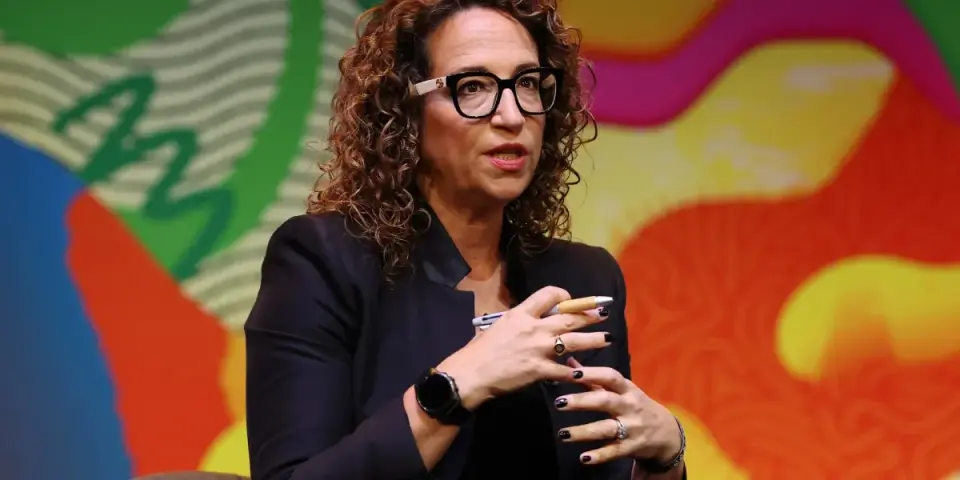
Futurist Amy Webb warns that corporate AI adoption is stuck in 'pilot purgatory,' where companies run endless experiments without integrating results into workflows. While AI lowers production costs, it increases overall operational expenses and creates decision paralysis through an overload of AI-generated decks. A Bain survey shows 40% of companies miss AI return targets, yet 90% plan to increase budgets. Webb predicts a reckoning within a year as Wall Street demands measurable results, contrasting this with the dot-com bubble by noting the unique, compounding costs of AI integration.
Key points
- Amy Webb, founder of Future Today Strategy Group, describes a 'pilot purgatory' where companies run 14-15 AI pilots annually but fail to scale any of them into sustainable workflows.
- A Bain & Company survey of 951 global firms found that 40% of companies measuring AI cost savings achieved less than 10% returns, despite targeting 11-20%, yet 90% plan to increase AI budgets.
- AI is creating 'decision paralysis' as executives are buried in 'insta-decks'—AI-generated presentations that are produced five times faster but in five times the volume, leading to generic, low-quality analysis.
- Webb predicts a market reckoning as early as 2027, when Wall Street will demand measurable results from AI pilots, potentially exposing that few companies have successfully productized their AI investments.
- Venture capitalist Marc Andreessen claims large companies are overstaffed by up to 75% and using AI as an excuse for cuts, while Oxford Economics data shows AI-cited layoffs account for only 4.5% of total US job losses.
Background
This story follows a broader trend of AI integration challenges in 2026. Earlier in August, EU regulators forced Apple to neutralize data prompts to level the playing field for third-party apps, reflecting ongoing regulatory scrutiny of tech giants. The current AI adoption crisis mirrors historical tech transitions, such as the dot-com bubble, but with distinct characteristics: AI is making production cheap while making other operational aspects more expensive, and it is not a single technology but an 'umbrella' of many, requiring data-driven planning rather than gut decisions.
How outlets are covering it
Fortune's Nick Lichtenberg, citing futurist Amy Webb, emphasizes the operational and strategic failures of AI adoption, focusing on 'pilot purgatory' and the inability to translate productivity gains into business value. The Globe and Mail's Tom Bradley frames the AI boom as an 'inflection bubble' driven by genuine technological progress, distinct from 'mean-reverting bubbles' like the 2008 subprime crisis, suggesting that while the bubble may burst, the underlying technology will endure. Business Insider's Jennifer Sor highlights the anxiety among elite tech workers, with 5-10% of clients at firms like Compound Planning and Mercer Advisors actively de-risking their portfolios through structured selling, real estate investments, and municipal bonds, fearing a potential AI market crash. These perspectives differ in focus: Fortune and The Globe and Mail analyze the macro-level corporate and market dynamics, while Business Insider zooms in on the micro-level financial behavior of individual tech employees, all converging on the theme of uncertainty and potential overvaluation in the AI sector.
Why it matters
The failure to scale AI pilots and the resulting 'decision paralysis' could lead to a significant waste of capital and a potential market correction, as companies face rising costs without corresponding productivity gains. This could impact workforce stability, as AI is being used to justify layoffs that may not be necessary, and could reshape corporate strategy, forcing companies to rethink their approach to technology adoption and workforce planning. The potential for a 'reckoning' in 2027 could have ripple effects across the tech sector and the broader economy.
What to watch
Watch for a potential market correction in 2027 as Wall Street demands measurable results from AI investments. Monitor corporate AI budgets and the success rate of AI pilots in scaling to production. Observe the financial behavior of tech workers, particularly the trend of de-risking portfolios and investing in real estate and municipal bonds, as a barometer of market sentiment. Track the development of AI integration frameworks and best practices that could help companies move beyond 'pilot purgatory' and achieve sustainable AI adoption.
- Why the AI economy is like a bad dating app — drowning in decks, pilot purgatory — and it's playing out like the dotcom bubble, except worse Fortune
- I asked ChatGPT if the S&P 500 will crash 50% due to the AI bubble and it said… Yahoo Finance UK
- Is the AI Capex Bubble About to Burst? What 250 Years of Market History Tell Us. Barron's
- Six signs a stock market bubble is ready to burst The Globe and Mail
- Silicon Valley wealth managers say elite tech workers are making these 5 money moves as AI mania continues Business Insider
Want the full story? Read the original reporting
Read on Fortune