
California Launches $3,500 Instant EV Rebate to Offset Federal Credit Loss
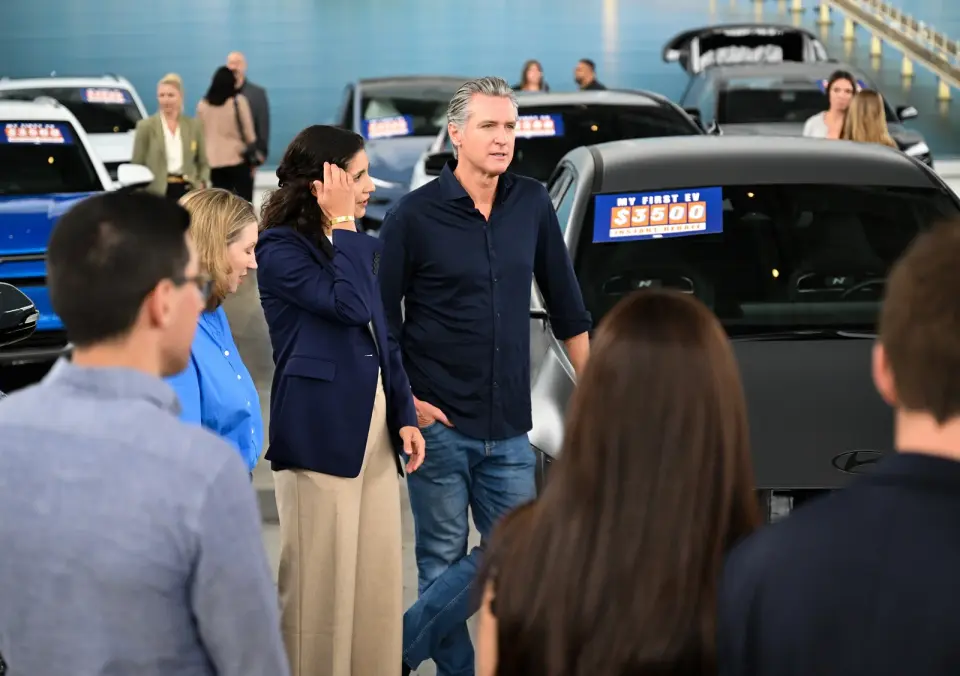
California’s MyFirstEV program launched August 7, 2026, offering a $3,500 instant rebate for new zero-emission vehicles (ZEVs) under $50,000 and $1,750 for used ZEVs under $25,000. The $135.5 million state fund is matched dollar-for-dollar by 15 participating automakers, creating $271 million in total savings. The program replaces federal tax credits eliminated by the Trump administration and aims to support 73,000 vehicle sales. Initial participants include Tesla, Hyundai, and Lucid, with Ford, Rivian, and others joining through November. The initiative is part of a broader $600 million clean transportation package and coincides with California surpassing 21,000 megawatts of battery storage, the largest in the nation.
Key points
- The MyFirstEV program provides an instant $3,500 rebate for new ZEVs priced under $50,000 and $1,750 for used ZEVs under $25,000, applied at the point of sale.
- California’s $135.5 million state investment is matched by participating automakers, totaling $271 million in incentives, sufficient for approximately 73,000 vehicles.
- The program is part of a $600 million clean transportation package in the 2026-2027 budget, also funding clean buses, trucks, and low-income incentives.
- Initial participants include Tesla, Hyundai, and Lucid; Ford, Rivian, Chevrolet, and Kia join in August, with Toyota, Honda, Subaru, and Mitsubishi following in September and November.
- California now has over 21,000 megawatts of battery storage, the largest in the U.S., and solar power surpassed natural gas as the largest electricity source in the first half of 2026.
Background
California’s EV adoption has fluctuated in response to federal policy changes. After the Trump administration eliminated the federal $7,500 EV tax credit in 2025, California EV sales dropped to 17.5% of new car sales in early 2026 before rebounding to 19.5% in the second quarter, partly due to rising gasoline prices from the Iran conflict. The state has long led in EV adoption, with 2.7 million EVs sold since 2012, and 22.9% of new car sales in 2025. The MyFirstEV program, signed into law as SB 168 in July 2026, was designed to offset the loss of federal incentives and maintain California’s clean energy leadership.
How outlets are covering it
KQED and CBS News emphasize the program’s role in replacing federal incentives and supporting clean energy leadership, with Newsom framing it as a choice for consumers and a way to reduce dependence on fossil fuels. The Mercury News highlights the program’s response to federal cuts and notes that EV sales rebounded after gasoline prices rose due to the Iran conflict. CA.gov focuses on the broader clean energy context, including battery storage and solar growth, while noting that 65% of likely voters oppose Newsom’s 2035 gasoline ban, per a Public Policy Institute of California poll. All sources agree on the rebate amounts and participating automakers, but differ in emphasis: KQED and CBS News focus on the rebate’s immediate impact, while CA.gov and The Mercury News contextualize it within California’s broader clean energy and air quality goals.
Why it matters
The MyFirstEV program addresses the loss of federal EV incentives by providing a state-level alternative, helping maintain California’s EV adoption rate and clean energy leadership. It also supports the state’s goal of reducing air pollution, as transportation accounts for 60% of smog-forming pollution and 40% of greenhouse gas emissions. The program’s success depends on automaker participation and consumer uptake, with funds likely to run out by year’s end at current sales rates. Additionally, the program coincides with California’s record battery storage and solar growth, reinforcing its position as a clean energy leader.
What to watch
Additional automakers, including Ford, Rivian, Chevrolet, and Kia, will join the program in August, with Toyota, Honda, Subaru, and Mitsubishi following in September and November. Nissan and Volvo have not announced launch dates. The California Air Resources Board will administer the program on a first-come, first-served basis until the $135.5 million fund is exhausted. California will continue to expand its battery storage and solar capacity, with the state’s first 8-hour battery project, Tumbleweed Energy Storage, already operational in Kern County.
- California Announces $3,500 Instant Rebate for New EV Purchases, Available Now KQED
- Governor Newsom announces $3,500 instant rebates now available for Californians buying their first zero-emission vehicle California State Portal | CA.gov
- Newsom announces rollout of California's $3,500 EV rebate for first-time buyers CBS News
- California announces new $3,500 rebates for electric vehicles. Here’s how to get one. The Mercury News
- Newsom announces instant rebate for first-time ZEV car buyers KRON4
Want the full story? Read the original reporting
Read on KQED