
2026 Fossil Fuel Emissions Dip 0.4% Amid Iran War, But Clean Energy Acceleration Still Needed for Peak
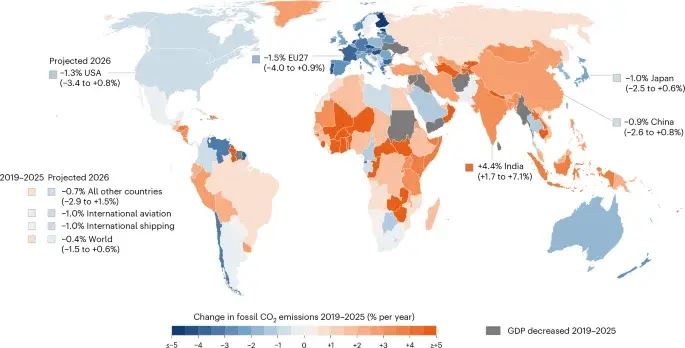
Global fossil fuel CO2 emissions are projected to fall by 0.4% in 2026, driven primarily by oil price spikes and supply constraints from the Iran conflict. While clean technologies offset 64-79% of demand-driven growth, experts warn this dip is temporary and not a structural peak without accelerated deployment.
Key points
- Global fossil fuel CO2 emissions are projected to decrease by 0.4% in 2026, reaching approximately 38.2 billion tons.
- The decline is largely attributed to a 1.9% drop in oil emissions caused by the Iran war and Strait of Hormuz disruptions, not structural clean energy shifts.
- Electric vehicles and solar/wind power offset 64-79% of emissions growth from demand, but this is insufficient to guarantee a sustained peak.
- China’s emissions are projected to fall by 0.9%, while India’s rise by 4.4% due to increased coal use.
- Total global CO2 emissions, including land-use changes, are expected to rise slightly to 43.3 billion tons.
Background
This follows a period of accelerating clean energy adoption, with 59 countries reporting lower emissions in 2025 than in 2019 despite economic growth. Recent archive data noted China’s Q3 2026 emissions dropped 3.1%, the largest quarterly decline since the pandemic, driven by renewables and EV adoption. The 2026 midterms also saw a market rotation from AI to clean energy, though US policy rollbacks under President Trump remain a counter-trend.
How outlets are covering it
Nature and AP News emphasize that the 2026 dip is a short-term response to the Iran war’s energy shock, not a structural peak. The Guardian highlights the temporary nature of the decline and warns that coal expansion in India and US fossil fuel policies could reverse trends. Bill Hare of Climate Analytics argues the 0.4% drop is statistically indistinguishable from zero and insufficient to prevent a 1.5C breach by 2030. Conversely, Niklas Höhne of NewClimate Institute suggests permanent shifts in EV adoption, especially in Asia, indicate the global peak may be near. Glen Peters of CICERO stresses that without accelerated clean technology deployment, emissions will likely rebound once oil prices stabilize.
Why it matters
The 2026 dip underscores that geopolitical shocks, not clean energy transitions, are currently driving emissions reductions. Without accelerated deployment of solar, wind, and EVs, global emissions are unlikely to peak, risking a sustained breach of 1.5C by 2030. The remaining carbon budget is estimated at 150 billion tons, or less than four years at current rates.
What to watch
The Global Carbon Project will monitor whether the 2026 dip persists or reverts as oil prices stabilize. Policymakers at Cop31 in Antalya are expected to debate accelerated clean energy investments, though current government actions show little sign of decisive fossil fuel phase-outs. China’s continued expansion of renewables and EV infrastructure may serve as a model for sustained emissions reduction.
- A further acceleration of clean energy is needed for global CO Nature
- The Iran War Unexpectedly Drove Down Carbon Emissions This Year The New York Times
- Slight fall in carbon emissions from fossil fuels as Iran war drives renewables push The Guardian
- Heat-trapping carbon pollution drops, but scientists cite the Iran war rather than energy progress AP News
- War in Iran led global emissions to fall this year, research finds NBC News
Want the full story? Read the original reporting
Read on Nature