
Louisiana judge halts prediction markets, sparking federal-state legal clash
A Louisiana judge issued a temporary restraining order blocking prediction market platforms, including Kalshi and Polymarket, from operating in the state. Attorney General Liz Murrill argues these platforms are illegal gambling, while operators claim they are federally regulated financial products. The ruling follows a preemptive federal lawsuit by Kalshi and coincides with similar actions in Arkansas.
Key points
- Judge Jeffrey Johnson of Tangipahoa Parish granted a temporary restraining order on November 12, 2026, barring Kalshi, Polymarket, Robinhood, and others from offering event contracts in Louisiana.
- Attorney General Liz Murrill’s lawsuit alleges that event contracts are unlicensed gambling, violating state laws and subjecting operators to jail time and penalties.
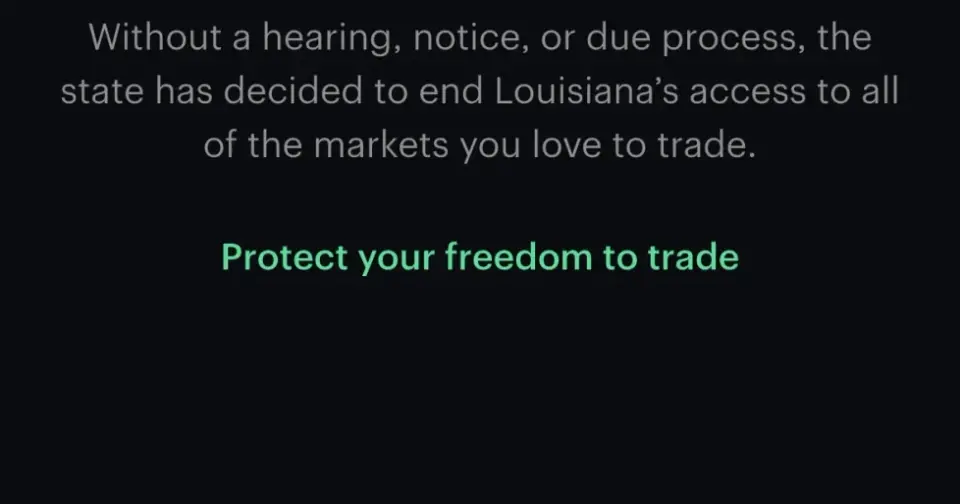
- Kalshi notified users that the state had ended their access without a hearing or due process, though users could still buy contracts at the time of reporting.
- Kalshi had previously sued Louisiana officials in federal court, arguing the state lacks authority to regulate its services, which are governed by federal law.
- Arkansas Attorney General Tim Griffin also sued a prediction market operator in November 2026, alleging unlicensed gambling and deceptive trade practices.
Background
This dispute follows a broader national debate over prediction market regulation. In October 2026, the NFL urged the Supreme Court to allow states to regulate these markets as gambling, opposing federal-only oversight. Kalshi recently ended an advisory role with Donald Trump Jr. amid regulatory scrutiny and is seeking a $65 billion valuation in a new funding round.
How outlets are covering it
NOLA.com and WBRZ report that the Louisiana ruling is a direct response to Murrill’s lawsuit, which targets multiple platforms including crypto exchanges like Coinbase and Gemini. WBRZ highlights Murrill’s statement that operators are trying to evade laws with new terminology. JD Supra notes that Arkansas’s lawsuit focuses on consumer protection and age restrictions, alleging the platform allowed users under 21 to participate. All sources agree that operators argue their products are federally regulated financial instruments, not gambling, but differ in emphasis: Louisiana focuses on criminal penalties, while Arkansas emphasizes deceptive trade practices and restitution.
Why it matters
The Louisiana ruling tests the limits of state power over prediction markets, which have grown rapidly. If upheld, it could force platforms to comply with state gambling laws or exit markets, impacting users and investors. The federal-state conflict may lead to Supreme Court intervention, as seen in the NFL’s recent amicus brief.
What to watch
Kalshi has requested a restraining order in federal court to block Murrill’s actions, but no ruling has been issued. The outcome of the Louisiana case will likely influence other states’ approaches and could prompt federal legislation or Supreme Court review.
- ‘Your government says you can’t use Kalshi anymore:’ Companies react to Louisiana court order NOLA.com
- Louisiana judge blocks prediction markets, crypto platforms over AG's illegal betting claims WBRZ
- Arkansas AG Sues Prediction Market Over Alleged Unlicensed Gambling JD Supra
- CFTC sues Arkansas to block state's Kalshi lawsuit SBC Americas
- Derivatives, Legislative and Regulatory Weekly Update (November 13, 2026) Gibson Dunn
Want the full story? Read the original reporting
Read on NOLA.com