
X-62 VISTA Achieves 27 Autonomous Intercepts Using AI and Infrared Sensors
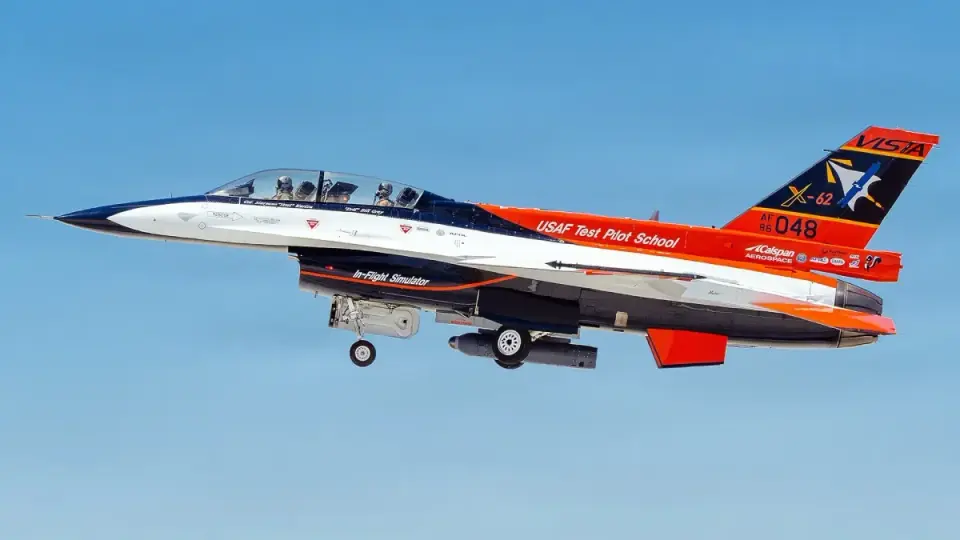
The U.S. Air Force successfully tested autonomous air-to-air combat capabilities using the X-62 VISTA aircraft. During the 'Have Heat' program, an AI agent processed live infrared sensor data to autonomously intercept a live T-38 target. The test involved eight flights and 27 successful intercepts, marking a shift from simulated data to real-time sensor streams. This milestone supports the development of Collaborative Combat Aircraft (CCA) and demonstrates the integration of passive sensors with AI for future air dominance.
Key points
- The X-62 VISTA, a modified F-16, executed 27 autonomous intercepts against a live T-38 target across eight test flights at Edwards Air Force Base.
- The test utilized the Lockheed Martin Legion Pod, an infrared search and track (IRST) sensor, to provide real-time targeting data to an onboard AI agent.
- Lockheed Martin Skunk Works and the Air Force Test Pilot School completed integration and ground testing for the AI agents in just three months using the 'Supermassive' generation capability.
- The 'Have Heat' tests were conducted in parallel with 'Have Holidays,' which focused on integrating third-party autonomous agents and safety rules into the aircraft's open mission system architecture.
- These tests are critical for the development of Collaborative Combat Aircraft (CCA), specifically the General Atomics FQ-42 Dark Merlin and Anduril FQ-44 Fury, which are expected to be fielded by 2030.
Background
The X-62 VISTA has been a central platform for testing autonomous air combat capabilities for years. In 2023, it participated in the first AI versus human dogfight under the DARPA Air Combat Evolution program. However, previous tests often relied on simulated or injected target data, which did not fully replicate the complexity of real-world engagements. The current tests address this gap by using live sensor feeds. Additionally, the Air Force has been testing autonomous capabilities on other platforms, such as the MQ-20 Avenger drone, and is preparing to integrate Raytheon's PhantomStrike radar into the X-62 as part of its Mission Systems Upgrade (MSU). The broader CCA program involves close coordination with allies like the Netherlands and aims to establish a common command and control architecture for uncrewed aircraft.
How outlets are covering it
Lockheed Martin emphasizes the technical breakthrough of closing the 'sensor-to-action loop' using real-time infrared data, highlighting the speed of their 'Supermassive' AI integration process. The Air Force, through the Test Pilot School, frames the test as a critical step toward mission autonomy and a bridge to advanced CCA capabilities, stressing the importance of human-machine teaming and safety. AeroTime notes the shift from simulated to live sensor streams as a key operational milestone, while also contextualizing the test within the broader CCA production contracts awarded in June 2026. All sources agree on the significance of the test but differ in emphasis: Lockheed Martin focuses on the technology and speed of development, the Air Force on the strategic and operational implications, and AeroTime on the transition to realistic testing environments.
Why it matters
This test demonstrates a significant step toward fully autonomous air-to-air combat, a key capability for future U.S. air power. By successfully using passive infrared sensors to guide an AI-controlled aircraft to intercept a live target, the Air Force validates the feasibility of using Collaborative Combat Aircraft as forward sensor nodes. This capability is crucial for detecting stealthy targets and reducing the electromagnetic footprint of manned aircraft. The success of these tests accelerates the development timeline for CCAs and provides a foundation for integrating AI into future fighter operations, potentially changing the nature of air combat by allowing uncrewed aircraft to operate independently or in close coordination with manned fighters.
What to watch
The Air Force plans to continue testing autonomous capabilities on the X-62 VISTA as part of its Mission Systems Upgrade, which includes the integration of the Raytheon PhantomStrike radar. The service is also preparing for the operational testing of pre-production CCA drones, including the FQ-42 Dark Merlin and FQ-44 Fury, at Creech Air Force Base. The first operational CCAs are expected to be fielded by 2030, with F-22 Raptors serving as initial airborne controllers. Further tests will focus on expanding the autonomy of these drones and refining command and control architectures to ensure safe and effective human-machine teaming in combat scenarios.
- X-62A Toting Infrared Search And Track Pod Used Its AI 'Brain' To Autonomously Intercept An 'Enemy' T-38 twz.com
- Onboard Sensor Drives Autonomous Intercepts In Mock Dogfights Aviation Week
- X-62 VISTA sets precedents with Mission Systems Upgrades, aligns human researchers with AI development for the warfighter DVIDS
- Skunk Works® Advances Sensor-Powered AI Fighter Intercept Morningstar
- Lockheed Martin AI flies F-16 in 27 live-target intercepts AeroTime
Want the full story? Read the original reporting
Read on twz.com