
U.S. Fiscal 2026 Deficit Hits Record $1.99 Trillion Amid Rising Interest Costs
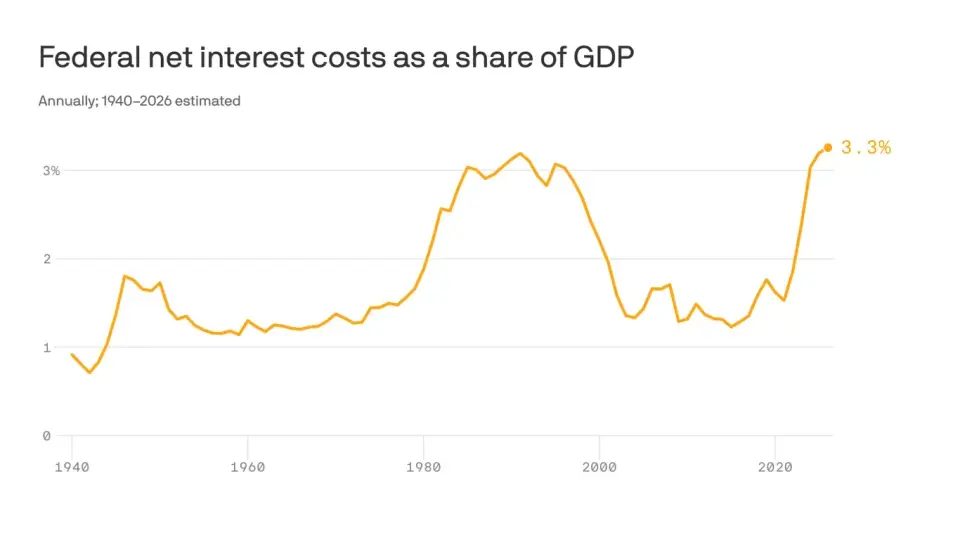
The U.S. federal budget deficit reached $1.992 trillion for fiscal year 2026, marking the 25th consecutive year of deficit and the largest since the 2021 pandemic peak. Net interest payments on the national debt exceeded $1 trillion, surpassing defense spending and becoming the third-largest federal outlay after Social Security and Medicare. This fiscal strain is driven by record borrowing costs, with net interest estimated at 3.3% of GDP, a historic high. While the economy remains relatively stable, the deficit has widened by 12% compared to the previous year, prompting concerns about long-term fiscal sustainability and the impact of recent tax legislation on revenue.
Key points
- The fiscal 2026 deficit totaled $1.992 trillion, a 12% increase from the $1.775 trillion deficit in fiscal 2025, making it the third-largest in U.S. history.
- Net interest payments on the national debt reached $1.052 trillion, exceeding defense spending and ranking as the third-largest federal expense after Social Security ($1.67 trillion) and Medicare ($1.07 trillion).
- The average weighted interest rate on outstanding debt rose to 3.53% at the end of fiscal 2026, up from 3.36% in the prior year, driven by higher borrowing costs and inflationary pressures.
- Corporate tax revenue declined by $43 billion, or 9%, due to deductions from the 'One Big Beautiful Bill' tax cuts, while individual income tax receipts rose by 7% to over $2.8 trillion.
- The U.S. recorded its 25th straight fiscal year of deficit, with the last surplus occurring in 2001, and the national debt exceeding $40 trillion.
Background
This development follows a trend of rising federal deficits since 2021, when pandemic-era stimulus spending peaked. Previous coverage noted that gross debt-service spending hit a record $1.36 trillion in fiscal 2026, including interest paid to federal trust funds. The current deficit is part of a broader pattern of fiscal stress, with the national debt doubling over the last decade. The 2026 figures highlight the long-term consequences of borrowing at higher interest rates, a trend that began as inflation rose in 2021.
How outlets are covering it
Axios emphasizes the historical context, noting that interest costs at this level last occurred during the George H.W. Bush administration, which led to bipartisan deficit reduction efforts. CNBC focuses on the immediate financial stress, highlighting that 10-year and 30-year Treasury yields hit 24-year highs, and notes the impact of the 'One Big Beautiful Bill' on corporate tax revenue. CNN frames the deficit as a looming issue for the upcoming midterm elections, citing Maya MacGuineas of the Committee for a Responsible Federal Budget, who warned that 'fiscal discipline requires finding something both achievable and aggressive.' WBFF, while its content was largely inaccessible, highlighted that voters are noticing the growing national debt problem. All sources agree on the $1.992 trillion deficit figure and the record net interest costs, but differ in their emphasis on political consequences, historical parallels, and market reactions.
Why it matters
The ballooning deficit and record interest costs signal a shift in the U.S. fiscal landscape, where the cost of servicing debt now rivals major spending categories. This trend could lead to higher borrowing costs, increased pressure on bond markets, and potential political backlash, as seen in the 1990s. The 25th consecutive year of deficit underscores the lack of bipartisan consensus on fiscal discipline, with both parties reluctant to pursue significant tax increases or spending cuts. The situation may force policymakers to address the debt ceiling and fiscal policy in the coming year, with potential implications for interest rates, mortgage costs, and economic stability.
What to watch
Lawmakers are expected to address the debt ceiling again next year, potentially forcing a confrontation over fiscal policy. The 'One Big Beautiful Bill' tax cuts, particularly those affecting Medicaid, are set to take full effect in the next fiscal year, which could further widen the deficit. Bond market volatility may continue as investors demand higher yields to hold U.S. debt, potentially leading to higher mortgage rates and economic slowdown. The Trump administration's tariff strategy, despite a Supreme Court ruling on its constitutionality, remains a key revenue source, but refunds have offset some gains. Future fiscal policy will likely be shaped by the need to balance growth, debt reduction, and political realities.
- The budget deficit swells, while the cost of debt rises Axios
- US Interest Costs Hit Record $1 Trillion, Risking Debt Snowball Bloomberg.com
- Federal deficit last year was largest since pandemic and voters are noticing WBFF
- U.S. budget deficit swells to almost $2 trillion for fiscal 2026, up 12% in a single year CNBC
- A $2 trillion deficit looms over the midterms CNN
Want the full story? Read the original reporting
Read on Axios