
DOE's Atlas Railcar to Haul First Spent Nuclear Fuel Cask to Idaho by Late 2027
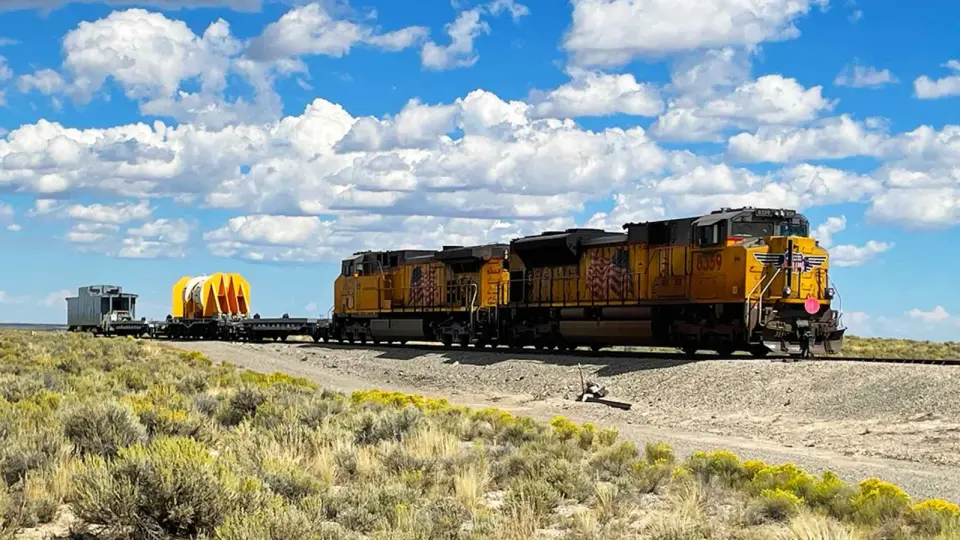
The Department of Energy (DOE) is preparing to transport its first spent nuclear fuel cask via the custom-built Atlas railcar, with the shipment expected in late 2027. The 78-foot, 12-axle vehicle was engineered to distribute weight more evenly than standard freight cars, allowing it to carry heavy casks while maintaining lower per-axle pressure than adjacent buffer cars. Idaho is currently refurbishing rail lines at the Idaho National Laboratory to receive the cargo, which will be used for high-burnup fuel research.
Key points
- The Atlas railcar, cleared for service in May 2024, weighs 111 tons empty and can carry up to 240 tons of cargo, totaling 355 tons when fully loaded.
- Despite its massive total weight, Atlas exerts less pressure per axle (approx. 59,000 lbs) than the 98-ton welded steel buffer cars (approx. 65,750 lbs per axle) required for safety simulations.
- The first shipment will transport a cask from Dominion Energy’s North Anna plant in Virginia to the Idaho National Laboratory, a journey of over 2,500 miles expected to take one week.
- The cask contains high-burnup fuel from a research project involving the Electric Power Research Institute, with temperatures currently lower than predicted, indicating stable storage conditions.
- The Association of American Railroads has granted conditional approval for the Atlas train, requiring 100,000 service miles before full certification, though this does not currently delay the 2027 shipment.
Background
The United States holds approximately 105,000 tons of spent nuclear fuel across 75 sites, with no federal repository built since the Yucca Mountain project stalled. Atlas was developed over ten years at a cost of $33 million to address this logistical gap. Idaho National Laboratory’s Hot Fuel Examination Facility, recently recognized as a Nuclear Historic Landmark, will receive the cask for examination in a hot cell, continuing its role in nuclear research and fuel testing.
Why it matters
The successful transport of the first cask validates the engineering of the Atlas railcar and establishes a viable pathway for moving high-level radioactive waste across the U.S. freight network. It also highlights the ongoing challenges in nuclear waste management, as the federal government remains legally responsible for spent fuel without a permanent disposal solution. The conditional approval status and the need for extensive rail refurbishments underscore the complexity and cost of implementing safe nuclear logistics.
What to watch
DOE is likely to conduct a dress rehearsal with an empty cask in the spring of 2026. The actual shipment of the North Anna cask is scheduled for late 2027. Following this, the Atlas train must accumulate 100,000 service miles to achieve full Association of American Railroads approval, a process that may take several years of regular operation.
Want the full story? Read the original reporting
Read on Autonocion.com