
US Battery Storage Hits Record 20.2 GWh in Q2 2026, Driven by Utility-Scale Projects and Data Center Demand
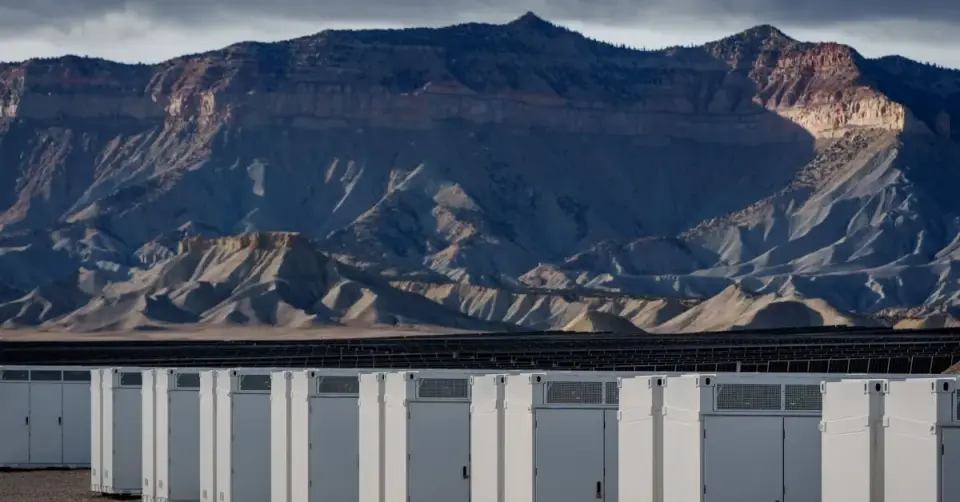
The US added a record 20.2 GWh of battery storage in Q2 2026, bringing H1 2026 totals to 30.8 GWh, up 23% year-over-year. Utility-scale projects accounted for 18 GWh, led by Arizona (6.2 GWh), Texas (3.8 GWh), and California (3.6 GWh). 44% of utility-scale capacity was paired with solar, while 56% was standalone. Battery storage supplied more electricity to the US grid in the first eight months of 2026 than in all of 2025. SEIA and Benchmark Mineral Intelligence raised their 2030 forecast by 11.5% to 683 GWh, citing rising demand from data centers and grid reliability needs. Residential storage fell 27% year-over-year to 657 MWh, while commercial/industrial added 1.8 GWh. Tesla launched its third Megafactory in Texas, with 50 GWh annual capacity, and began shipping Megapacks with domestically made lithium iron phosphate cells.
Key points
- Q2 2026 set a record with 20.2 GWh of new battery storage, the largest quarter ever recorded.
- Utility-scale projects drove 18 GWh of the total, supported by seven gigawatt-scale projects.
- Arizona led with 6.2 GWh, followed by Texas (3.8 GWh) and California (3.6 GWh).
- 44% of utility-scale capacity was paired with solar; 56% was standalone storage.
- Battery storage supplied more electricity to the US grid in the first eight months of 2026 than in all of 2025.
- SEIA and Benchmark Mineral Intelligence raised their 2030 forecast by 11.5% to 683 GWh.
Background
The US battery storage market has been growing rapidly, with utility-scale capacity expanding from 88 GWh to 165 GWh during the first 18 months of the Trump administration. The 2026-08-14 article on European heatwaves highlighted the need for storage to manage evening demand when solar output drops, a dynamic now being addressed in the US through utility-scale battery deployments. The 2026-08-31 and 2026-08-25 articles on quantum batteries, while not directly related to grid-scale storage, underscore the broader innovation in energy storage technologies, though they remain at the nanoscopic scale and are not relevant to current utility-scale deployments.
How outlets are covering it
Electrek emphasizes the record-breaking nature of Q2 2026 and the shift away from California and Texas as the primary markets, highlighting Arizona's record 6.2 GWh. OilPrice.com focuses on the grid reliability and rising power demand drivers, noting the 70% annual average growth rate in utility-scale storage over the last three years. pv-magazine-usa.com highlights the role of data centers and hyperscalers in driving demand, with Fluence CEO Julian Nebreda stating that 'there will not be a data center built in the US without battery storage.' All three sources agree on the record 20.2 GWh figure and the 11.5% forecast increase, but differ in emphasis: Electrek and OilPrice.com focus on the geographic and utility-scale drivers, while pv-magazine-usa.com highlights the commercial model shift toward long-term contracts and data center demand.
Why it matters
The record Q2 2026 installations signal a structural shift in the US energy market, with battery storage becoming a critical tool for grid reliability and meeting rising demand from data centers and other high-load sectors. The 11.5% forecast increase to 683 GWh by 2030 indicates sustained growth, while the decline in residential storage suggests a shift toward utility-scale and commercial/industrial applications. The launch of Tesla's third Megafactory and the shift toward domestically made lithium iron phosphate cells indicate a move toward supply chain resilience and domestic manufacturing. The geographic spread beyond California and Texas suggests a more balanced national deployment, with Arizona, Texas, and Utah leading. The role of data centers as a major demand driver indicates that battery storage will be integral to supporting AI and compute expansion, with developers combining batteries with onsite solar, wind, and natural gas to manage grid constraints and fast-changing power loads.
What to watch
SEIA and Benchmark Mineral Intelligence expect the US to install about 71 GWh of battery storage in 2026, around 20% more than in 2025. The 2030 forecast of 683 GWh implies continued rapid growth, with utility-scale projects likely to dominate. The shift toward long-term contracts and data center demand may reduce reliance on merchant arbitrage, stabilizing revenue for developers. Residential storage is expected to fall 16% in 2026 after a 56% jump in 2025, but long-term growth may resume as electricity costs rise and net-metering rules change. The launch of Tesla's third Megafactory and the shift toward domestically made lithium iron phosphate cells may reduce supply chain risks and support domestic manufacturing. The geographic spread beyond California and Texas suggests a more balanced national deployment, with Arizona, Texas, and Utah leading. The role of data centers as a major demand driver will likely continue to grow, with developers combining batteries with onsite solar, wind, and natural gas to manage grid constraints and fast-changing power loads.
- The US added a record 20.2 GWh of battery storage in just 3 months Electrek
- U.S. Energy Storage Capacity Installations Hit Record High in Q2 Crude Oil Prices Today | OilPrice.com
- Big batteries to bolster the grid are stuck waiting to plug in TelegraphHerald.com
- U.S. battery storage boom is driven by data centers and interconnection backlogs pv-magazine-usa.com
- Texas sees battery storage surge ahead of potential import restrictions bizjournals.com
Want the full story? Read the original reporting
Read on Electrek