
US-China AI Dialogue Framework Agreed Ahead of Trump-Xi Summit
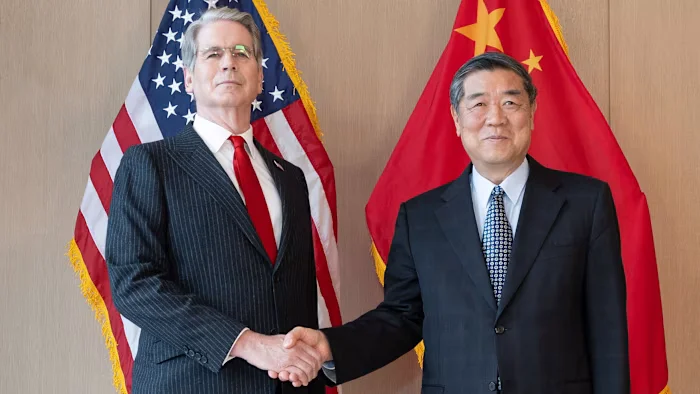
US Treasury Secretary Scott Bessent and Chinese Vice Premier He Lifeng agreed to establish a formal dialogue on AI and a mutual notification mechanism for security incidents. This move precedes the upcoming summit between President Donald Trump and President Xi Jinping, aiming to create guardrails for AI development despite deep mutual distrust and conflicting views on the technology's risks.
Key points
- Bessent and He Lifeng agreed to create a formal US-China dialogue on AI and a notification mechanism for incidents with national security implications.
- The US proposal resembles a 'hotline' for AI incidents, aiming to prevent escalatory spirals from AI-directed cyberattacks or bioweapon development.
- Security experts from both nations have developed recommendations since 2019, including absolute red lines against autonomous AI decisions for nuclear weapon launches.
- China has mandated labeling of AI-generated content and restricted chatbot outputs, but views US calls for slowing development as attempts to suppress its technological growth.
- The upcoming Trump-Xi summit is expected to have low expectations for major breakthroughs, with trade tensions and the Taiwan issue remaining central points of friction.
Background
This development follows recent US accusations that Chinese firms are engaging in mass AI distillation to steal intellectual property, which Beijing denied. In September 2026, China rejected US calls to slow AI development, labeling them as fearmongering that disrupts global governance. The current agreement builds on a previous informal notification mechanism proposed by Bessent, which was framed as a minimal step toward transparency rather than a comprehensive joint threat-reporting system.
How outlets are covering it
The Financial Times emphasizes the potential for the new dialogue to act as a critical safety framework, comparing it to the nuclear hotline established after the Cuban missile crisis. It highlights shared vulnerabilities regarding non-state actors and the need for clear rules on AI in weaponry. The Guardian, however, notes deep distrust between the two nations, with China viewing US safety standards as a tool to lock Beijing into second place in the AI race. The Guardian also points out that while tech executives like Jeff Bezos and Sam Altman will attend a state dinner, few expect major breakthroughs, describing the summit as high on positive vibes but low on substantive ambition. The two outlets agree on the establishment of the dialogue but differ on the likelihood of it yielding meaningful security outcomes.
Why it matters
The agreement signals a tentative shift toward managing the risks of advanced AI between the world's two largest economies. By establishing a communication channel for AI incidents, the US and China aim to prevent accidental escalations that could lead to conflict. This is particularly significant given the rapid development of AI capabilities and the potential for these technologies to be misused by non-state actors or to compromise nuclear control systems. The dialogue could set precedents for global AI governance and influence future trade and technology policies between the US and China.
What to watch
President Trump and President Xi Jinping are scheduled to meet in Washington, where the AI dialogue may be further discussed. The US and China are expected to meet again in Shenzhen in approximately two months to continue negotiations. The trade truce between the two nations is set to expire in November, which may influence the tone and outcomes of future discussions. Security experts will likely continue to refine recommendations for AI safety standards, focusing on human control over weapons systems and containment mechanisms for AI agents.
- How China and the US can work together on AI security Financial Times
- AI looms large over Trump-Xi meeting amid deep distrust between US and China The Guardian
- COMMENTARY: AI 'Terminator’ fears may mask real Chinese threat: McGeever Reuters
- Opinion | China Is Scared of A.l. Just in Not the Way We Are. The New York Times
- Xi and Trump Seek Safe AI Without Slowing the Race for Supremacy Bloomberg.com
Want the full story? Read the original reporting
Read on Financial Times