
Beijing deploys state funds to halt China's AI-driven market crash
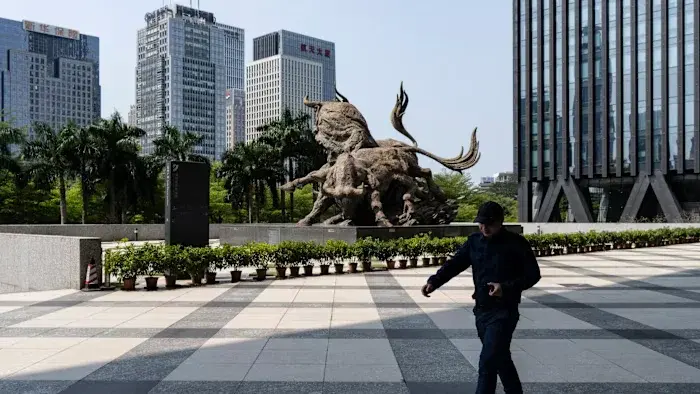
China's stock markets have entered a technical bear market, with the CSI 300 index down 20% from its June peak and the STAR 50 tech index falling 40%. Beijing is using state-aligned funds to buy ETFs and stabilize prices, but analysts note that a sustained recovery requires stronger domestic demand, which remains weak due to low consumer spending and thin corporate profit margins.
Key points
- The CSI 300 index has fallen 10% year-to-date and over 20% from its June peak, entering a technical bear market.
- Hong Kong's Hang Seng index is down 12% this year, with mainland investors selling HK$20 billion in stocks this month, marking the largest outflow since July 2021.
- State-aligned funds, known as the 'national team,' have aggressively purchased domestic exchange-traded funds, with activity levels matching those seen after April 2025 tariff announcements.
- AI hardware stocks have suffered the most, with battery maker CATL down 37% and chip producer CXMT down 20% in the past month.
- China's fiscal policy has turned contractionary, with government spending declining in the first nine months of the year, contrary to earlier expectations of expansionary stimulus.
- Retail sales declined in May for the first time since late 2022, and fixed-asset investment has fallen 7.2% year-on-year, indicating weak domestic demand.
Background
China's stock markets had previously shown resilience in 2024 following a package of policies that included financing for share buybacks. However, hopes for major stimulus have faded in 2026 as economic data indicates worsening momentum, particularly in consumer demand. The current market turmoil follows a period where Beijing invested heavily in AI, including a 60 billion yuan state-backed fund, but domestic consumers remained reluctant to spend, leading to thin profit margins for tech companies.
How outlets are covering it
The Financial Times emphasizes the role of state intervention and the shift to contractionary fiscal policy, noting that national team buying aims to put a floor under the market but that a sustained rally depends on domestic demand recovery. The Guardian highlights the broader impact of the AI trade, noting that AI stocks account for over 40% of China's market value, and that the sell-off is driven by weak consumer demand, thin profit margins, and US restrictions on Chinese technology. Both outlets agree that major stimulus is unlikely before the upcoming Party Congress, but the FT focuses on the technical aspects of the market crash, while the Guardian emphasizes the geopolitical and economic anxieties surrounding AI and robotics.
Why it matters
The crash in China's stock markets signals a broader economic slowdown and a lack of confidence in the country's AI-driven growth strategy. The reliance on state intervention to stabilize markets highlights the fragility of the current economic model, which depends heavily on exports and government spending. The lack of major fiscal stimulus before the Party Congress suggests that policymakers are prioritizing political stability over economic recovery, which could have long-term implications for China's global competitiveness and domestic economic health.
What to watch
Analysts are watching the fifth plenum of the Communist Party for any signs of policy shift, but most expect no major stimulus measures due to the politically sensitive period. The market may continue to be supported by state-aligned funds, but a sustained recovery will depend on improvements in domestic demand and consumer spending. The upcoming 21st Party Congress is expected to anoint Xi Jinping for a fourth term, and any major policy changes are likely to be delayed until after this event.
- China rushes to shore up struggling markets Financial Times
- In China, the AI bubble has already burst Reuters
- China Steps In to Rescue Stocks, But the Market Continues to Fall The New York Times
- Chinese markets lose trillions as race for AI supremacy with US takes its toll The Guardian
- China AI Hardware Firms Face Earnings Test After Stock Selloff Bloomberg
Want the full story? Read the original reporting
Read on Financial Times