Inflation fears push global bond markets into retreat
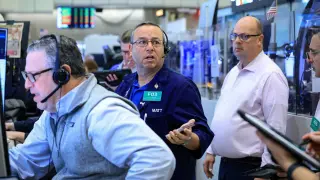
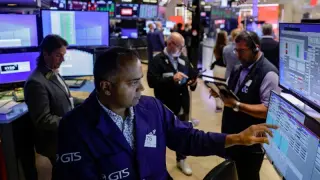
Global bond prices dropped and yields rose as investors priced in persistent inflation, triggering a broad sell-off across government and corporate debt and weighing on related risk assets.
All articles tagged with #global markets

Global bond prices dropped and yields rose as investors priced in persistent inflation, triggering a broad sell-off across government and corporate debt and weighing on related risk assets.

Global stocks retreat from fresh records as inflation concerns and oil-price volatility rattle markets, with AI-related shares leading declines and bond markets showing increased volatility amid the broad sell-off.

Global stocks ticked to new highs on optimism about an extended U.S.-Israel ceasefire and upcoming Israel-Lebanon talks, with China posting stronger quarterly growth; however, the World Bank warns disruption could persist for months, and ECB officials remain cautious on rate moves ahead of a policy meeting.
Global equities fell about 5–10% over the past month as Middle East conflict and oil-supply disruptions, centered on the Strait of Hormuz, boosted volatility. European and Asian markets bore steeper losses than U.S. shares, inflation concerns grew with higher oil prices, and investors wrestled with geopolitical risk and uncertain growth prospects before any stabilization.

Stocks rose worldwide and oil slipped after reports of a 15-point Iranian peace framework and Tehran’s permission for non-hostile ships to pass the Strait of Hormuz, lifting supply fears. Oil hovered near $100 as markets in Asia, Europe and the US gained; fertiliser supply disruption and food security concerns were noted, gold pulled back from recent highs, and BlackRock CEO Larry Fink warned that sustained high oil could reach $150 a barrel and trigger a global recession.

Despite the U.S. being the world's top oil producer, gas prices have risen to about $3.79 a gallon because global oil prices set the pace and U.S. refineries are mostly configured for heavier crude. The U.S. both exports roughly 11 million barrels per day and imports about 8 million, so the domestic price of fuel tracks international markets; diesel has topped $5 per gallon and jet fuel costs are lifting airline fares as a result.

Australia’s ASX 200 fell 4.3%, the index’s worst day since March 2020, potentially returning to November-levels and risking a move toward May 2025 levels if losses continue. A spike in crude oil prices (and a rally in gold) is driving risk-off sentiment and could complicate the RBA’s soft-landing path, possibly prompting faster rate hikes. Globally, markets slumped: Korea’s Kospi hit a circuit breaker after about an 8% drop and Japan’s Nikkei fell roughly 7.4%, while S&P 500 futures and Nasdaq futures were lower. Bond yields rose: US 10-year up about 8 bps to 4.21%, Australian 10-year up around 15 bps to 4.99% (the highest since Nov 2023). Geopolitical uncertainty and oil-price momentum are underpinning a broad risk-off mood.
Asian stock markets were mixed but headed for sharp weekly losses as the Iran-Israel-US conflict intensified and oil prices surged, weighing on sentiment across the region and prompting caution ahead of key US payrolls data.

European shares opened lower as President Trump announced a blanket 15% global tariff, with the Stoxx 600 down about 0.3%, DAX down 0.6% and CAC 40 down 0.2% while Italy’s FTSE MIB rose 0.4%. Markets had briefly assessed a Supreme Court ruling limiting reciprocal tariffs, but the new policy signaled broader levies and heightened uncertainty about inflation and global growth.

Global equities are mixed as a Nvidia-led rally on Wall Street lifts US futures, while non-U.S. shares move in varying directions.

International markets have outpaced U.S. stocks early in 2026, with global benchmarks leading and international ETFs seeing record January inflows, fueling talk that a years-long shift away from U.S. dominance may be underway.

Global shares and US futures fell as investors weighed concerns about Donald Trump’s choice for the Federal Reserve chair and the potential impact of artificial intelligence on markets.

Investors are increasingly selling U.S. assets and seeking non-U.S. opportunities as a new investment thesis—an ex-America trade—gains traction after tariff shocks and policy tensions with the Fed, pushing the dollar lower and contributing to a stalled stock market and higher government borrowing costs.

India and the EU announced a landmark free-trade agreement to reduce tariffs on more than 90% of goods, with India cutting duties in agriculture and autos and the EU easing tariffs on textiles, leather, marine products and jewelry—a long-sought deal that faces uncertainty from U.S. President Trump’s stance even as markets brace for a Fed decision and broader shifts in global trade.

Veteran analysts warn that the ongoing global market rally could be running on borrowed time, with stretched valuations and geopolitical risks raising the odds of a coming correction.