
FDA Upgrades Midwest Poultry Egg Recall to Class I After 98 Salmonella Cases
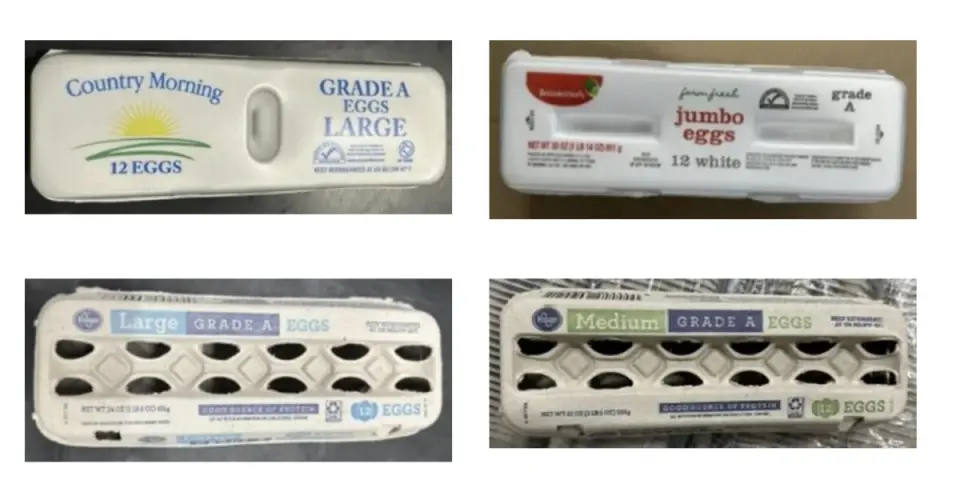
The FDA has elevated a recall of approximately 1.6 million cartons of eggs to Class I, its highest risk level, due to a Salmonella outbreak that has sickened 98 people and hospitalized 26 across 17 states. The affected products, distributed by Midwest Poultry Services, were sold at Kroger and Brookshire Grocery locations in the southern and southwestern US. Consumers are advised to check carton codes and discard or return affected eggs, as the recall coincides with a broader wave of food safety concerns.
Key points
- The FDA reclassified the recall to Class I on August 12, 2026, indicating a reasonable probability of serious health consequences or death.
- The recall covers approximately 1.6 million cartons (roughly 19 million eggs) with sell-by dates between July 20 and August 17, 2026.
- Affected eggs bear carton codes P-1950 or 0840962 and Julian dates between 157 and 184.
- Midwest Poultry Services identified the issue through environmental monitoring and ceased distributing fresh eggs from its Texas farms by July 22, 2026.
- The outbreak has resulted in 98 illnesses and 26 hospitalizations, with no reported deaths as of the latest reports.
Background
This recall is part of a broader pattern of food safety issues in the US, including a cyclosporiasis outbreak linked to lettuce and a Salmonella outbreak involving jalapeños. The FDA’s reclassification follows initial shelf removals in July 2026. Previous coverage noted that the eggs were sold under brands such as Country Morning, Simple Truth, and Brookshire’s, with distribution extending to smaller retail outlets beyond major chains.
How outlets are covering it
Scripps News and The Washington Post emphasize the scale of the recall and the FDA’s highest-risk designation, focusing on the specific carton codes and dates for consumer identification. The Guardian highlights the broader context of food safety crises, noting the cyclosporiasis and jalapeño outbreaks, and mentions regulatory changes by the FDA. Denver7 adds a public health perspective, citing Jordan Jeske of the Denver Department of Public Health, who attributes the contamination wave to seasonal factors and issues at distribution centers, while also noting concerns over CDC funding cuts affecting disease tracking.
Why it matters
The Class I designation signals a severe health risk, prompting urgent consumer action to avoid potential Salmonella infection. The recall affects a wide geographic area, including Texas, Louisiana, Oklahoma, Arkansas, New Mexico, and Mississippi, impacting major retailers like Kroger and Brookshire Grocery. The broader context of multiple foodborne illness outbreaks raises concerns about systemic issues in food safety and regulatory oversight.
What to watch
Consumers should check their egg cartons for the specified codes and dates, discarding or returning affected products for refunds. Health officials are continuing to investigate the root causes of the contamination, with a focus on distribution center practices and seasonal factors. The FDA is also implementing changes to food notification rules, though these are seen as insufficient by some critics.
- FDA elevates egg recall to highest risk level over salmonella concerns Scripps News
- F.D.A. Classifies Egg Recall as Class I, for Highest Health Risk The New York Times
- Massive egg recall in US south and south-west due to salmonella outbreak The Guardian
- FDA upgrades egg recall to highest health-risk level amid string of food safety concerns Denver7
- 1.5 million dozen recalled eggs receive FDA’s highest-risk warning The Washington Post
Want the full story? Read the original reporting
Read on Scripps News