
Apple Stock Becomes Rare Safe Haven as Tech Sector Sells Off
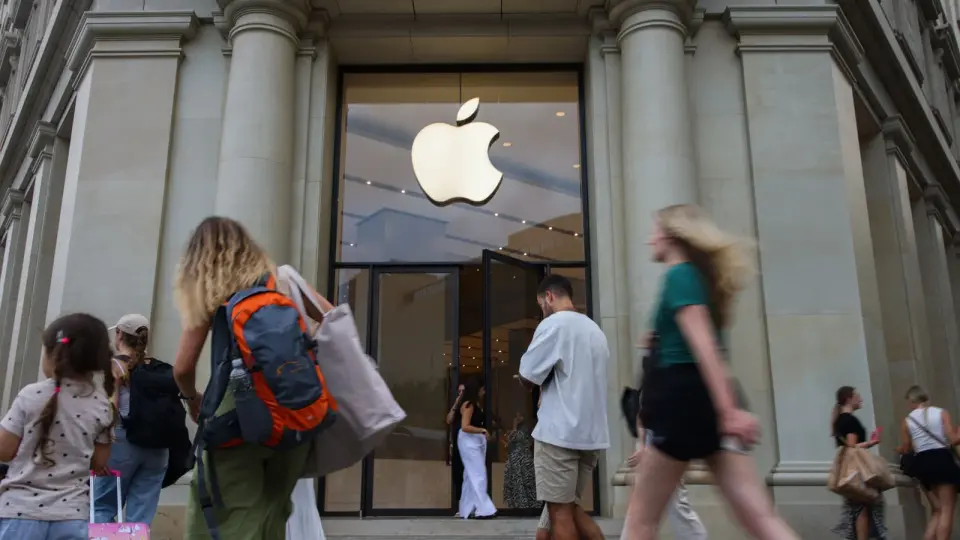
Apple shares have surged 7% in the past month, outperforming the Nasdaq-100, as investors flee AI-heavy tech stocks during a broader market sell-off. This inverse correlation, unseen since 2005, positions Apple as a defensive hedge within the tech sector. While the stock trades at a premium valuation with limited upside to analyst targets, strong cash reserves and consistent earnings beats support its role as a market stabilizer.
Key points
- Apple's 30-day correlation with the Nasdaq-100 hit -0.82, its lowest level since 2005, indicating strong inverse movement during tech volatility.
- Shares rose 2.6% on Tuesday amid a tech rout, continuing a trend where Apple outperforms the broader market by 6 percentage points over the last month.
- Options traders are heavily bullish, with nearly 1.5 million calls traded versus 700,000 puts, and volume double the 30-day average.
- Apple trades at 33x forward earnings with only 1.5% upside to the $324 analyst consensus, leading some analysts to rate it a 'Hold' rather than a 'Buy'.
- September gross margins are expected to drop to 47-48% from 50% due to memory inflation and supply constraints, despite strong Q3 revenue of $109.4 billion.
Background
Apple recently crossed the $5 trillion market cap milestone in July 2026, becoming the second company after Nvidia to reach that valuation. This occurred as investors sought havens amid a sell-off in AI and semiconductor stocks. The company has largely avoided heavy AI spending, gradually advancing its AI features, which has made it an attractive alternative to high-risk AI disruptors. Recent competitive pressures, such as Samsung's Galaxy Z Fold 8 gaining traction in Japan, have not significantly dented Apple's market dominance, further reinforcing its defensive appeal.
How outlets are covering it
CNBC emphasizes Apple's role as a 'safety trade' and 'hedge inside the Nasdaq,' highlighting its inverse correlation with tech peers as a unique 20-year phenomenon. Dave Mazza of Roundhill Investments notes that Apple does not sell off with the AI trade because it never carried that risk. In contrast, 24/7 Wall St. focuses on valuation concerns, arguing that at 33x forward earnings, the stock is a 'Hold' for existing shareholders due to limited upside and margin compression from memory costs. Moomoo community posts reflect a long-term bullish stance, citing services expansion and AI ecosystem integration, but these are anecdotal and not representative of institutional views. The divergence lies in the interpretation of Apple's strength: CNBC sees it as a defensive haven, while 24/7 Wall St. sees it as overvalued and lacking margin of safety for new buyers.
Why it matters
Apple's shift to a defensive asset signals a broader market rotation away from high-growth AI stocks toward stable, cash-rich tech leaders. This trend could influence portfolio construction for risk-averse investors seeking to hedge against tech volatility. The inverse correlation with the Nasdaq-100 suggests Apple may continue to outperform during market stress, but its high valuation and margin pressures could limit further gains if AI sentiment rebounds.
What to watch
Investors will watch Apple's October 29 earnings report for signs of margin stability and Siri AI monetization traction. Key metrics include whether memory costs compress margins beyond the 47-48% guidance and if Greater China revenue stabilizes after a decline from $25.5 billion in Q1 to $18.8 billion in Q3. Analysts may upgrade to 'Buy' if Siri AI drives iCloud+ tier migration, or downgrade to 'Sell' if iPhone 17 demand weakens or margins slip below guidance.
- Apple shares are doing something they haven't done in 20 years. Here’s what’s happening CNBC
- Apple stock becomes hedge as AI trade wobbles in 2026 qz.com
- Day 1 check in Moomoo
- Apple at $320: Here’s Who Should Hold Their Shares 24/7 Wall St.
- What is shaping Apple (NASDAQ:AAPL) shares ahead of its biggest hardware event? Kalkine Media
Want the full story? Read the original reporting
Read on CNBC