Investors are advised to maintain long-term strategies while holding cash for opportunities, as market indices near record highs mask widespread weakness in non-tech sectors. Rising interest rates and narrow participation highlight the need for stock selection over broad market exposure.
Gen Z investors are increasingly using them to gain targeted exposure, especially in AI, but experts warn that themed ETFs can be volatile and should be balanced with broader diversification and careful research into holdings, providers, and costs.
Lululemon stock sank about 18% after-hours following a disappointing Q2 (revenue down 4%, comparable sales down 9%, full-year guidance cut). Michael Burry still backs the name, calling LULU a “trickster” in his portfolio but saying he’ll add to the position if shares stay below $100, keeping LULU as his largest holding (roughly 17% of his portfolio) and emphasizing patience despite volatility.
Robert Kiyosaki, author of Rich Dad Poor Dad, is reportedly carrying about $1.2 billion in debt tied to real estate investments. His ex-wife says the debt is largely linked to properties owned with partners and not his personal liability, with a portfolio that includes roughly 1,500 units; Kiyosaki argues debt can be a wealth-building tool when used to acquire income-producing assets and partitions investments via LLCs. Experts caution that leverage can pay off in rising markets but carries risk, and Vanity Fair’s estimate of his personal share depends on the income he claims to generate. The story underscores ongoing debates about Kiyosaki’s strategy and how debt figures are presented around his wealth-building brand.
Meta announced a round of layoffs totaling about 10% of its workforce, tying the cuts directly to funding a massive AI infrastructure and other investments, with leadership noting efficiency goals and the need to offset spending on AI. In a separate memo, Mark Zuckerberg acknowledged the emotional toll and said he expects no further large-scale layoffs in 2026 as Meta pushes tens of billions into AI. Analysts say the blunt framing highlights tech’s leverage in today’s job market and reflects a broader trend of aligning staffing with automation and AI bets across the industry.
The article argues that space is shifting from one-off hardware bets to a networked, service-based model. With thousands of satellites and fleets like Starlink, space infrastructure now provides ongoing connectivity, Earth observation, and secure communications. Investors should focus on companies that own or operate space networks and deliver recurring revenue (not just single-component suppliers), diversify across the value chain to reduce risk, and push for clear regulatory rules to enable long-term planning as the space economy could reach trillions by 2035.
LIV Golf announced an independent board led by Gene Davis and Jon Zinman to guide its transition to a multi-partner investment model, aiming to secure long-term capital and accelerate growth after a record-breaking 2026 season with a 100% revenue increase and rising engagement.
Bank of America’s famed 'sleep like a baby' portfolio is delivering its strongest year on record, the Chart of the Day shows, marking the best performance since 1933 across its holdings.
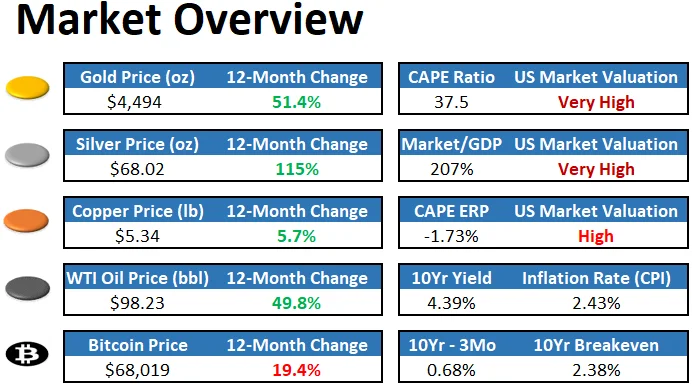
The March 2026 issue analyzes how the ongoing Iran war challenges the Fed’s “gradual print” balance-sheet expansion, comparing current projections to past QE magnitudes and noting that a prolonged energy shock could force a bigger monetary response. It links geopolitics to potential stagflation, outlines how higher energy prices could pressure households and Treasury yields, and emphasizes a three-pillar investment approach (profitable equities, commodities/hard money, cash equivalents) to navigate volatility. The piece also highlights the author’s new sci-fi thriller and encourages readers to pursue longer-term, immersive activities beyond daily news cycles.
Saudi Arabia’s Public Investment Fund will test a revised 2026–2030 investment strategy at its Private Sector Forum, seeking private-sector funding to sustain its giga‑projects while signaling up to a 15% cut to capital expenditure. The plan, shaped by investor feedback, prioritizes Expo 2030 and the 2034 World Cup, with projects like Neom and the Mukaab under reprioritisation and tighter financial scrutiny as oil prices and liquidity tighten.
XRPL developer Bird says there is no universal XRP holding target; the right amount depends on individual circumstances, cost of living, goals, and risk tolerance. He cites 10,000 XRP as a rough reference, not a rule, and cautions against chasing online numbers, stressing that a sustainable, personalized plan matters more than token counts.
Peter Thiel's recent stock purchases, including stakes in Microsoft and Apple, contrast with sales by Warren Buffett and Bill Gates, highlighting differing investment strategies among billionaires with strong AI and tech interests.
In response to the unprecedented events in Venezuela involving U.S. military actions and political charges, investors are advised to consider safe-haven assets like gold and cash, monitor oil prices and oil company stocks, but generally maintain a long-term, steady investment approach without making drastic changes.
Vanguard favors a 40/60 stock-bond portfolio for 2026, believing it offers higher risk-adjusted returns compared to other allocations, reflecting their optimistic outlook for this balanced investment approach.
Palantir's stock has declined 19% amid a cooling in AI enthusiasm and concerns over its high valuation, despite long-term AI demand projections. Top investor Oliver Rodzianko advises caution, highlighting valuation risks and market sentiment, and currently recommends a hold on the stock with a 12% upside potential over the next year.