
Systematic Selling Amplifies Record $2.3 Trillion Nasdaq 100 Plunge
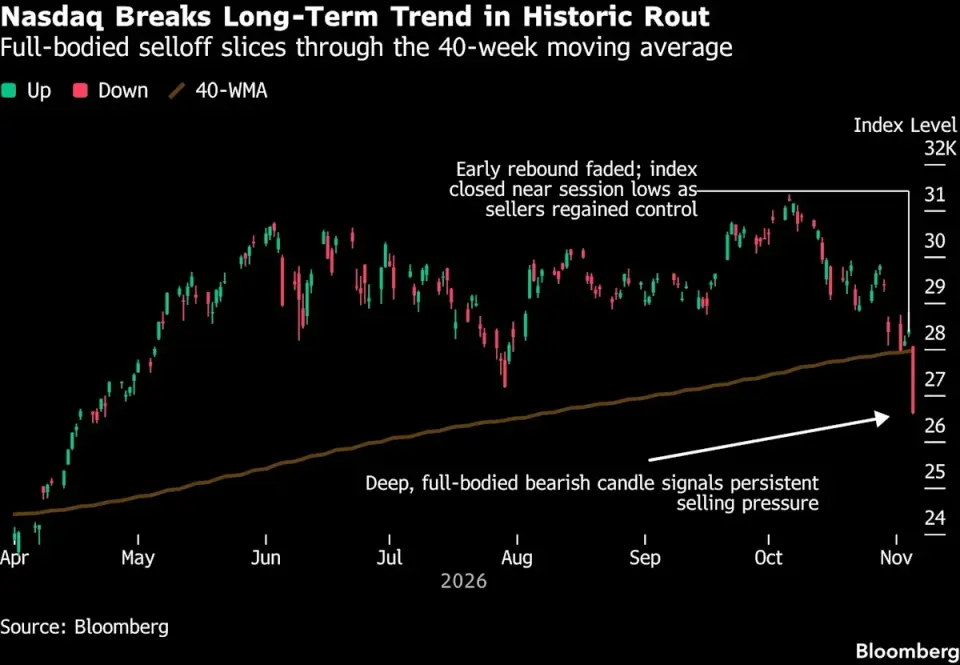
The Nasdaq 100 suffered its largest single-day market value loss ever, dropping 6.4% to erase $2.3 trillion. JPMorgan strategists attribute the accelerated decline to trend-following funds and volatility-targeting portfolios being forced to cut exposure after key technical levels broke. This mechanical selling amplified initial concerns about potential Democratic regulatory tightening on AI infrastructure.
Key points
- The Nasdaq 100 index fell 6.4% on Thursday, wiping out $2.3 trillion in market value, marking the largest single-day decline in its history.
- JPMorgan Chase strategists led by Bram Kaplan state that commodity trading advisers and other trend-following strategies turned net short US equities, accelerating the drop.
- Volatility-targeting portfolios are estimated to have $50 billion in equity exposure to sell over the next few days as they reduce leverage targets from the 67th to the 30th percentile.
- Barclays models suggest these funds could reduce equity exposure by 30 percentage points, potentially selling $135 billion in US equity futures within 48 hours.
- Leveraged ETFs sold over $60 billion of stocks into the close, with 90% of this volume concentrated in technology-related products like semiconductors and Nasdaq 100 ETFs.
- The initial sell-off was triggered by fears that a Democratic sweep in midterms could lead to tighter regulation of AI buildouts, impacting chipmakers and data-center suppliers.
Background
This event follows a broader tech rout in late October 2026, where the Nasdaq 100 dropped 2.6% and the AI trade lost $5 trillion in value due to disappointing earnings and skepticism over AI infrastructure returns. Earlier in November, hedge fund profit-taking triggered a 5% Nasdaq plunge, described by Nomura as an institutional shakeout. The current decline extends this trend, with semiconductor stocks like Lam Research and Applied Materials having already fallen significantly over the past month.
How outlets are covering it
JPMorgan emphasizes the mechanical nature of the sell-off, highlighting how systematic strategies amplified the initial price drop by breaking technical levels. Fundstrat’s Mark Newton focuses on technical support levels for QQQ and SOXX, suggesting a low may be near as the market tests long-term trendlines. Zacks’ Andrew Rocco frames the decline as a necessary mean-reversion pullback, arguing that political gridlock and seasonality historically favor equity gains post-midterm, despite current AI funding fears.
Why it matters
The record plunge highlights the vulnerability of concentrated AI-driven market rallies to regulatory and mechanical selling pressures. The forced deleveraging by systematic funds could continue to drive volatility, while the shift in political control may reshape the regulatory landscape for AI infrastructure, affecting long-term growth prospects for tech giants.
What to watch
Investors should monitor continued selling from volatility-targeting portfolios, which may sell up to $135 billion in futures over the next 48 hours. The market will also watch for signs of capitulation or stabilization as technical support levels are tested, with potential relief buying offsetting some rebalancing needs.
- Fast-Money Systematic Funds Stoked $2.3 Trillion Tech-Stock Rout Yahoo Finance
- Thursday's severe selloff has QQQ and SOX at trendline support, and a low looks to be right around the corner Fundstrat Direct
- S&P 500, Dow Jones, and Nasdaq 100 Outlook: Top Drivers for US Stocks This Week Benzinga
- Q4 QQQ Roadmap: Navigating AI Turbulence & Market Headwinds Zacks Investment Research
- The Market Climbs The Wall Of Worry (NYSEARCA:SPY) Seeking Alpha
Want the full story? Read the original reporting
Read on Yahoo Finance