
Tech-led selloff triggers $2.5 trillion market wipeout, underscoring diversification
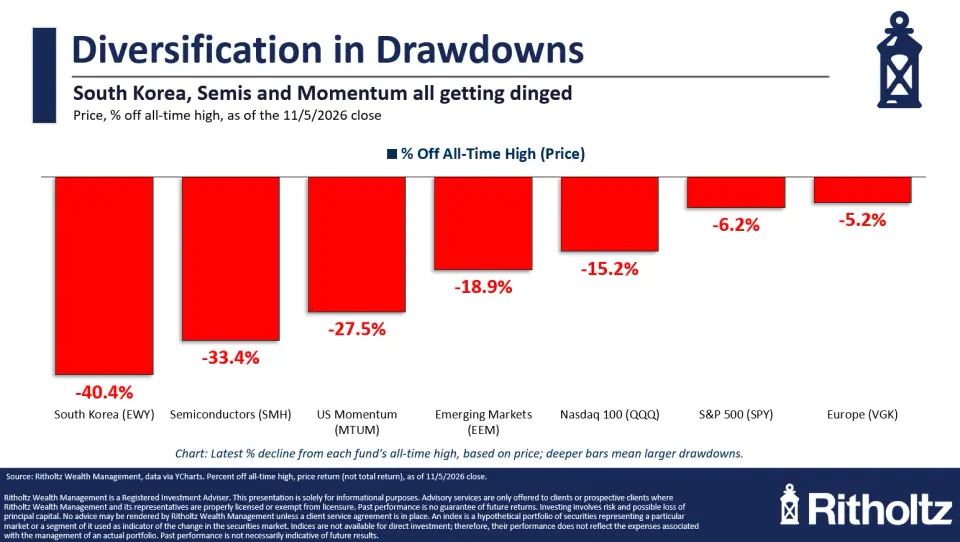
A sharp sell-off in artificial intelligence and technology stocks triggered a significant market correction on Thursday, November 5, 2026. The S&P 500 fell over 4%, while the Nasdaq 100 dropped 5.5%, resulting in a $2.5 trillion loss for the Nasdaq Composite. Semiconductor stocks declined by more than 11%, and South Korean markets fell nearly 14%. Analysts emphasize that this volatility highlights the risks of concentrated portfolios and the benefits of diversification across sectors such as healthcare and bonds.
Key points
- The S&P 500 fell more than 4% and the Nasdaq 100 dropped 5.5% on Thursday, marking the worst day for major indexes in 19 months.
- Semiconductor stocks plunged over 11%, while South Korean markets declined nearly 14% in a single session.
- The Nasdaq Composite lost $2.5 trillion in value during the week, driven by a sharp decline in AI-related equities.
- The S&P 500 is currently down approximately 6% from its recent highs, a drawdown smaller than the average intra-year peak-to-trough decline of 14% since 1990.
- Chipmakers account for nearly one-fifth of the S&P 500’s market value, with the top 10 stocks representing almost 40% of the index.
Background
The current market volatility follows a period of significant gains for technology stocks, with the S&P 500 rising 88% between November 2022 and the recent correction. This surge was largely driven by the artificial intelligence boom, which increased the concentration of major indexes. Recent political developments, including a Democratic sweep in midterm elections, have raised concerns about potential policy hurdles for AI data center construction, contributing to investor anxiety.
How outlets are covering it
Ben Carlson of A Wealth of Common Sense argues that the recent drawdowns, while severe for tech, are manageable for diversified investors, noting that the S&P 500 is only down 6% overall. He advocates for index funds as a way to capture broad market gains without picking individual winners. CNN, however, frames the event as a 'wake-up call' for investors who have drifted from diversified portfolios, emphasizing that the concentration of AI stocks in major indexes has left many portfolios underprepared for such volatility. While Carlson focuses on the historical context of drawdowns, CNN highlights the need for active rebalancing into sectors like healthcare and bonds to mitigate risk.
Why it matters
This event underscores the systemic risk posed by high market concentration in AI and technology sectors. It serves as a reminder that even broad market indexes can experience significant volatility when dominated by a few high-growth companies. For investors, it highlights the importance of diversification to protect portfolios from sector-specific shocks and to maintain stability during periods of rapid re-pricing in the technology sector.
What to watch
Investors are advised to reassess their risk tolerance and portfolio composition. Market participants may continue to monitor the impact of political policies on AI infrastructure development. While the current drawdown is smaller than historical averages, further volatility is possible if the AI trade continues to unravel or if broader economic conditions deteriorate. Long-term investors are encouraged to remain disciplined and avoid panic selling.
- Diversification & Drawdowns A Wealth of Common Sense
- AI nerves reinforce age-old investing lesson: Get diversified CNN
- AI Has Taken Over Every Corner of the Market Bloomberg.com
- The 8 AI Giants Behind Nearly Half of the S&P 500’s Growth Visual Capitalist
- Bad AI cholesterol vs good AI cholesterol The Economic Times
Want the full story? Read the original reporting
Read on A Wealth of Common Sense