Tag

Diversification

All articles tagged with #diversification

Canada hits back with dollar-for-dollar tariffs as US trade war escalates
business2 days ago

Canada hits back with dollar-for-dollar tariffs as US trade war escalates

Canada will retaliate dollar-for-dollar against US 50% tariffs on about $20 billion of goods, targeting steel, dairy, appliances, agricultural equipment, pulp and paper, and electronics; Ottawa plans to announce the details soon and says the measures could last years, while Washington says no new talks are planned and warns higher costs for businesses and families as Canada seeks to diversify its trade relationships.

Diversify Now: Don’t Let a Tech-Heavy S&P 500 Define Your Nest Egg
markets3 days ago

Diversify Now: Don’t Let a Tech-Heavy S&P 500 Define Your Nest Egg

Long-running gains from low-cost S&P 500 funds have built wealth, but heavy exposure to tech and mega-cap stocks raises risk. Analysts urge adding non-correlated assets—such as equal-weighted S&P 500 exposure, small-cap and international equities, dividend/value ETFs, and shorter-duration bonds—to reduce volatility and improve resilience in a potential bear market, with gold as a diversifier and time-horizon considerations guiding how aggressively to allocate.

Magnificent Seven Lose Momentum as Concentration Sparks Rebalancing
business6 days ago

Magnificent Seven Lose Momentum as Concentration Sparks Rebalancing

The Magnificent Seven tech giants have underperformed in the first half of 2026, with Nvidia the sole standout while others like Apple, Alphabet, Amazon, and Microsoft are flat or down; rising concerns about high valuations and AI-spending fuel talk of market concentration and the need to diversify beyond the Mag-7, including value stocks, small caps, and non-U.S. equities. While some Mag-7 names remain in top stock lists, analysts warn investors not to rely on them as the market shifts away from their former dominance.

Global Rate Hikes Put Bond Diversification at Risk
markets7 days ago

Global Rate Hikes Put Bond Diversification at Risk

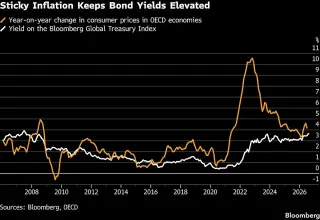
Bloomberg reports that rate hikes are expected across major economies beyond the U.S., with about two-thirds of tracked swap markets pricing higher policy next year. Fueled by energy costs, fiscal stimulus, and an AI-driven growth boom, inflation pressures could force central banks to tighten further, potentially turning bonds from portfolio ballast into a drag as yields rise and financing conditions tighten, weighing on both bonds and equities.

Cuban and Burry warn AI boom could imperil retirement portfolios
finance23 days ago

Cuban and Burry warn AI boom could imperil retirement portfolios

Billionaires Mark Cuban and Michael Burry warn the Nvidia-led AI surge is dangerously concentrated and could unravel with a surprise shock, risking retirement accounts heavily exposed to AI-rich equities. They cite Nvidia’s rising debt insurance costs and a lofty Shiller P/E as signs of stretched valuations, echoed by Jeremy Grantham’s bubble warning and Goldman Sachs’ projection of a 10–20% equity drawdown in the next 12–24 months. The piece advocates diversification beyond tech, including gold (even Gold IRAs), private real estate platforms like Mogul and Lightstone DIRECT, and art via Masterworks, to shield long‑term retirement funds from a potential downturn.

AI Spending Tightens the Tie Between Wall Street and Korea’s Chipmakers
business28 days ago

AI Spending Tightens the Tie Between Wall Street and Korea’s Chipmakers

AI demand is linking Wall Street’s tech winners with Korea’s memory-chip giants (Samsung Electronics and SK Hynix), pushing the Kospi–Nasdaq 100 60-day correlation near 0.5 and making Korea an early read on AI trends. Yet the closer tie reduces diversification benefits and raises risk if hyperscaler capex slows, even as factors like product mix, U.S. onshoring, and China’s memory-chip push could eventually drive divergence.

Gen X retirement at risk as dot-com era lessons reappear in today’s markets
business29 days ago

Gen X retirement at risk as dot-com era lessons reappear in today’s markets

Gen X near-retirees face heightened risk from market crashes timed to withdrawal needs, with many having been heavily invested in S&P 500 funds after years of strong gains. Experts urge a diversified “war chest” of cash, short-term bonds, and other high-quality assets to cover early retirement expenses, plus glide-path strategies and gradual rebalancing to avoid selling during downturns. They also caution about concentration risk in the S&P 500 as AI-driven themes increasingly dominate index weights, which echoes the dot-com era’s vulnerabilities.

business1 month ago

Micron's Momentum as a Diversified Return Engine

Micron Technology has surged, outpacing the S&P 500, but the smarter question for investors is how owning Micron changes portfolio risk and whether its gains are truly distinct from the market. The stock offers strong upside and a better risk-adjusted return than the market (five-year 69% annualized, Sharpe 1.15 vs 0.58), yet it remains correlated with the market and tends to amplify both upswings and downswings (roughly 467% of market gains on up days, 248% of losses on down days). Micron is pursuing multiyear Strategic Customer Agreements that could stabilize earnings and shift its boom-bust cycle, potentially making it a more durable return engine. The takeaway is to watch SCAs for durability and balance Micron with broader exposure if seeking steady portfolio performance.

IBM's Crash Reveals the Retirement Lesson: Diversify Beyond a Dividend Anchor
personal-finance1 month ago

IBM's Crash Reveals the Retirement Lesson: Diversify Beyond a Dividend Anchor

IBM’s ~30% one-week plunge despite raising its dividend highlights concentration risk for retirees who rely on a single stock for income. While Social Security provides an inflation-adjusted income floor that isn’t affected by stock swings, selling appreciated shares to trim a concentrated position can push provisional income into taxable territory and threaten benefits. The takeaway is to keep single-stock exposure to 5–10% of a draw-down portfolio, trim gradually (not all at once), harvest tax losses, consider charitable donations of appreciated shares, and structure retirement income in layers anchored by Social Security with fiduciaries focusing on your long-term interests.

Investing Through the AI Boom: How to Brace for a Bubble
markets1 month ago

Investing Through the AI Boom: How to Brace for a Bubble

The Unhedged piece argues that the AI rally appears to be inflating a bubble, with lofty valuations and volatile pockets making it hard to time a top. For investors, the answer isn’t to sit entirely on the sidelines but to accept that some underperformance may be the cost of risk control. Hedge beyond traditional bonds with commodities and commodity exporters, consider non-tech core exposures (healthcare, Japan), and be mindful of leverage and a higher-inflation regime that can blunt bonds as hedges. In short, diversify, manage risk, and aim for “good-enough” returns rather than chasing peak performance as the bubble evolves.

Ultrawealthy look beyond the U.S. for asset diversification, Citi executive says
business1 month ago

Ultrawealthy look beyond the U.S. for asset diversification, Citi executive says

A Citi Wealth executive says American ultra‑wealthy clients are increasingly booking assets outside the United States for optionality and resilience, pursuing additional residencies or golden visas in places like Italy, Portugal, Jersey, Australia and New Zealand without fully expatriating. Citi’s Wealth Beyond Borders projects about $3.06 trillion shifting to hubs such as Hong Kong, Singapore, Switzerland, the UAE and the U.S. from 2025–2029, driven by lifestyle, growth and policy risk concerns; UBS and Henley & Partners also note rising global migration and residency-by-investment activity. Family offices report increased cross-border investing and a continued but not reduced U.S. exposure, underscoring a deliberate diversification trend rather than flight from America.

SCHD’s Tiny Fee Masks a 38% Ten-Year Performance Gap
investing1 month ago

SCHD’s Tiny Fee Masks a 38% Ten-Year Performance Gap

SCHD’s 0.06% expense ratio is tiny, but the fund’s concentration—top 10 holdings make up about 40% of assets, with energy exposure around 17%—has coincided with a 38% lag to WisdomTree’s DGRW over the last decade, costing roughly $3,800 on a $10,000 investment. A March 2026 reconstitution also reduced a quarterly dividend, underscoring that income can be unstable despite a “defensive” label. For broader income, consider VYM; for a quality-growth tilt, DGRW; and for broader diversification you may already hold similar exposure in VOO or VIG. In short, the fee is cheap, but the real cost is opportunity cost and concentration, not the expense ratio.

From Welder to Millionaire: SpaceX Stock Turns One Immigrant’s Wealth Ambition Into Reality
business2 months ago

From Welder to Millionaire: SpaceX Stock Turns One Immigrant’s Wealth Ambition Into Reality

A Mexican immigrant who started at SpaceX as a contractor earning $28/hour eventually became a full‑time employee with an equity grant; after SpaceX’s IPO his roughly 6,500 shares were worth over $1 million, illustrating how ownership can unlock huge wealth. The piece also highlights diversifying into real estate, gold, and automated investing to manage risk and grow wealth over time.

Carney Sees Canada’s Diversification as a Boost for America
world2 months ago

Carney Sees Canada’s Diversification as a Boost for America

Canadian Prime Minister Mark Carney told a New York audience that Canada’s push to diversify away from the United States would benefit both countries, calling for a new, deeper partnership with the U.S. while acknowledging Trump-era tariffs and global shifts, and signaling openness to targeted integration in selected sectors to preserve free trade.

Retirees’ Worst-Case Reality: $1.7M Portfolio Drops $312K in 18 Trading Days
personal-finance3 months ago

Retirees’ Worst-Case Reality: $1.7M Portfolio Drops $312K in 18 Trading Days

A 65-year-old couple retired with about $1.7 million in a 70/30 portfolio and planned to withdraw $68,000 annually under the 4% rule. In 18 trading days, their portfolio declined to roughly $1.39 million—a loss of about $312,000—as both stocks and bonds fell amid rising rates (VIX near 31; 10‑year yield up from 4.3% to 4.5%). Keeping the same $5,667 monthly withdrawal on the smaller balance would push the withdrawal rate to around 5%, increasing the risk of depletion before age 90. The piece argues a 24‑month cash buffer (about $136,000) could have allowed the portfolio to recover without selling equities, and suggests rethinking early-retirement allocations and applying guardrail withdrawal rules. In short, diversification isn’t a foolproof shield in a higher-rate environment; cash reserves are a crucial buffer for retirees.