
Census data reveals EV adoption gap between homeowners and renters
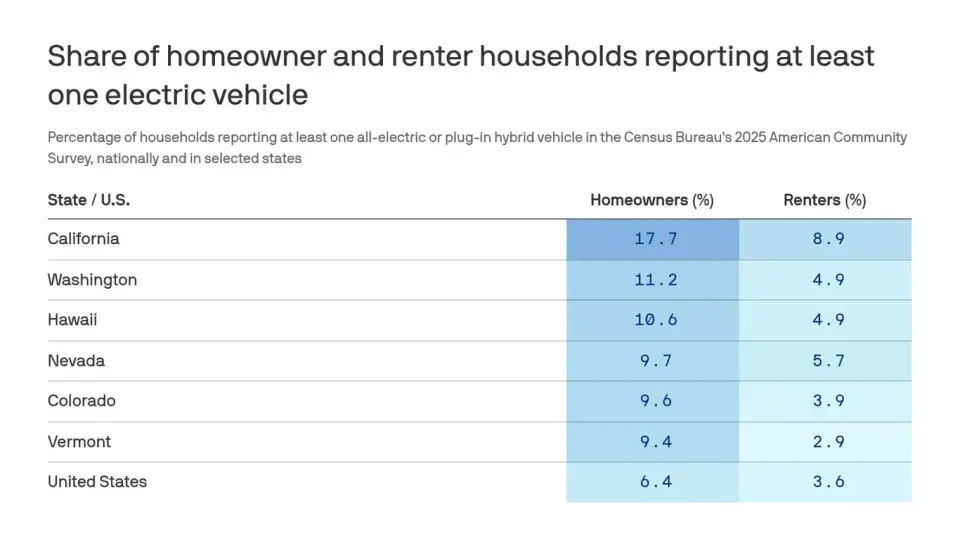
The 2025 American Community Survey reveals a significant disparity in electric vehicle (EV) adoption between homeowners and renters. While 5.5% of all U.S. households own or lease an EV, homeowners report a 6.4% adoption rate compared to 3.6% for renters. California leads the nation with a 13.8% overall rate, but even there, the gap persists, with 17.7% of homeowners owning EVs versus 8.9% of renters. This divide suggests that access to private charging infrastructure, such as driveways or garages, remains a critical barrier for renters in multifamily housing.
Key points
- 7.3 million U.S. households, or 5.5% of the total, reported having at least one EV or plug-in hybrid in 2025, according to the Census Bureau.
- Homeowners were nearly twice as likely to have an EV (6.4%) as renters (3.6%), highlighting a structural inequality in the transition to electric mobility.
- California leads the nation with a 13.8% adoption rate, followed by Washington (8.9%), Hawaii (8.5%), and Nevada (8.2%).
- Santa Clara County in California recorded the highest adoption rate at 24.1%, with approximately 163,000 households owning an EV.
- North Dakota (1.3%), Wyoming (1.6%), and Louisiana (1.6%) had the lowest EV adoption rates nationwide.
- A 2026 study from the University of Vermont and UC Davis found that higher installation costs for home chargers in rental properties deter EV adoption among renters.
Background
This is the first time the American Community Survey has collected data on EV ownership, providing a baseline for future analysis. Previous coverage of EV technology, such as the reliability of the Lucid Air and the launch of the Citroën 2CV EV concept, focused on vehicle performance and market competition rather than demographic adoption patterns. The new Census data shifts the focus to accessibility and infrastructure, revealing that the EV revolution is not evenly distributed across housing types.
How outlets are covering it
Axios emphasizes the 'driveway divide,' arguing that the lack of private charging access in multifamily buildings is the primary barrier for renters. KTVU highlights California's dominance, noting that all top five counties for EV adoption are in the Bay Area, and links this to high gas prices and state incentives like the MyFirstEV program. The Census Bureau itself notes that Western states lead adoption, with statistician Tricia Holley attributing this to regional trends. The Atlanta Regional Commission points to a correlation between high gasoline prices and EV adoption, noting that oil-rich states like Texas have lower EV penetration. While all sources agree on the data, Axios and the academic study cited by Axios focus on structural housing barriers, whereas KTVU and the Atlanta Regional Commission emphasize economic and geographic factors like fuel costs and state policies.
Why it matters
The data reveals that the shift to electric vehicles may exacerbate existing socioeconomic inequalities. If EV adoption is concentrated among homeowners with private charging access, renters and lower-income households may be left behind in the transition to cleaner transportation. This could impact public policy, as governments may need to invest in public charging infrastructure or incentivize EV adoption in multifamily housing to ensure equitable access to the benefits of electric mobility.
What to watch
Policymakers may need to address the charging infrastructure gap in multifamily housing to close the adoption divide. Future Census data will track whether the homeowner-renter gap widens or narrows. State and local governments may introduce new incentives or regulations to support EV adoption in rental properties, particularly in high-adoption states like California. The Atlanta Regional Commission plans to analyze EV ownership variations within its region in future reports.
- New Census data reveal a homeowner-renter divide in America's electric-car transition Axios
- Nearly 25% of households in this Bay Area county use electric vehicles, leading the nation in EV adoption KTVU
- This California county has the highest electric-vehicle ownership rate in the U.S. San Francisco Chronicle
- Western States Led the Way in Electric Car Adoption Census.gov
- The EV Revolution is Real. It’s Just Not Happening Everywhere. Atlanta Regional Commission
Want the full story? Read the original reporting
Read on Axios