
Nvidia’s Volatility and Political Rescue Expose Fragility of AI Boom
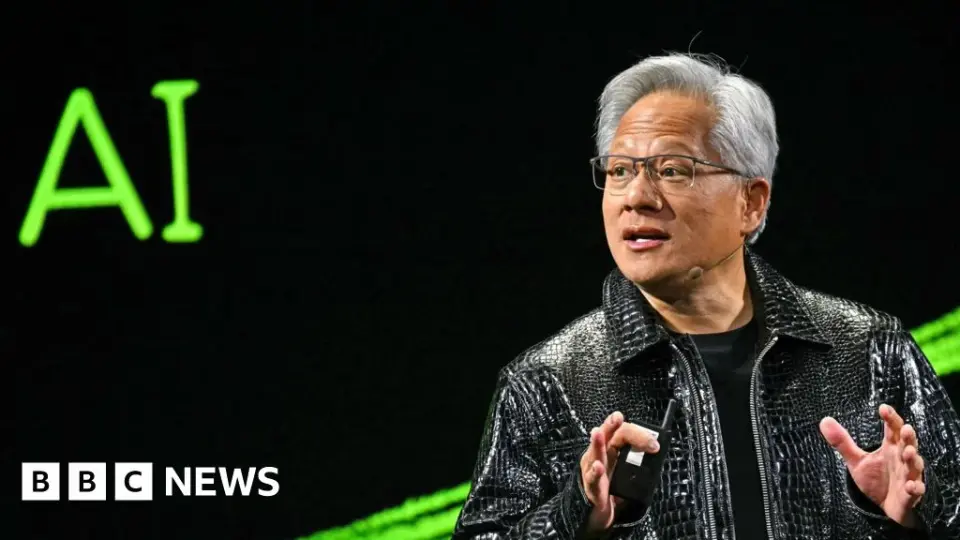
Nvidia shares have fallen nearly 30% over six months despite a recent rebound following the reinstatement of CEO Jensen Huang. The return was driven by direct intervention from President Trump, who claimed a two-day national security review cleared Huang. While Nvidia’s $400bn annual chip sales remain central to the tech sector, investors are increasingly skeptical of the AI boom’s sustainability. Anthropic’s post-IPO share price has dropped, raising concerns about OpenAI’s future listing. Critics argue the sector’s reliance on political support and massive capital expenditure, rather than proven revenue, creates systemic market risks.
Key points
- Nvidia shares are down approximately 30% over the past six months, though they recently surged after Jensen Huang was reinstated as CEO.
- President Trump publicly intervened with Nvidia’s board, claiming a brief national security investigation cleared Huang of concerns, despite allegations involving a Chinese spy and employee affairs.
- Anthropic, the first purely AI company to be publicly listed, has seen its share price fall below its initial flotation level, signaling waning investor appetite.
- Nvidia’s $400bn annual chip sales are described as the 'central cash-generating foundation' of the tech boom, but its role in financing data centers is viewed as politically fragile.
- Investors are currently trading based on levels of political support rather than fundamental revenue numbers, amid broader skepticism about AI sustainability.
Background
This volatility follows a period of intense scrutiny on AI infrastructure. In late October, gold prices fell to a one-year low as inflation fears and tech stock losses drove margin calls. In November, San Francisco faced warnings of an AI-driven crash despite rising rents, while Anthropic’s record $1.5 trillion IPO in late November divided public opinion between small-business optimism and safety concerns. The current market instability reflects a broader shift from speculative growth to a focus on political and regulatory risks.
How outlets are covering it
BBC emphasizes the 'psychodrama' of Trump’s direct intervention, noting that investors are now trading on political support rather than fundamentals. U.S. News & World Report frames the situation as a 'too big to fail' scenario, comparing the government’s defense of Huang to historical bank bailouts, while also highlighting Google’s leverage over schools through AI-integrated search tools. The American Bazaar focuses on structural sustainability, questioning whether AI’s capital-intensive nature, energy demands, and lack of job creation justify its market valuation, and links this to new government programs like Trump Accounts. While BBC and U.S. News focus on the immediate political and market shock, The American Bazaar critiques the long-term economic and environmental viability of the sector.
Why it matters
The episode reveals that the AI sector’s stability is increasingly tied to political intervention rather than organic market forces. If major AI firms rely on government backing to maintain leadership and market confidence, it introduces systemic risk to the broader economy. The decline in Anthropic’s stock and the volatility of Nvidia suggest that investor confidence is fragile, potentially impacting the financing of data centers and the adoption of AI technologies across industries.
What to watch
Watch for the outcome of OpenAI’s planned stock listing, which may serve as the next test of investor appetite. Monitor whether Nvidia’s strategy on data center financing, previously signaled to be scaled back by interim CEO Colette Kress, is reversed or maintained. Also, observe if other AI firms face similar political interventions or if regulatory backlash against AI data centers intensifies, particularly regarding energy and water usage.
- Faisal Islam: Fears over the AI boom haven't gone away BBC
- Opinion | America Hits the Brakes on AI WSJ
- Has AI Become Too Big to Fail? U.S. News & World Report
- Trump Accounts and the AI Bubble The American Bazaar
- ‘Brace for Impact’ in AI. Nvidia, Tariffs, Founders & Climate. ARD #213 AI: Reset to Zero
Want the full story? Read the original reporting
Read on BBC