
Amazon’s Zoox Secures First U.S. Approval for Paid, Steering-Wheel-Free Robotaxis
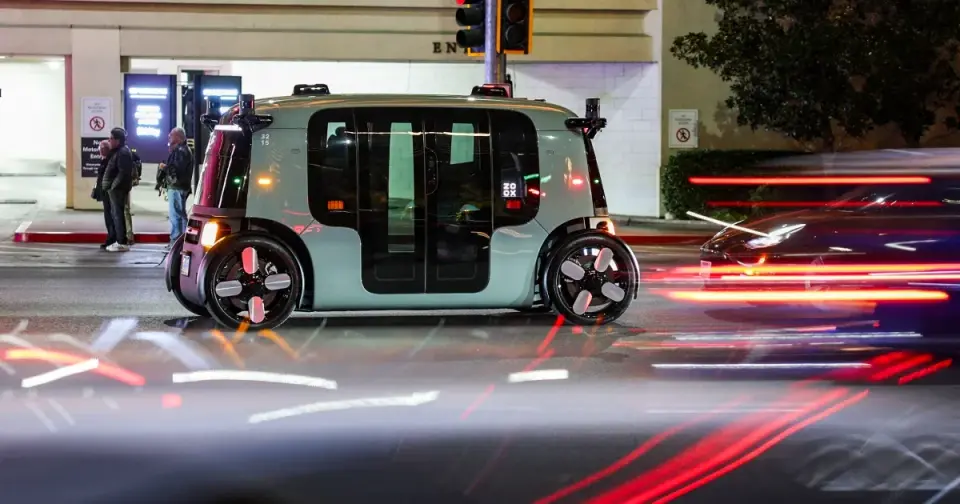
Amazon’s Zoox has received the first federal exemption in the U.S. allowing a purpose-built, steering-wheel-free robotaxi to charge for rides. The National Highway Traffic Safety Administration (NHTSA) approved limited commercial deployment, permitting up to 2,500 vehicles annually for two years. Zoox plans to begin paid service in Las Vegas soon, with expansion to other markets pending state approvals. This milestone follows years of free testing in Las Vegas and San Francisco and precedes potential regulatory changes for brake pedals and mirrors.
Key points
- NHTSA granted Zoox a federal exemption from rules requiring human controls like steering wheels, marking the first such approval for a purpose-built autonomous vehicle.
- Zoox is authorized to deploy up to 2,500 vehicles per year for the next two years, subject to state and local approvals.
- Paid rides are expected to begin in Las Vegas, where Zoox has already conducted free testing, with other markets to follow.
- The exemption includes strict reporting requirements for crashes and inappropriate stops, with NHTSA retaining the right to revoke approval for major safety issues.
- Remote operators must be located in the United States, and Zoox must publish maps of its operating areas.
- Zoox cannot sell the vehicles to the public; they are intended for ride-hailing services only.
Background
Zoox, acquired by Amazon for $1.2 billion, has been testing its driverless, boxy robotaxi in Las Vegas and San Francisco since 2025. The vehicle features two rows of inward-facing seats and a top speed of 75 mph. In June 2026, Zoox unveiled a production-ready redesign with improved interiors and safety features. The company aims to scale production to 10,000 vehicles annually at its Bay Area facility. Prior to this approval, Zoox had recalled its fleet of 105 vehicles to update software after NHTSA raised concerns about autonomous vehicles interfering with first responders and emergency smoke detection.
How outlets are covering it
NBC News and the Associated Press (via Boston.com) emphasize the regulatory milestone and NHTSA Administrator Jonathan Morrison’s confidence in the vehicle’s safety, noting that Zoox’s systems exceed equivalent performance requirements. However, Boston.com highlights concerns from the Advocates for Highway and Auto Safety, which criticized Zoox for lacking detailed data to prove safety, describing the company’s claims as 'glossy language' without evidence. The Insurance Institute for Highway Safety, also cited by Boston.com, noted that limited crash data makes it difficult to assess the safety record of robotaxis. Baton Rouge Business Report focused on the commercial implications, noting the approval as a step toward challenging Waymo, while also mentioning unrelated news on mortgage rates and WIC benefits. All sources agree on the core facts: the exemption, the 2,500-vehicle limit, and the Las Vegas launch.
Why it matters
This approval signals a shift in U.S. regulatory frameworks, moving from rules designed for human drivers to standards accommodating fully autonomous vehicles. It could accelerate the commercialization of robotaxis, potentially reducing reliance on human drivers and addressing safety issues related to distracted or drunk driving. However, it also raises questions about data transparency and safety oversight, as critics argue that current reporting requirements are insufficient to evaluate the true risk profile of autonomous vehicles. The approval may also influence future regulations for other components like brake pedals and mirrors, reshaping vehicle design and safety standards.
What to watch
Zoox is expected to begin charging for rides in Las Vegas soon, with expansion to other markets pending state and local approvals. NHTSA is developing the first federal safety standards for automated driving systems, expected by the end of the Trump administration. The agency is also proposing to overhaul rules requiring brake pedals and rear-view mirrors. Zoox will continue to submit reports on crashes and operational issues, with NHTSA adjusting conditions based on vehicle performance. The company aims to scale production to 10,000 vehicles annually, competing with Waymo and Tesla in the autonomous ride-hailing market.
- Amazon’s Zoox wins first U.S. approval for paid robotaxis without human controls NBC News
- Amazon’s Zoox Gets Clearance to Start Paid Robotaxi Rides WSJ
- Some robotaxis approved to operate without steering wheels and losing the brake pedal could be next boston.com
- Roundup: New robotaxis to hit the road / Mortgage rates climb / New WIC system Baton Rouge Business Report
- Amazon’s Zoox Gets Green Light to Deploy Up to 5,000 Robotaxis Bloomberg.com
Want the full story? Read the original reporting
Read on NBC News