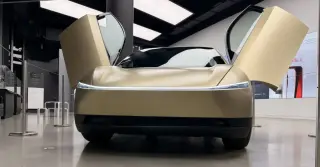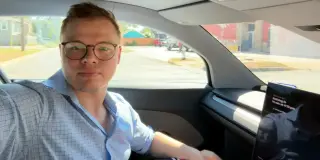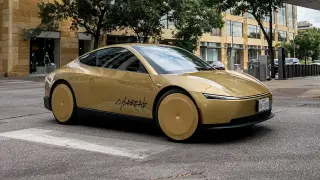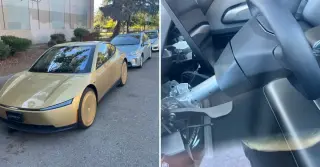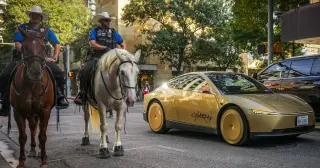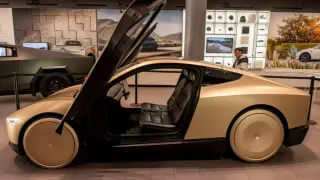
Tesla is moving toward a public rollout of its Starlink-enabled Cybercab in Austin, a pedal- and steering wheel-free two-seater that relies on Full Self-Driving; production is at Gigafactory Texas, employees are testing it on public roads, and a ride lottery suggests a late-2026 launch, though no firm date has been announced.
Waymo wins approval to expand robotaxi service across 18 California counties with full-speed, all-weather operation for most residents, signaling a major scale-up as GM tests hands-off driving in its Cadillac EVs and pushes a unified charging experience via GM Energy; the episode also highlights Gemini AI and a new UI in the Ojai robotaxi.
Waymo’s robotaxis accounted for about 15% of gross ride bookings in San Francisco and Los Angeles, and 16% in Phoenix in June, per Yipit, with shares remaining in the mid-teens as the service expands. The impact on human drivers is likely to show up first in utilization metrics (more idle time, longer waits, fewer trips per hour) rather than outright layoffs, since drivers are flexible independent workers. Measuring displacement is difficult due to data gaps and the gig-economy structure; industry voices suggest a gradual shift toward a hybrid future as AVs scale.
California regulators approved Waymo to expand its robotaxi service to 18 counties, broadening the LA and Bay Area coverage to include San Diego, Sacramento, and more. The rollout will be gradual, with rider-only service planned for San Diego later this summer and deployment using its newer, cheaper Ojai vehicle across northern and southern California. Waymo cites extensive autonomous miles and improved safety, despite ongoing public attention to incidents.
California regulators approved Waymo's plan to expand its autonomous ride-hailing service to Sacramento and San Diego, with gradual expansion across the SF Bay Area and Los Angeles and deployment in 18 counties using Jaguar I-Pace and Zeekr Ojai robotaxis under Waymo's safety framework.
Lucid announced an operational reset focused on cash, cost, customer experience, and culture, anchored by a $1.4 billion cash-flow improvement plan and four must-win projects (Robotaxi with Uber/Nuro, AMP-2 in Saudi Arabia, Midsize) with a leaner org to speed decision-making. Production was intentionally reduced to lower inventory and free up cash. In Q2 2026, Lucid produced 4,774 vehicles (3,953 delivered), revenue of $405 million, and ended the quarter with about $3.0 billion in liquidity, supported by new financing that extends runway into 2027. The Robotaxi program is in active testing in the SF Bay Area and Houston, Gravity deliveries to Nuro have begun, and AMP-2 is moving toward industrialization, with ongoing Midsize validation and production readiness work.
Lucid Group posted a Q2 miss as it launches an operational reset under new CEO Silvio Napoli, suspending 2026 guidance, cutting costs, and delaying its midsize vehicle to likely the second half of 2027. The company plans a robotaxi program with Uber and Nuro using Gravity-based prototypes, aiming for non-prototype production next year and about 100 preproduction Gravity units this year. Second-quarter results showed a net loss exceeding $1B and an adjusted loss of $3.30 per share on $405 million in revenue, with production of 4,774 vehicles and deliveries of 3,953. Lucid has roughly $3 billion in liquidity, providing runway into 2027 as it works to lower costs and refocus its strategy.
Lucid unveiled an operational reset centered on three priorities—Cash & Cost, Customer & Quality, and Culture & Team—anchored by a $1.4 billion cash-flow improvement plan. The company also outlined four must-win projects: Robotaxi with Uber and Nuro, AMP-2 manufacturing in Saudi Arabia, and ongoing Midsize program development, plus a plan to simplify the organization and accelerate decision-making. In Q2 2026, Lucid produced 4,774 vehicles (up 24% YoY) and delivered 3,953 (up 19% YoY), with revenue of $405 million (up 56% YoY) and total liquidity of about $3.0 billion. Recent financing and internal actions are expected to extend a liquidity runway well into 2027. The release notes ongoing production adjustments to align with demand and leadership changes to improve accountability and execution.
Uber and Waymo will terminate their exclusive robotaxi agreement in Atlanta and Austin in early 2028, with Waymo launching its own app in January 2028 while hundreds of Waymo robotaxis remain on Uber through May 2028; the change lets Uber add non-Waymo autonomous vehicles, reflects Waymo's broader non-exclusive strategy, and comes as Uber’s stock slid about 4% on the news.
IIHS analyzed 2021–2024 crash data and found Waymo’s autonomous taxis had 68% fewer police-reported crashes per million miles than the average human driver (1.28 vs 4.06) over about 50 million Waymo miles, with crashes typically less severe and not primarily Waymo’s fault. However, data limitations—such as miles driven not uniformly reported, exclusion of highway miles, and small-sample effects in Austin—mean the finding should be interpreted cautiously when comparing robo-taxis to an 'average' human driver.
Tesla’s stock fell about 13.5% in a single day—the worst drop in years—after Q2 results showed 31 cents per share vs 51 cents expected, even as revenue beat; investors remain wary of large investments in robotics and AI (Robotaxi and Optimus), and the quarter posted negative free cash flow amid broad tech-share declines.
Tesla (TSLA) stock dropped about 14% after a mixed Q2 report: revenue of $28.24B beat expectations, but adjusted EPS of $0.33 and EBITDA of $3.2B fell short of estimates. Free cash flow burned $1.09B. Management reaffirmed a capex binge for 2026, guiding “more than $25B” in spends to fund Optimus, AI data centers, and Cybercab, as Elon Musk said 2026 would be a massive capex year. Q2 deliveries reached 480,126 with energy storage at 13.5 GWh, and Optimus/Robotaxi programs continued to scale across multiple metros. Analysts weigh ROI timing and potential headwinds from tax credits and safety rules.
Tesla reported mixed Q2 results: revenue of $28.24B beat expectations of $26.32B, but adjusted EPS of $0.33 and EBITDA of $3.2B missed estimates; cash burn was $-1.09B vs. about $-3.64B expected. The company reaffirmed a capex run rate above $25B for the year as it pushes ahead with Optimus robotics and Robotaxi deployments, while deliveries reached 480,126 in Q2, up about 25% year over year, helping explain the stock’s roughly 10% dip.
Tesla reported Q2 revenue of $28.24B that beat estimates but posted a profit miss, with adjusted EPS around $0.33 vs $0.50 expected and margins at 16.8% as capex rose to about $5.8B, sending the stock lower after hours. Management signaled a continued heavy AI-focused investment cycle—Robotaxi, Optimus, Megapack—while FSD subscriptions climbed about 56% YoY to roughly 1.4M and robotaxi deployments expanded to seven markets; energy storage deployments rose 13% YoY. Musk also teased near-term AI data-center ideas and a Terafab reveal amid questions about SpaceX-Tesla synergy.
Tesla is set to report Q2 2026 results with expected revenue of about $25.71 billion and 51¢ per share as auto deliveries rise 25% YoY to over 480,000, though the stock is down for the year. The company has been cutting prices on lower-cost Model 3/Y variants and expanding driver-assistance features, while shifting toward robotics and AI with plans for Optimus humanoid robots, the Cybercab, and a Terafab chip factory with Intel in Texas. Investors will look for updates on autonomy technology and how Tesla and SpaceX may collaborate amid competition from Chinese EV makers and questions about robotaxi timelines.