
Global AI Infrastructure Boom Set to Decade Current Capacity by 2028
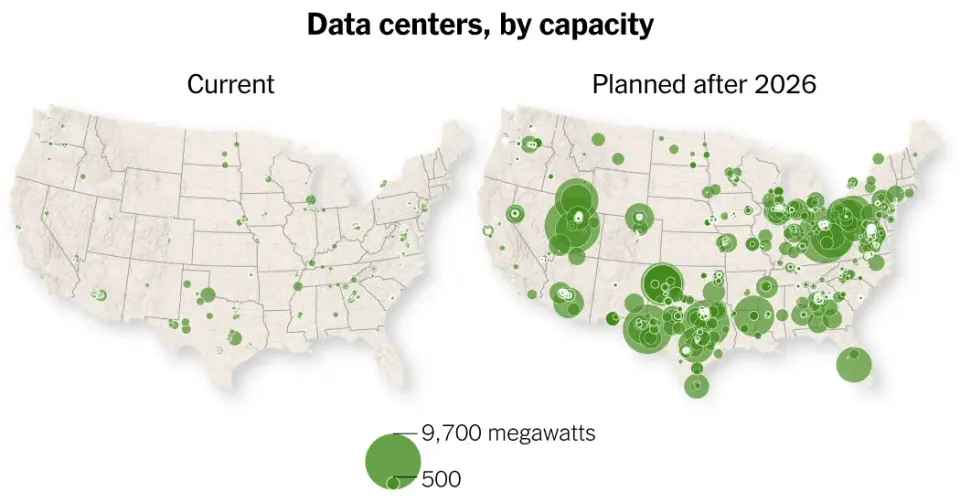
A massive expansion of AI data centers is set to increase global computing power tenfold by 2028, driven by the belief that scaling infrastructure directly correlates with advanced AI capabilities. This surge, comparable to historical infrastructure booms, is intensifying geopolitical competition between the U.S. and China while raising concerns about energy consumption, environmental impact, and potential economic bubbles.
Key points
- Global AI chip capacity is projected to reach 200 million H100 equivalents by late 2028, up from 20 million currently, doubling every nine months.
- U.S. companies control approximately 80% of global AI computing power, with Amazon, Google, Microsoft, Meta, and Oracle spending $750 billion on infrastructure this year.
- China is accelerating its own infrastructure build-out to close the gap, with Huawei, ByteDance, and Alibaba investing $111 billion, though U.S. export controls remain a significant hurdle.
- Data center electricity consumption is expected to quadruple by 2030, potentially exceeding the combined power usage of South America and Africa.
- Public backlash is growing over environmental and energy costs, with data centers becoming a key issue in U.S. midterm elections.
Background
Recent coverage has highlighted the environmental scrutiny surrounding AI data centers, including water usage and energy demands, as well as specific large-scale projects like Meta's $9 billion facility in Alberta. The current expansion represents a significant escalation of these infrastructure trends, moving from individual large facilities to a global-scale build-out that rivals historical industrial projects.
Why it matters
The unprecedented scale of AI infrastructure investment is reshaping global economic and geopolitical dynamics, potentially leading to a widening gap between nations with advanced computing power and those without. It also raises critical questions about sustainability, energy security, and the long-term economic viability of such massive capital expenditures.
What to watch
Investors and economists are watching for signs of a potential bubble, as past technological revolutions have been followed by downturns. The coming years will determine whether the massive capital outlay translates into widespread economic benefits or leads to a correction. Geopolitical tensions may also escalate as nations compete for dominance in AI capabilities.
- A Deluge of A.I. Computing Power Is About to Come Online, Fueling Major Leaps The New York Times
- COLUMNIST: Data Centers and My AI Thighs Shoreline Media Group
- Chips jolted as momentum shifts in AI TradingView
Want the full story? Read the original reporting
Read on The New York Times