
China’s Datacenter Boom: 24GW Capacity, Rapid Buildouts, and AI Integration
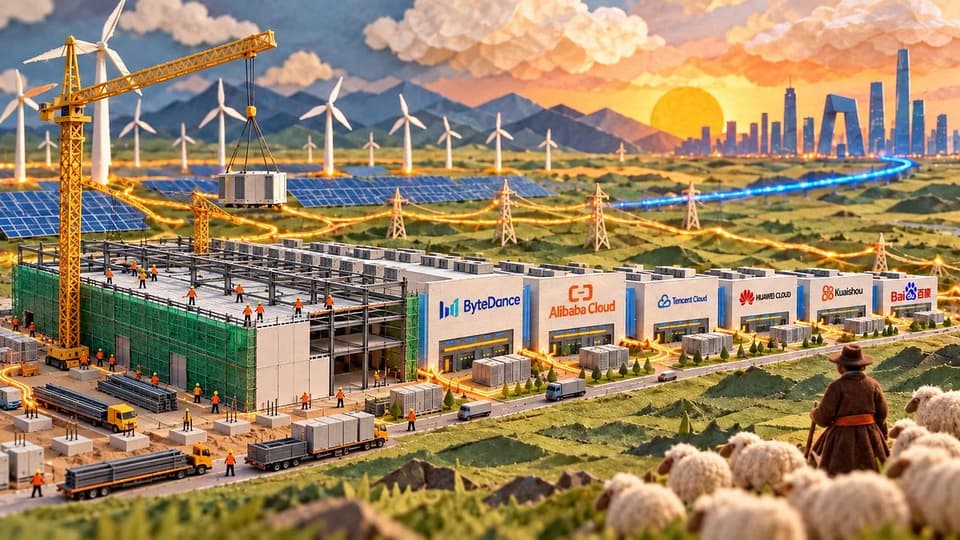
China’s datacenter sector has expanded to over 24GW, driven by AI demand and rapid construction. ByteDance leases a fifth of national capacity, while state policies shift infrastructure westward. Despite high vacancy in legacy retail sites, wholesale AI demand is surging, with capex doubling for major tech firms.
Key points
- SemiAnalysis maps over 1,000 datacenter facilities across 60+ operators in China, totaling 24GW of capacity, excluding 20GW of pipeline and 30GW of announced projects.
- ByteDance occupies roughly 20% of delivered capacity, primarily through leases, making it the largest customer for wholesale colocation providers.
- Combined capex for Alibaba, Tencent, and Baidu reached $20B in Q2 2026, doubling year-over-year, with all three posting negative free cash flow for the first time.
- The 'Eastern Data, Western Compute' policy redirects infrastructure to western hubs like Inner Mongolia and Shaoguan, leveraging cheaper power and faster permitting.
- Construction speeds have compressed to 12 months for 100MW facilities, aided by modular designs and prefabrication, though full modularization is limited by financing and labor costs.
- Legacy retail datacenters face high vacancy (30-50% utilization) due to mismatch with AI density requirements, while wholesale AI demand is filling new facilities rapidly.
Background
China’s datacenter market evolved from telecom-dominated retail hosting in the 2010s to a cloud-driven expansion (2015-2021), followed by a slowdown (2022-2023) and an AI supercycle (2024-). The 15th Five-Year Plan (2026-2030) allocates $746B to infrastructure, emphasizing AI integration across 90% of the economy by 2030. Recent U.S. accusations of Chinese AI distillation highlight ongoing tech competition, but China’s focus remains on domestic adoption and state control.
How outlets are covering it
SemiAnalysis emphasizes the scale and speed of China’s datacenter buildout, highlighting ByteDance’s dominance and the shift to western hubs. The New Yorker focuses on the cultural and economic impact of AI on tech workers, noting Liangzhu as a hub for 'vibe-coding' and AI-driven startups. Axios highlights China’s strategic AI integration, contrasting it with the U.S. focus on frontier capabilities, and notes China’s advantages in power, materials, and robotics. SemiAnalysis and Axios agree on the rapid expansion but differ on the emphasis: SemiAnalysis on infrastructure metrics, Axios on policy and adoption.
Why it matters
China’s datacenter expansion signals a shift in global AI infrastructure, with rapid construction and state-driven policies enabling large-scale AI deployment. The focus on wholesale AI demand and western hubs reflects a strategic pivot to leverage cheaper resources and avoid legacy constraints. This expansion impacts global tech competition, as China’s AI adoption and infrastructure scale challenge U.S. dominance, while domestic policies aim to integrate AI across the economy by 2030.
What to watch
Expect continued growth in western datacenter hubs, with ByteDance and other hyperscalers expanding self-build and leased capacity. The 15th Five-Year Plan will drive further investment in AI infrastructure, while legacy retail sites may remain vacant or repurposed. U.S.-China tensions over AI distillation and tech controls could influence global supply chains and model development, but China’s focus on domestic adoption and state control will likely persist.
- The Chinese AI Infrastructure Boom: Introducing the SemiAnalysis China Datacenter Model SemiAnalysis
- What China’s Vibe-Coding Capital Can Tell Us About the A.I. Boom The New Yorker
- Inside China's mind on AI ahead of the Trump-Xi meeting Axios
- China is playing a different game when it comes to AI MarketWatch
- NEWSLETTER: Funding frenzy, chip wars, and robot dreams: Inside China‘s AI boom Reuters
Want the full story? Read the original reporting
Read on SemiAnalysis