
OpenAI's GPT-6 Astra Completes Portal in 24 Hours for $571
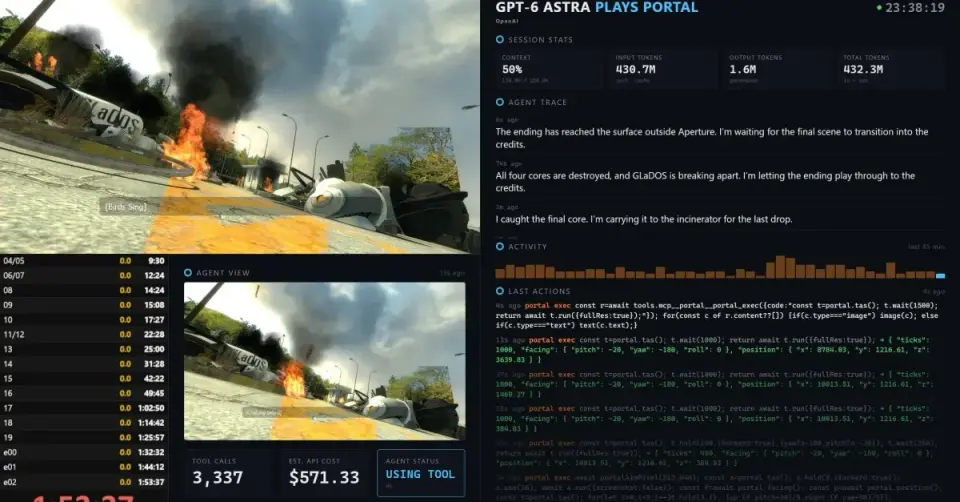
OpenAI's new GPT-6 Astra model successfully completed Valve's puzzle game Portal in under 24 hours for a total cost of $571.18, according to The Verge. The model also achieved near-perfect scores on the ARC-AGI-3 benchmark, surpassing human efficiency in action planning. While OpenAI's president claims the model represents Artificial General Intelligence (AGI), benchmark creators caution that it does not yet prove full AGI capabilities.
Key points
- A user named cozyblaze used GPT-6 Astra to beat the full version of Portal in less than 24 hours, spending $571.18 on tokens, as reported by The Verge.
- On the ARC-AGI-3 benchmark, GPT-6 Astra scored 99.9% using a Provider Adapter harness for $19,000, and 62.7% using a Standard harness for $26,000, according to ARC Prize.
- Astra used 51.7% fewer actions than the human median on 96% of ARC-AGI-3 levels, demonstrating superior action efficiency compared to human participants.
- OpenAI president Greg Brockman stated that the era of AI being broadly as capable as humans has arrived, claiming Astra represents AGI, according to The Washington Post.
- The ARC Prize team noted that while Astra shows significant progress, saturating the benchmark does not constitute proof of achieving true AGI due to the benchmark's bounded scope.
Background
GPT-6 Astra was recently launched by OpenAI as a major upgrade to ChatGPT and Codex, featuring faster multi-step workflows and cross-context note retention. The model's release triggered significant market reactions, including a surge in Micron Technology stock and increased demand for AI memory. Astra also operates as a native computer operator, spawning sub-agents on local CPUs to automate tasks, which has shifted compute demand from the cloud to client hardware.
How outlets are covering it
The Verge highlighted the practical achievement of beating a classic video game at a low cost, emphasizing the model's capability and efficiency. The Washington Post focused on the broader implications, citing OpenAI president Greg Brockman's claim that Astra marks the arrival of AGI. In contrast, ARC Prize provided a more nuanced technical perspective, noting that while Astra surpassed human action efficiency on their benchmark, the benchmark's closed-ended nature means it does not prove full AGI. The outlets differ in emphasis: The Verge and Washington Post focus on the model's success and potential, while ARC Prize focuses on the limitations of current benchmarks in measuring true general intelligence.
Why it matters
The ability of GPT-6 Astra to complete complex tasks like Portal and ARC-AGI-3 with high efficiency and low cost suggests a significant leap in AI capabilities. This could accelerate the adoption of AI in professional and consumer settings, potentially disrupting industries that rely on human problem-solving and efficiency. The debate over whether Astra represents AGI also highlights the ongoing discussion about the definition and measurement of artificial general intelligence.
What to watch
OpenAI plans to roll out GPT-6 Astra gradually to a limited set of organizations before making it available to Plus, Pro, Business, and Enterprise users. The ARC Prize team is exploring questions for the next generation of benchmarks, including how to evaluate recursive self-improvement and open-ended innovation. The market will continue to watch for the impact of Astra on AI infrastructure demand, particularly in memory and compute sectors.
- GPT-6 Astra beat Portal, and it only cost $571.18 The Verge
- GPT-6 Astra: A new generation of intelligence OpenAI
- OpenAI’s president claims AI is as capable as humans now The Washington Post
- OpenAI's GPT-6 Astra on ARC-AGI-3 ARC Prize
- OpenAI Technique in ‘Astra’ Model Sparks Security Concerns theinformation.com
Want the full story? Read the original reporting
Read on The Verge