
IBM Unveils World’s First Dual-ISA Mainframe Core for Z and Arm
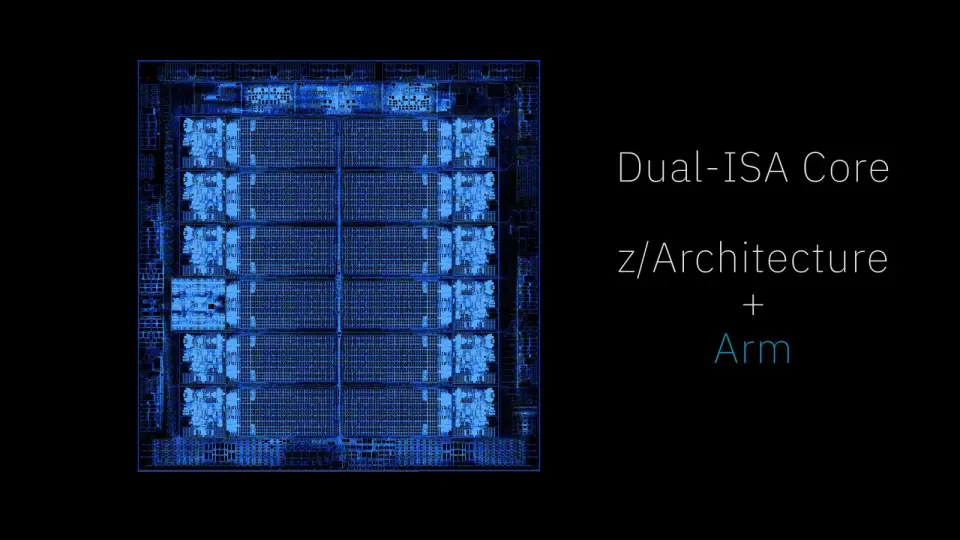
IBM has announced the world’s first dual-Instruction Set Architecture (ISA) processor core, designed to natively execute both IBM Z and Arm instructions on the same chip. Presented at Hot Chips 2026, this next-generation processor for IBM Z and LinuxOne systems will feature 11 cores running at over 5.7 GHz on a 2nm process node. The design integrates Arm capabilities directly into mainframe cores rather than using separate cores or emulation, aiming to combine the Arm software ecosystem with IBM’s enterprise security and reliability. The chip includes AI accelerators, a dedicated data processing unit, and a large cache hierarchy, with tape-out scheduled soon.
Key points
- IBM’s Christian Jacobi revealed the first dual-ISA core at Hot Chips 2026, enabling simultaneous execution of z/Architecture and AArch64 instructions.
- The new processor uses a 2nm process node and features 11 cores clocked above 5.7 GHz, with a 36 MB private L2 cache and a virtual L3/L4 cache structure reaching 3.5 GB.
- The chip includes on-chip AI inference accelerators for fraud detection, a dedicated DPU for I/O, and hardware-level fault detection and recovery.
- IBM Z and LinuxOne currently handle 68% of global production IT workloads, with 77 of the top 100 banks using these platforms.
- The design allows KVM virtualization to run both S390X/Z and Arm64 architectures, facilitating Linux workloads adjacent to core z/OS operations.
Background
This announcement follows IBM’s April 2026 collaboration with Arm, marking the first major milestone from that partnership. It also comes after IBM’s July 2026 financial results, which indicated a strategic shift in capital expenditure toward hardware to support AI infrastructure, despite initial software stock market reactions. The move aligns with broader industry trends where Arm is becoming the dominant architecture for AI and cloud-native applications, as noted by Arm executives during the reveal.
How outlets are covering it
Wccftech emphasizes the technical novelty of the dual-ISA core, highlighting that it is not an emulation or a multi-core design like Intel’s P/E cores, but a true integration of Arm into the mainframe core. IBM’s official newsroom focuses on the strategic benefit of expanding software choice for enterprises, citing the 22 million developers in the Arm ecosystem and the ability to run Arm-native Linux alongside z/OS. Both sources agree on the core specifications, but IBM places greater weight on the security and reliability advantages for regulated industries, while Wccftech details the specific cache and accelerator architectures. IBM notes that no other OS support is planned currently, whereas Wccftech mentions ongoing discussions with partners for future integration possibilities.
Why it matters
This processor represents a significant shift in enterprise computing by allowing mainframes to natively run Arm-based applications, including AI and cloud-native software, without compromising the security and reliability that define IBM Z and LinuxOne. It could reduce the need for separate infrastructure for Arm workloads, streamline application modernization, and provide enterprises with greater flexibility in deploying AI within mission-critical environments. The move also signals IBM’s commitment to integrating emerging architectures into its legacy platforms, potentially influencing the future of hybrid cloud and AI infrastructure in highly regulated sectors.
What to watch
IBM is preparing to send the chip to tape-out, with the full product expected to be a few years away. The company will continue to work with clients and partners to explore additional integration areas beyond the current z/OS and Linux support. Enterprises can expect to see the first systems with this dual-architecture core in future IBM Z and LinuxOne releases, potentially accelerating the adoption of Arm-based AI and cloud applications in mainframe environments.
- IBM Details The World’s First Dual-Architecture Processor As It Builds Its Next-Gen Dual ISA Core That Natively Executes Z & Arm Software On The Same Chip Wccftech
- IBM Unveils Next Generation Dual-Architecture Processor for IBM Z and LinuxONE IBM Newsroom
- IBM’s next-gen mainframe chip is the first to run Arm and Z workloads on the same cores VentureBeat
- IBM and Arm: Expanding the Arm ecosystem for the next era of enterprise computing Arm Newsroom
- IBM unveils first dual-architecture mainframe processor with Arm tech (IBM:NYSE) Seeking Alpha
Want the full story? Read the original reporting
Read on Wccftech