
Nvidia names Colette Kress interim CEO after Huang’s resignation amid espionage probe
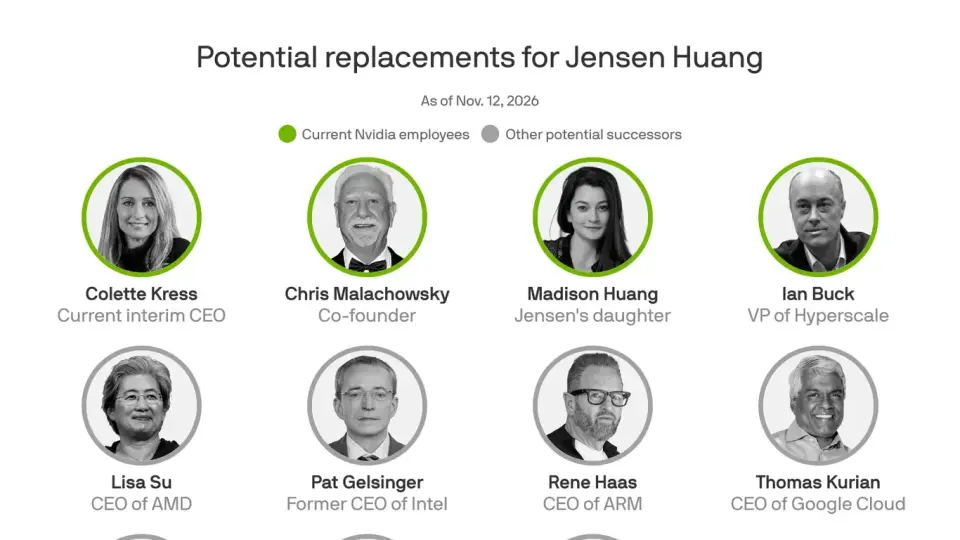
Nvidia appointed CFO Colette Kress as interim CEO following the immediate resignation of founder Jensen Huang on November 12, 2026. The board, now chaired by Harvey Jones, is searching for a permanent successor from both internal and external pools. Huang’s departure followed a scandal involving extramarital affairs, including one with a woman suspected of being a Chinese intelligence asset. While Asian chip partners expect near-term supply stability, analysts warn that the leadership vacuum creates uncertainty for Nvidia’s long-term product roadmap and strategic direction.
Key points
- Nvidia’s board appointed CFO Colette Kress as interim CEO and named Harvey Jones as the company’s first board chair following Huang’s resignation.
- The board is conducting a search for a permanent CEO, considering both internal candidates like Ian Buck and external figures such as Arm’s Rene Haas and Apple’s Tim Cook.
- Huang’s resignation followed reports of affairs with a subordinate and Alice Huang, a Chinese businesswoman suspected by some US officials of being a spy, though intelligence agencies have not reached a definitive conclusion.
- Asian semiconductor partners, including TSMC and Samsung, expect their supply relationships with Nvidia to remain intact in the short term, but long-term strategic uncertainty persists.
- US intelligence officials are divided on whether Alice Huang acted as a spy, with some citing her career pivot and access to Huang as red flags, while others note the lack of conclusive evidence.
Background
This follows earlier reports that Huang’s departure triggered a significant market value loss and intensified scrutiny of Nvidia’s governance. Previous coverage noted that AMD CEO Lisa Su emerged as a potential external successor due to her track record in semiconductor leadership. The current transition occurs against a backdrop of ongoing investigations into the diversion of restricted AI chips to China via foreign shell companies.
How outlets are covering it
Axios highlights the need for political savvy in the next CEO, listing 11 potential successors ranging from internal leaders like Kress and Ian Buck to external figures like Tim Cook and Lisa Su. CNBC focuses on the impact for Asian chipmakers, noting that while near-term supply chains are stable, long-term product roadmap uncertainty is a concern for partners like TSMC and Samsung. CNN emphasizes the national security dimension, detailing the US intelligence community’s disagreement over whether Alice Huang was a spy, with some officials viewing her as a clear risk due to her access to Huang, while others argue the evidence is insufficient. Nvidia’s official statement confirms the transition and assures that operations and customer commitments will continue without interruption, with Kress pledging to build on the foundation Huang created.
Why it matters
The leadership transition at Nvidia, the world’s leader in AI chips, creates uncertainty for global supply chains and AI development. The potential for a new CEO to alter strategic priorities or partnerships could impact the competitive landscape with rivals like AMD and Intel. Additionally, the unresolved questions regarding national security and chip diversion to China may influence US regulatory policies and international trade relations in the semiconductor sector.
What to watch
The board will continue its search for a permanent CEO, potentially involving an outside recruitment firm. Nvidia is scheduled to report its third-quarter fiscal 2027 financial results on November 17. US intelligence agencies will continue their investigation into Alice Huang and the potential diversion of chips to China, which may lead to further regulatory actions or policy changes regarding AI chip exports.
- 11 names to watch in the Jensen Huang succession search Axios
- EXCLUSIVE: Former Nvidia CEO Huang had a relationship with a second employee, sources say Reuters
- Nvidia without Jensen Huang. What lies ahead for Asian chipmakers? CNBC
- NVIDIA Announces CEO Transition NVIDIA Newsroom
- US intel isn’t sure if businesswoman spied on Nvidia for China, doesn’t mean she wasn’t a risk, sources say CNN
Want the full story? Read the original reporting
Read on Axios