
Nvidia's Groq 3 LPX enters production to accelerate AI agent inference
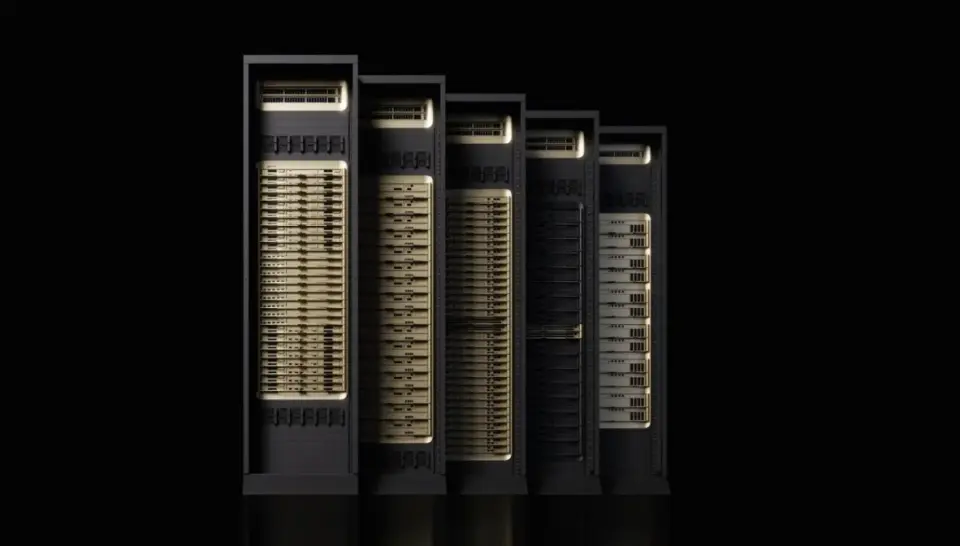
Nvidia has announced that its Groq 3 LPX inference accelerator is now in full production, marking the commercialization of technology acquired in a $20 billion deal with Groq Inc. in December 2025. The chip, unveiled at Hot Chips 2026, is designed to extend the Vera Rubin platform by handling high-latency decode workloads for autonomous AI agents. Nebius Group is the first customer, planning to deploy the technology in its Token Factory. Benchmarks show the system achieving 3,400 tokens per second, a four-fold improvement over competitors for specific tasks.
Key points
- Nvidia's Groq 3 LPX accelerator is now in full production, serving as a dedicated inference engine for agentic AI workloads.
- The technology was acquired from Groq Inc. for $20 billion in December 2025, Nvidia's largest acquisition to date.
- Nebius Group is the first customer, integrating the chips into its Nebius Token Factory for production inference.
- Benchmarks by Artificial Analysis show the system achieving 3,400 tokens per second on the Gemma 4 31B model with a 100,000-token context.
- The architecture uses 256 LPUs per rack, each with 500 MB of SRAM, to offload decode tasks from Vera Rubin GPUs.
Background
Nvidia previously announced the Vera Rubin platform in March 2026, projecting $1 trillion in cumulative sales through 2027. The company had also acquired Groq's technology and key personnel, including founder Jonathan Ross, in a deal finalized in December 2025. This move follows a trend of AI cloud providers seeking specialized hardware to reduce latency in complex, multi-step agent tasks.
How outlets are covering it
SiliconANGLE and Nvidia emphasize the strategic importance of the LPX in enabling real-time agentic workflows, highlighting the 3,400 tokens per second benchmark as a record-breaking achievement. CNBC focuses on the commercial implications, noting that low-latency inference allows cloud providers to charge premium rates for responsive services. The Register offers a more critical technical view, questioning the scalability of the SRAM-heavy design for larger models and noting that Cerebras' newer accelerators may challenge Nvidia's performance lead. While Nvidia frames the LPX as a complement to its GPUs, The Register points out that the benchmark uses a relatively small, dense model, which may not reflect performance on larger Mixture-of-Experts architectures.
Why it matters
The launch of the Groq 3 LPX signals a shift in AI infrastructure toward specialized, disaggregated architectures that separate context processing from token generation. This approach aims to eliminate latency bottlenecks in autonomous agents, potentially transforming how enterprises deploy AI for coding, reasoning, and tool execution. The success of this model could define the next generation of AI data centers, moving beyond general-purpose GPUs toward optimized inference engines.
What to watch
Nvidia expects the Groq 3 LPX racks to be online later this year at Nebius. The company is also ramping up shipments of its Vera Rubin systems, with SpaceX announced as a new customer for the platform. Nvidia will report earnings on Wednesday, which may provide further insight into the commercial traction of its new inference stack.
- Nvidia's dedicated inference accelerator Groq 3 LPX enters full production to supercharge AI agents SiliconANGLE
- Nvidia says Groq racks will be online this year following $20 billion purchase CNBC
- NVIDIA Groq 3 LPX Now in Full Production With World-Class Speed for Agentic AI NVIDIA Newsroom
- What Nvidia's first Groq 3 LPU benchmarks tell us about its $20B gamble The Register
- Nvidia’s $20 Billion Groq Bet Is Going Live Before the End of 2026. Here’s What It Means for Investors. The Motley Fool
Want the full story? Read the original reporting
Read on SiliconANGLE