
Tesla FSD v15 Launches Amid Hardware Constraints and Mixed Market Reactions
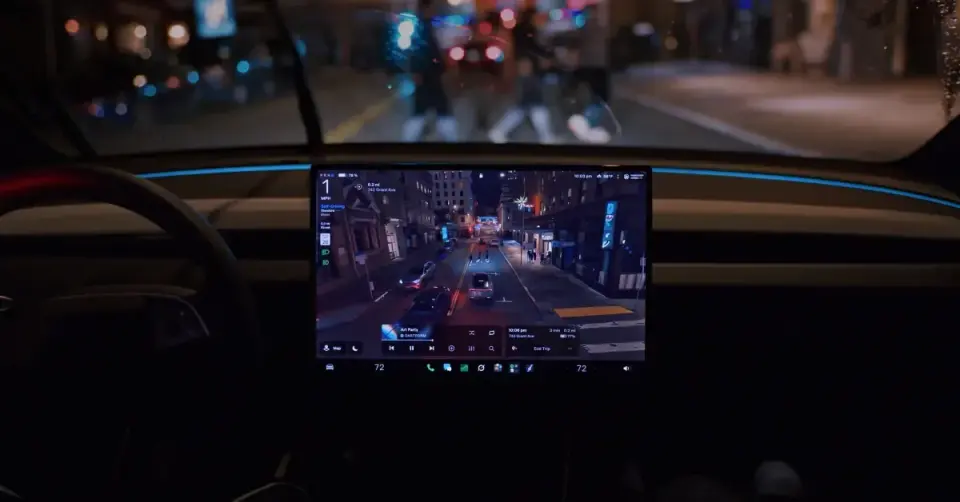
Tesla has begun rolling out Full Self-Driving (FSD) version 15, featuring a new 'Reality View' visualization that renders the vehicle's surroundings in a video-game style. While the update claims a 25-fold improvement in handling safety-critical cases, it is currently limited to early testers with a wider release scheduled for December. The software update highlights significant compute constraints on Tesla's current AI4 hardware, as Elon Musk confirmed that the next-generation AI5 chip will not be available for cars, only for robots and data centers. Market reactions are divided, with some analysts viewing the release as a competitive advantage, while others question the lack of baseline data for safety claims and the potential for overcautious driving behavior.
Key points
- FSD v15 introduces 'Reality View,' a real-time AI-generated visualization of the car's environment, which Musk described as using only half of one AI4 TRIP accelerator due to compute limitations.
- Tesla claims the update offers a 25x improvement in handling safety-critical cases, but has not disclosed baseline metrics or absolute numbers of interventions, a point criticized by Electrek and Car and Driver.
- Elon Musk confirmed that the next-generation AI5 chip, described as having roughly 12x more compute, will be reserved for Optimus robots and data centers, not consumer vehicles, which will remain on AI4 or the updated AI4.5.
- The AI4.5 hardware refresh, initially announced with 32GB of RAM, was reduced to 24GB due to memory costs and bandwidth constraints, indicating that the upgrade is primarily a memory swap rather than a significant performance boost.
- Early user reports from Reddit suggest FSD v15 may be overly cautious, aggressively avoiding random items or reacting to road repairs as if they were potholes, though Tesla notes that early updates often improve with broader rollout.
Background
Tesla has historically promised that its current hardware would be sufficient for unsupervised self-driving, a claim that faced scrutiny when HW3 owners were left waiting for upgrades. The recent rollout of FSD v15 follows previous updates that introduced features like 'Bike Rack Mode' and improved detection of potholes and road signs. The current hardware constraints and the decision to reserve AI5 for non-vehicle applications raise questions about the long-term viability of Tesla's autonomy strategy for its existing fleet.
How outlets are covering it
Electrek emphasizes the severe compute constraints of the AI4 hardware, noting that Musk admitted the 'Reality View' feature is running on leftover compute and that the AI4.5 refresh is primarily a memory swap due to cost and bandwidth issues. In contrast, Yahoo Finance highlights a bullish Wall Street stance, with JPMorgan analyst Rajat Gupta viewing the v15 release as evidence of Tesla's head start in consumer autonomy compared to competitors like Rivian, Ford, and GM. Car and Driver focuses on the user experience, noting that while the graphics are impressive, early reports suggest the system may be overcautious, and questions the lack of baseline data for Tesla's safety claims. These differing perspectives highlight the tension between technical limitations, market optimism, and user experience.
Why it matters
The FSD v15 rollout is critical for Tesla's autonomy strategy, as it represents the last major software update for the AI4 hardware before the shift to AI5, which is now reserved for robots and data centers. The lack of baseline data for safety claims and the potential for overcautious driving behavior could impact consumer trust and regulatory scrutiny. Additionally, the hardware constraints and the decision to reserve AI5 for non-vehicle applications raise questions about the long-term viability of Tesla's autonomy strategy for its existing fleet, potentially affecting stock prices and investor confidence.
What to watch
Tesla is scheduled to roll out FSD v15 to a wider audience in December, alongside the 2026 Holiday Update. The company will likely continue to refine the software based on user feedback and early reports of overcautious behavior. The AI4.5 hardware refresh, with 24GB of RAM, is expected to be more widely available, but its impact on performance will be limited by memory bandwidth constraints. The next major hardware update, AI5, is not expected to reach consumer vehicles until at least 2027, with volume production delayed to the second half of 2027 due to Samsung's Texas fab timeline.
- Tesla FSD v15 is AI4’s last shot as Musk reveals how little compute is left Electrek
- Tesla's autonomy ambitions just got a Wall Street vote of confidence Yahoo Finance
- Tesla’s Latest Edition of Its Driver-Assistance Software Now Looks Like a Video Game Car and Driver
- Tesla FSD V15 Offers Stunning Visualizations That Distract From “25x” Forbes
- FSD V15 and the Front Bumper Camera: 5 Details That Matter BASENOR - Tesla Accessories
Want the full story? Read the original reporting
Read on Electrek