
Chicago unveils $2.25B private 'O'Hare Flyer' for 15-minute airport transit
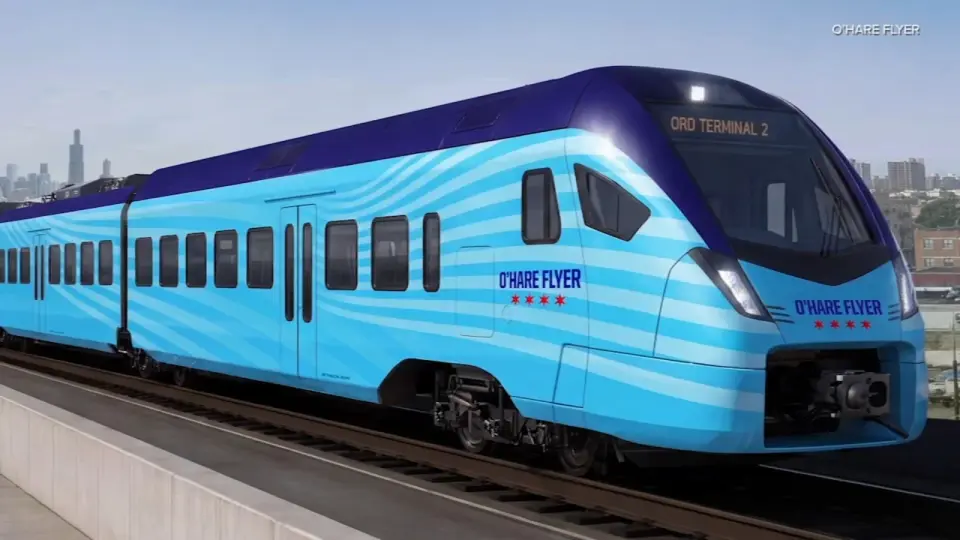
Chicago business leaders announced the 'O'Hare Flyer,' a privately funded $2.25 billion express train project designed to connect O'Hare International Airport to downtown Chicago in 15 minutes. The battery-electric service would utilize existing freight right-of-ways and the old post office building as a downtown terminus, aiming to launch within five years without government subsidies.
Key points
- The 'O'Hare Flyer' is a private initiative led by CEO Dave Lundy, with co-founder Mark Walbrun, to create a high-speed rail link between O'Hare and the Loop.
- The project is estimated at $2.25 billion and is financed through private investors and federal Railroad Rehabilitation and Improvement Financing loans, avoiding direct government subsidies.
- The route uses existing freight tracks from Union Pacific and Canadian National, with new construction required only for the final 1.5 miles to the airport terminals.
- The downtown terminus will be the Old Post Office on Van Buren Street, featuring a new covered walkway connecting to Union Station and the CTA Blue Line.
- Proponents aim to have the service operational within five years, offering a 30-minute time advantage over the CTA Blue Line.
- The trains are battery-electric, whisper-quiet, and designed to seat up to 450 passengers, with service running from 4 a.m. to 10 p.m.
Background
This announcement follows earlier private proposals for express airport transit in Chicago, including an unrealized 2018 concept by the Boring Company. The project addresses long-standing concerns about traffic congestion on the Kennedy Expressway and the lack of a direct, high-speed rail connection between Chicago's major airport and its central business district, a feature common in many global cities.
How outlets are covering it
ABC7 Chicago and the Chicago Sun-Times reported the announcement as a significant step toward modernizing Chicago's transit infrastructure, emphasizing the private funding model and the use of existing freight corridors. The Chicago Tribune, in an editorial, expressed strong support for the project, calling it a necessary upgrade for a world-class city, but warned of potential bureaucratic delays, union demands, and NIMBY opposition. While ABC7 focused on the speed and private nature of the project, the Tribune highlighted the need for strong city leadership to navigate regulatory hurdles and ensure the project's success, noting that no U.S. city currently has a comparable express airport train.
Why it matters
The O'Hare Flyer could significantly reduce travel time for business and leisure travelers, alleviate traffic congestion on major highways, and enhance Chicago's competitiveness as a global hub. Its success would demonstrate a viable model for private-public infrastructure development in the U.S., potentially influencing future transit projects in other cities.
What to watch
The project team must finalize right-of-way agreements with Union Pacific and Canadian National and secure necessary federal and local approvals. The Chicago Tribune urged Mayor Brandon Johnson to appoint a dedicated project manager to streamline the process and overcome potential bureaucratic obstacles. The goal is to have the train operational within five years, with construction expected to begin after regulatory clearances are obtained.
- Plans unveiled for 15 minute express 'O'Hare Flyer' trains from airport to downtown ABC7 Chicago
- O'Hare to the Loop in 15 minutes? This company thinks it can finally bring fast rail to Chicago Chicago Sun-Times
- Private group announces plans for new express train connecting downtown, O’Hare WGN-TV
- A 15-minute train to O’Hare? This group thinks it’s finally cracked the code. Crain's Chicago Business
- Editorial: An express train from the Loop to O'Hare International Airport in 15 minutes? We're on board Chicago Tribune
Want the full story? Read the original reporting
Read on ABC7 Chicago