
Venice Biennale Awards Go to Nick Cave and India After Jury Resignation
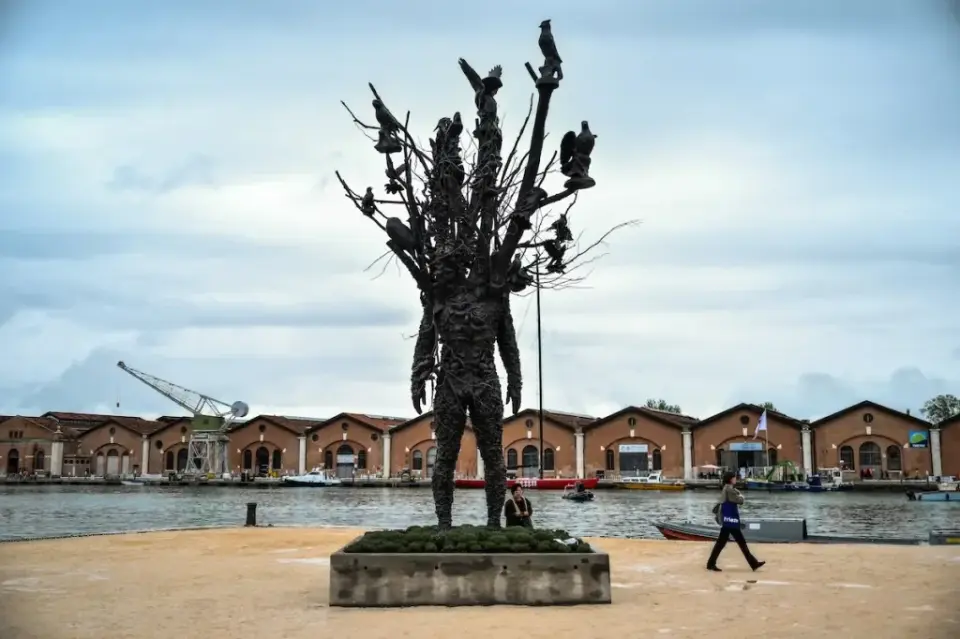
The Venice Biennale 2026 awarded its top honors, the Visitors’ Lions, to American sculptor Nick Cave and the Indian national pavilion. The awards were decided by public vote after the traditional jury resigned in protest over the inclusion of Israel and Russia. Cave won for his participation in the main exhibition, while India’s pavilion, curated by Amin Jaffer, won for its focus on memory and home. The decision followed a boycott by dozens of artists who refused to be considered for the awards in solidarity with the resigned jury.
Key points
- Nick Cave won the Visitors’ Lion for best artist in the main exhibition, 'In Minor Keys,' curated by Koyo Kouoh. His entry included the 26-foot bronze sculpture 'Amalgam (Origin)' and the installation 'Two Points in Time – At Once,' which Cave described as addressing grief, rebirth, and the history of violence against Black individuals in the United States.
- India won the Visitors’ Lion for best national pavilion. The exhibition, 'Geographies of Distance: Remembering Home,' was curated by Amin Jaffer and featured works by Sumakshi Singh, Alwar Balasubramaniam, Ranjani Shettar, Asim Waqif, and Skarma Sonam Tashi. It was India’s first participation in the Biennale since 2019.
- The Visitors’ Lions replaced the Golden Lions after a five-person jury resigned in May 2026. The jury had stated it would not consider countries whose leaders were charged with crimes against humanity by the International Criminal Court, effectively excluding Israel and Russia.
- Dozens of artists and national pavilions boycotted the awards in solidarity with the jury, refusing to be considered for the Visitors’ Lions. The Biennale stated that all national participations were eligible, but the boycott reduced the pool of potential winners. The Biennale did not release a breakdown of the public votes.
- The 2026 Biennale closed on November 22 with 714,000 visitors, the second-highest attendance in the exhibition’s history. The Biennale president, Pietrangelo Buttafuoco, called the edition a success despite the controversy, citing the vibrant presence of visitors.
Background
The Venice Biennale is one of the world’s most important art events, featuring a main group exhibition and national pavilions. The 2026 edition was curated by Koyo Kouoh, who died in 2025 before the exhibition opened. The event was marked by protests over the participation of Israel and Russia, with many artists and institutions calling for their exclusion. The Biennale maintained that it could not exclude any nation recognized as a state by the Italian government. The European Union announced it would revoke a 2 million euro grant to the Biennale in protest of the Russian pavilion’s return.
How outlets are covering it
ARTnews and Artnet News reported the awards as a clear victory for Cave and India, emphasizing the public vote and the artists’ statements. The New York Times noted that it was unclear whether Cave and India secured the most votes, as many artists boycotted the awards and the Biennale did not release a breakdown of the votes. The Biennale’s official release did not include citations for the winners, likely because they were not selected by a jury. All sources agreed that the awards were a result of the jury’s resignation and the subsequent public vote, but they differed on the legitimacy of the process due to the boycott.
Why it matters
The 2026 Venice Biennale highlights the growing tension between artistic freedom and political neutrality in major cultural events. The jury’s resignation and the subsequent public vote reflect a shift in how art institutions respond to geopolitical conflicts. The awards also underscore the global reach of contemporary art, with India’s pavilion winning its first top honor in seven years and Nick Cave’s work addressing racial history and grief. The controversy over Israel and Russia’s participation may influence future decisions about which countries are allowed to participate in the Biennale and other international art events.
What to watch
The Venice Biennale 2026 has concluded, and the next edition is the Venice Architecture Biennale, scheduled to open on May 8, 2027. Debate has already begun over which countries should be allowed to participate in that event, with Poland and nine other European governments urging the exclusion of Russia. The Biennale’s stance on political neutrality may be tested again in 2027, as the organization seeks to balance artistic expression with geopolitical realities.
- Venice Biennale Awards Selected by Public Vote Go to Nick Cave, Indian Pavilion ARTnews.com
- India and U.S. Artist Nick Cave Win Venice Biennale’s Top Prizes The New York Times
- Visitors’ Lions of the Biennale Arte 2026 La Biennale di Venezia
- Nick Cave and India Win the Venice Biennale Visitors’ Awards Artnet News
- Venice Biennale visitors award top prizes to Nick Cave and India after jury quit AP News
Want the full story? Read the original reporting
Read on ARTnews.com