
A Statement: Tom McCarthy’s 1980 Climate Drama Premieres at NYFF
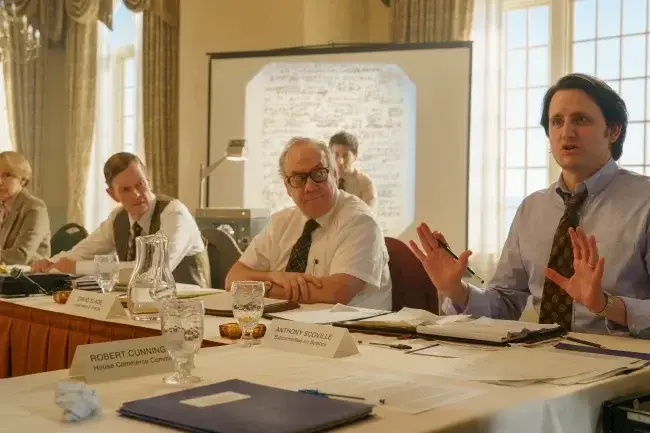
Tom McCarthy’s new film, A Statement, premiered at the 2026 New York Film Festival. The movie dramatizes a failed 1980 congressional conference on climate change, using verbatim transcripts to depict a 36-hour debate that ended without a consensus statement. Critics praise the acting and historical context but note the film’s static, talk-heavy format.
Key points
- A Statement is a 104-minute drama directed by Tom McCarthy, based on a 10-page section of Nathaniel Rich’s 2019 book, Losing Earth.
- The film depicts a 1980 conference at the Don CeSar Hotel in St. Petersburg, Florida, where 20 experts were tasked with creating a statement on CO2 emissions.
- The screenplay uses verbatim transcripts from the actual meeting, with the conference room scenes comprising roughly half of the film.
- The ensemble cast includes Paul Rudd, Paul Giamatti, Evan Peters, Amy Ryan, John Turturro, and Tatiana Maslany.
- The film premiered at the 2026 New York Film Festival and is set for a wider release in 2027 by Sony Pictures Classics.
Background
The 1980 conference depicted in A Statement took place just days before the election of Ronald Reagan. At the time, climate change was not yet a polarizing political issue, and experts generally agreed on the fundamental facts of the problem. The film serves as a historical look back at a time when expertise was trusted, before corporate greed and political expediency mired debate about rising CO2 levels in misinformation and inaction. This context is particularly relevant today, as the current administration has twice withdrawn from the Paris Agreement and embraced fossil fuels, making the film’s message about the failure of consensus all the more poignant.
How outlets are covering it
Critics are largely positive about A Statement, praising the ensemble cast and McCarthy’s direction. IndieWire’s Sabrina Lantos gives the film a B-, noting that while the talky format can be tedious, the film is a 'sobering, if muted, microcosm' of climate squabbling. The Hollywood Reporter’s David Rooney calls it 'talky but stimulating and incisively acted,' highlighting the 'excellent and uncommonly egalitarian ensemble cast.' Deadline’s Pete Hammond calls it a 'splendid humanist look at climate change,' noting that despite its density, it is 'entertaining, sly, humorous, enlightening, and even moving.' The Guardian’s review praises the 'outstanding climate change dramedy,' noting that the verbatim transcript adds a layer of 'historical accuracy' and 'thrill' to the viewing experience. All critics agree that the film’s failure to reach a consensus is a poignant reflection on the ongoing struggle to address climate change.
Why it matters
A Statement offers a historical perspective on the early stages of the climate change debate, showing how even in 1980, reaching consensus on action was difficult. The film’s use of verbatim transcripts and its focus on the human dynamics of the conference provide a unique insight into the challenges of addressing a global issue. In the context of today’s political climate, where the US has withdrawn from the Paris Agreement and embraced fossil fuels, the film’s message about the failure of consensus is all the more relevant. It serves as a reminder that the struggle to address climate change is not new, and that the challenges of reaching agreement and taking action are as relevant today as they were 46 years ago.
What to watch
A Statement is set for a wider release in 2027 by Sony Pictures Classics. The film’s success at the New York Film Festival and the positive critical reception suggest that it may find a wider audience in the coming year. The film’s focus on the human dynamics of the climate change debate and its use of verbatim transcripts may make it a unique and compelling addition to the growing body of climate change cinema.
- 'A Statement' Review: Tom McCarthy's Talky Climate Crisis Seriocomedy IndieWire
- 'A Statement' Review: Paul Rudd in Tom McCarthy's Climate Docu-Drama The Hollywood Reporter
- 'A Statement' Review: Tom McCarthy, Paul Rudd, Paul Giamatti, Amy Ryan Deadline
- A Statement review – outstanding climate change dramedy about a 1980 meeting The Guardian
- ‘A Statement’: Oscar Winner Tom McCarthy Flames Out With New Film The Daily Beast
Want the full story? Read the original reporting
Read on IndieWire