
Paris Unveils Plaque Marking the Exact Spot of the First Photographed Humans
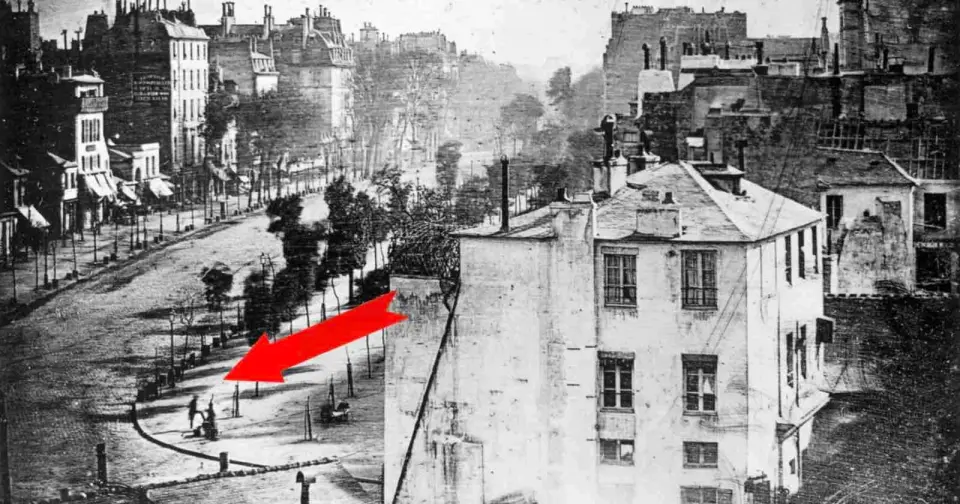
Researchers have identified the precise location in Paris where the first humans were ever captured in a photograph. A bronze plaque was installed at Place de la République to mark the spot where a shoeshine boy and his client stood during Louis Daguerre's 1838 exposure. The discovery, which took two years of archival research and 3D modeling, coincides with the bicentennial of photography.
Key points
- Maximilien Van Aertryck, Axel Danielson, and Kalle Boman spent two years analyzing archives to locate the exact position of the subjects in Daguerre's 1838 'View of the Boulevard du Temple.'
- The team discovered that the archived daguerreotype was reversed, requiring them to reconstruct the 1838 street layout using historical records and 3D models.
- Only three buildings from the original neighborhood survived Haussmann's redevelopment, serving as reference points for two architectural firms to triangulate the location.
- A bronze plaque titled 'An Unexpected Detail' was installed by the City of Paris on October 15, 2026, near the center of Place de la Republic.
- The original daguerreotype plate was damaged in World War II, and researchers are currently searching for a negative sent to the Museum of Modern Art in 1937 to better understand the original image.
Background
This development follows the bicentennial of photography in France. While previous archive entries covered unrelated scientific breakthroughs in seismology and medical technology, this story focuses on the historical preservation of the earliest photographic evidence of human presence. The research builds on the known fact that Daguerre's 1838 image is the first to capture human figures, a milestone in the history of visual media.
How outlets are covering it
PetaPixel emphasizes the technical achievement of the researchers, highlighting the use of 3D models and the discovery that the original image was a mirror image. Smithsonian Magazine focuses on the narrative aspect, describing the 'poetic' nature of the two figures and the collaborative effort between French and Swedish architectural firms to determine the exact spot. Le Monde frames the event as a tribute to the bicentennial of photography, noting the cultural significance of marking the site of the first 'social interaction and labor' captured in a photograph. All sources agree on the installation of the plaque but differ in their emphasis on the technical versus cultural implications of the discovery.
Why it matters
This discovery provides a tangible link to the origins of photography, allowing the public to engage with the history of the medium at a specific physical location. It also highlights the ongoing effort to preserve and understand early photographic artifacts, particularly as the original daguerreotype plate is damaged and the search for a negative continues.
What to watch
Researchers are continuing their investigation to locate the negative of the daguerreotype, which was sent to the Museum of Modern Art in 1937. They are cross-referencing letters and collaborating with the Bavarian National Museum and the Getty Center to trace the negative's current location.
- Researchers Pinpoint the Exact Location of First Ever Photo of a Human PetaPixel
- In 1838 the World’s First Photo of Humans Was Taken in Paris. 188 Years Later, Its Exact Location Has Finally Been Found People.com
- Where Exactly Were the First Humans to Be Captured in a Photograph Standing? Three Obsessed Filmmakers Solved the Nearly 200-Year-Old Mystery Smithsonian Magazine
- 188-Year-Old Mystery of Photography’s First Human Subjects Solved Artnet News
- Bicentenary of photography: In search of the first person in a photograph Le Monde.fr
Want the full story? Read the original reporting
Read on PetaPixel