
Spotify to Badge and Deprioritize AI Artist Personas Starting September
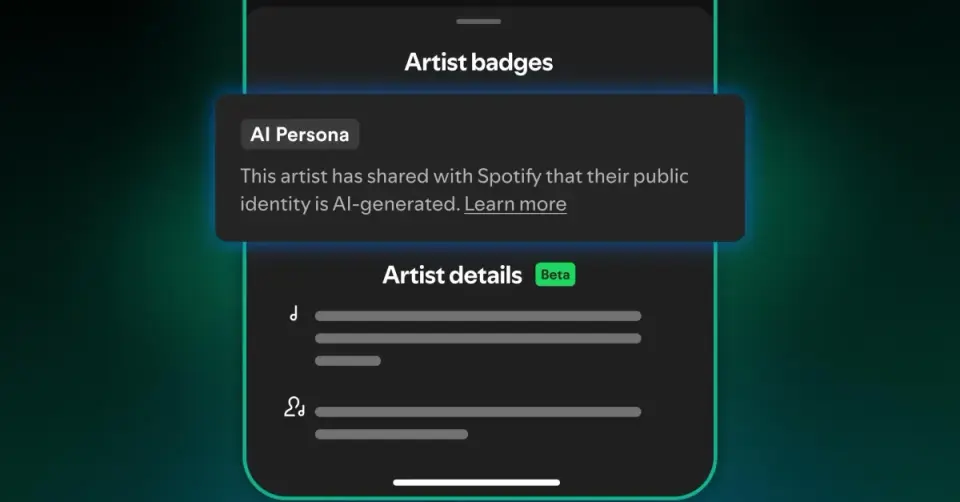
Spotify will introduce an 'AI Persona' badge in mid-September to flag artist profiles that do not represent real humans. Music from these profiles will be excluded from editorial and algorithmic recommendations by default, though users can still follow them. The platform will use both self-disclosure and automated review to identify these identities, prioritizing high-traffic profiles.
Key points
- Spotify is launching an 'AI Persona' badge in mid-September to identify artist profiles that appear to be AI-generated rather than real humans.
- Music from flagged AI Personas will not appear in Spotify’s editorial or algorithmic recommendations by default, though listeners can opt-in by following the artist.
- The policy relies on a mix of voluntary self-disclosure by artists and Spotify’s own human and AI-driven review of profile names and imagery.
- Spotify will prioritize reviewing profiles that meet specific audience thresholds to ensure the most listened-to artists are covered first.
- Artists flagged by Spotify will be notified and given the opportunity to appeal the decision or formally disclose their status.
Background
This move follows Spotify’s 2026 rollout of 'Verified by Spotify' badges and AI Credits, which aim to distinguish authentic human artists from AI-generated content. The platform previously removed 75 million spam tracks in a year, reflecting a broader industry effort to combat AI slop. Competitor Deezer has also noted that AI-generated tracks now constitute half of its daily uploads, highlighting the scale of the issue across streaming services.
How outlets are covering it
The Verge and Rolling Stone emphasize the technical mechanics of the badge, noting it applies to identity rather than the music creation process itself. The Guardian highlights the consumer trust angle, citing specific examples like the Velvet Sundown and Sienna Rose, and notes that Spotify’s legitimate catalog stands at 100 million tracks. Spotify’s official statement frames the change as a necessary step for 'authenticity' and 'trust,' arguing that listeners dislike discovering that a seemingly human profile is actually an AI construct. All sources agree that the policy is a response to the flood of AI-generated content, but Spotify’s official channel provides the most detailed breakdown of the broader 'Artist Identity & Trust' initiative, including SongDNA and Artist Profile Protection.
Why it matters
This policy marks a significant shift in how major streaming platforms regulate AI-generated content, moving from voluntary disclosure to active identification and deprioritization. By excluding AI Personas from recommendations, Spotify aims to protect human artists from losing streams to artificial rivals and to maintain listener trust. It sets a precedent for how the music industry will handle the boundary between human and machine-generated identities in the coming years.
What to watch
Spotify plans to introduce a feature in the coming months that allows listeners to flag artist profiles they believe are AI-generated. The company will also continue to refine its review processes and may expand the scope of its AI-related tools as the landscape of AI music evolves.
- Spotify says it won’t recommend music from ‘AI Personas’ The Verge
- Spotify to distinguish AI artists from real people – and stop recommending them The Guardian
- Spotify Details Plan to Label AI Artists Rolling Stone
- Introducing a New Label for AI-Generated Artist Identities on Spotify Spotify — For the Record
- Spotify’s AI Persona Label to Pluck AI Artists From Your Algorithm CNET
Want the full story? Read the original reporting
Read on The Verge