Grand Theft Auto 6 players on PlayStation 5 and Xbox are facing account suspensions for sharing gameplay clips containing nudity. Xbox users report 48-hour bans, while PS5 users face up to 30-day restrictions on social features. The issue stems from automatic upload features capturing mature content, prompting players to disable these settings to avoid penalties.
Grand Theft Auto 6 players on Xbox and PlayStation 5 are receiving account suspensions for sharing gameplay clips containing mature content. Xbox users face at least 48-hour bans due to automatic screenshot uploads, while PS5 users report up to 30-day restrictions for sharing explicit images. Both platforms use AI-driven moderation, prompting players to disable auto-upload features to avoid penalties.
Xbox players are receiving two-day bans for automatically uploading Grand Theft Auto 6 gameplay that contains nudity or mature content. The console’s default auto-upload feature scans captures for safety violations, leading to automated suspensions. Users are advised to disable this setting to avoid penalties.
Children’s Health Defense (CHD), an anti-vaccine organization with close ties to US Health Secretary Robert F. Kennedy Jr., has reopened six accounts on Facebook and Instagram between May and September 2026. This return occurs four years after Meta banned the group for violating misinformation policies. The reinstatement coincides with a significant measles resurgence in the US, which has resulted in at least 10 deaths and the loss of the country’s measles elimination status. CHD’s new accounts are actively sharing content that contradicts public health guidance, including claims that vaccines are deadly and that recent measles deaths were not caused by the disease. Meta has not explained why it allowed the group back or why it is permitting apparent policy violations, while CHD declined to comment. This development follows a broader rollback of content moderation on Meta platforms, which has allowed other anti-vaccine groups to spread misinformation unchecked.
Apple announced that starting with iOS 27.3, content shared via public 'Anyone with the link' options in iCloud Photos and Drive will be scanned for 'harmful content.' This change removes end-to-end encryption for these links, allowing Apple to review material and potentially disable accounts or involve law enforcement if violations are found. The update, currently in beta, is scheduled for public release in December 2026.
Apple announced that starting with iOS 27.3, content shared via public 'Anyone with the link' options in iCloud Photos and Drive will be scanned for 'harmful content.' This change removes end-to-end encryption for these links, allowing Apple to review material and potentially disable accounts or involve law enforcement if violations are found. The update, currently in beta, is scheduled for public release in December 2026.
Itch.io has expanded its AI disclosure filters to combat a surge in low-quality, AI-generated game uploads. The platform reports that daily game page creations have doubled since August, though downloads and sales have not increased proportionately. In response, itch.io introduced a 'No AI' search filter, deleted terabytes of spam content, and extended disclosure requirements to tabletop and book categories. While the platform maintains that bulk uploaders are not the primary cause of the surge, the influx of AI slop is degrading the user experience and making it harder for legitimate indie titles to be discovered.
Itch.io has deleted terabytes of AI-generated content and expanded disclosure requirements after daily game listings doubled without a corresponding rise in sales.
Instagram head Adam Mosseri stated that public frustration with AI will intensify over the next few years. He acknowledged that the platform currently ranks AI-generated content less favorably than human-made material but admitted it is not practical to ban AI entirely. Mosseri highlighted a specific crisis where AI accounts are stealing jokes from comedians to funnel viewers to OnlyFans, noting that Instagram is actively seeking solutions but lacks a clear strategy to prevent wholesale content theft without enabling false copyright claims.
Valeriia Litvinova Cunningham, a North Carolina State University student and Ukrainian refugee, shares how her sister Anya’s strength training journey inspired a community for people with Down Syndrome. However, the family faces AI-generated impostor accounts that mimic Anya’s face on other creators’ bodies. WRAL Investigates found that platforms like TikTok and Meta struggle to detect these fakes, often rejecting user reports. While TikTok cites C2PA technology for tracking content origins, Meta did not respond to inquiries. The incident underscores the difficulty of distinguishing real human creators from AI fabrications in current moderation systems.
Etsy has introduced strict new policies to combat AI-generated 'slop' by requiring at least one unedited photo of the actual item against a real background for most listings. The platform now bans AI-generated functional guides, such as patterns and recipes, and prohibits bot-generated listings. While AI-generated art remains permissible if disclosed, sellers must ensure images accurately represent the physical product, with refunds required if the received item differs materially from the listing.
YouTube is reportedly testing a UI change that moves the dislike button from its standard position next to the like button into a hidden three-dots menu. This follows previous moves to hide dislike counts and remove the button from Shorts, potentially reducing user feedback on video quality.
Spotify has removed 50 million AI-generated 'slop' tracks from its recommendation algorithms this year, following the deletion of 75 million spam tracks last year. The platform now uses listener feedback and AI detection tools to prioritize human artistry, while introducing new features like 'AI Persona' badges and artist verification to combat impersonation and protect royalties.
Spotify has removed over 50 million AI-generated 'slop' and spam tracks from its recommendation algorithms over the past year. The company updated its systems to prioritize human-created music, using listener feedback and AI detection tools. While Spotify labels AI personas, it does not mandate labels for all AI-assisted tracks, a stance that contrasts with stricter policies from competitors like YouTube Music and Bandcamp.
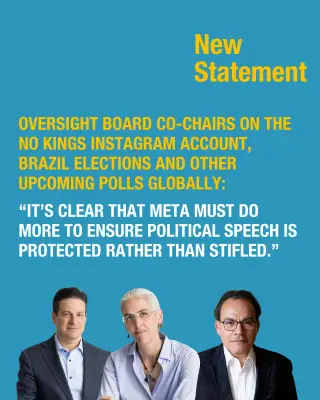
Meta is facing intense scrutiny from the Oversight Board and Brazilian courts over alleged election integrity failures. The Oversight Board criticized Meta for overenforcement against political accounts in the US and Brazil, while Brazilian courts ordered Meta to prove equal treatment for presidential candidates Lula and Bolsonaro ahead of the October 25 runoff. Meta denies bias, attributing issues to technical errors, but faces escalating fines and protests.