
C-SPAN Caller Confronts Former CDC Chief Over Vaccine Mandates and Autism Claims
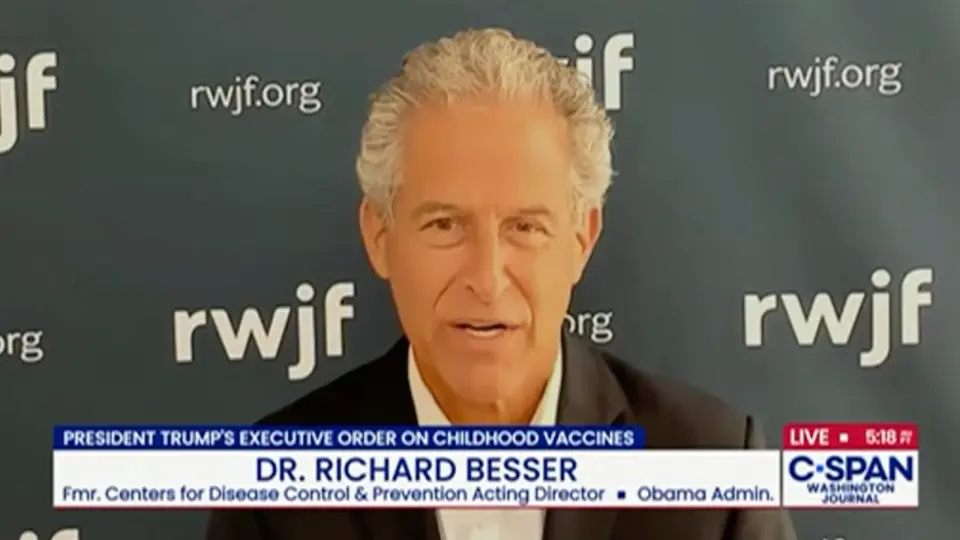
A C-SPAN caller criticized former CDC acting director Richard Besser for supporting childhood vaccines, citing personal tragedies and linking immunizations to cancer. Besser responded by noting that vaccines prevent diseases like meningitis and protect children with weaker immune systems, such as those with leukemia. The exchange occurred shortly after President Trump signed an executive order reducing federal vaccine recommendations, a move supported by the caller but criticized by medical experts who state there is no evidence linking vaccines to autism or childhood cancer.
Key points
- A caller identified as Jamie from Garden City, Missouri, called C-SPAN to criticize Dr. Richard Besser, the CDC’s acting director in 2009, for his stance on childhood vaccines.
- The caller described vaccine support as 'utterly ridiculous,' arguing that the number of immunizations has increased from five to eight in the 1960s to approximately 80 today.
- Jamie cited personal experiences, including a grandchild hospitalized after a Hepatitis B vaccine and a grandson who died of leukemia, claiming childhood cancer is linked to immunizations.
- The caller expressed support for President Donald Trump’s recent executive order, which reduces broadly recommended vaccines, spreads shots across separate appointments, and plans to split the MMR vaccine into three individual shots.
- Dr. Besser responded by expressing sympathy for the caller’s loss and explaining that vaccines protect children with weaker immune systems, such as those with leukemia.
- Besser noted that diseases like meningitis, which caused hearing loss, blindness, and death in the 1960s, are now rare in America due to vaccine development.
Background
This incident follows a series of policy changes and public statements regarding vaccine safety in the United States. In 2009, Richard Besser served as the acting director of the CDC under President Barack Obama. Recently, President Donald Trump and Health and Human Services Secretary Robert F. Kennedy Jr. have promoted claims about vaccines that lack scientific backing, including the debunked theory that vaccines cause autism. Trump recently acknowledged having no evidence for his claim that the combined MMR vaccine could be 'quite lethal.' These developments have sparked significant debate in public health and media circles, with various outlets and experts emphasizing the safety and efficacy of vaccines.
Why it matters
The interaction highlights the ongoing public debate over vaccine safety and policy in the United States. It underscores the tension between scientific consensus and political or personal beliefs regarding immunizations. The executive order mentioned by the caller represents a significant shift in federal health recommendations, potentially impacting public health outcomes. Dr. Besser’s response serves as a reminder of the historical impact of vaccines in preventing deadly diseases, while the caller’s arguments reflect growing skepticism and misinformation in public discourse.
What to watch
The implementation of the executive order reducing vaccine recommendations and splitting the MMR vaccine will likely lead to further public debate and potential changes in healthcare practices. Medical experts and public health organizations may continue to advocate for the safety and efficacy of vaccines, while political figures may push for reduced immunization requirements. Public opinion and media coverage will play a crucial role in shaping the future of vaccine policy and public health strategies in the United States.
Want the full story? Read the original reporting
Read on Mediaite