
Dissolving magnesium battery powers ingestible medical devices in pig trials
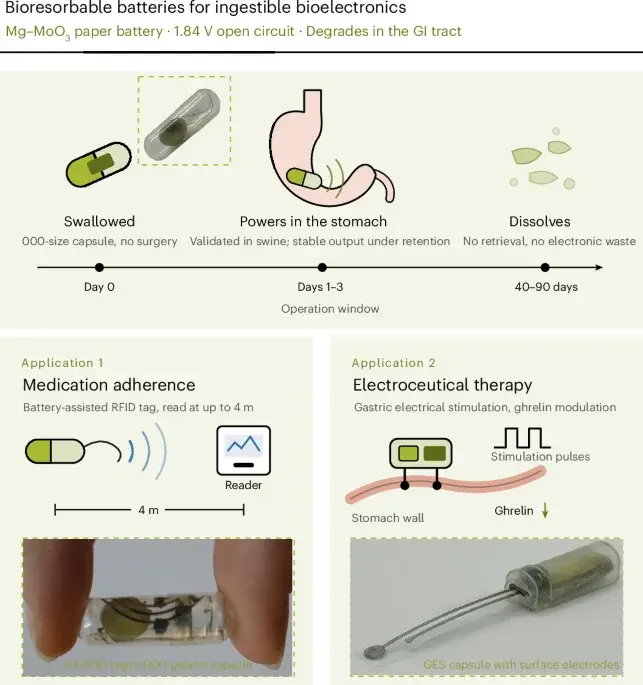
Researchers have developed a bioresorbable magnesium-molybdenum trioxide battery that powers ingestible medical devices for up to three days before safely dissolving in the gastrointestinal tract. Tested in swine, the battery enabled wireless medication tracking and gastric electrical stimulation, offering a non-invasive alternative to surgical implants. The technology aims to eliminate electronic waste and toxic leakage risks associated with conventional batteries, with human clinical trials expected to begin within two years.
Key points
- The battery uses a magnesium alloy anode and molybdenum trioxide cathode, delivering a peak voltage of 1.84 V.
- It is encapsulated in beeswax and candelilla wax to control degradation, dissolving completely within months in simulated gastric fluid.
- In vivo tests in pigs demonstrated stable operation for three days, powering radio-frequency identification tags and electroceutical therapy capsules.
- The system allows for wireless monitoring of medication adherence from up to 4 meters away without requiring surgical retrieval.
- A human clinical trial is planned to start in approximately two years, focusing on conditions like gastroparesis and appetite regulation.
Background
This development builds on earlier 2026 reports of biocompatible, dissolvable batteries designed for swallowable medical devices. Previous iterations focused on proving the concept of fully biodegradable power sources that avoid toxic leakage, whereas this new study validates integrated systems for specific therapeutic applications in large-animal models.
How outlets are covering it
Nature emphasizes the technical specifications, highlighting the battery's high voltage output and the use of a biodegradable ionic liquid electrolyte to improve performance over previous phosphate-buffered saline systems. The Financial Times focuses on the clinical potential, noting that the technology could help regulate appetite-related signals and treat stomach conditions, while quoting MIT professor Giovanni Traverso on the transition from materials demonstration to integrated biomedical systems. Live Science characterizes the results as 'quite impressive,' focusing on the safety aspect of the battery dissolving without generating sharp fragments or toxic byproducts. While all sources agree on the safety and dissolvable nature of the device, Nature provides the most detailed electrochemical data, whereas the Financial Times highlights the timeline for human trials and the specific application in gastric stimulation.
Why it matters
This technology addresses the critical challenge of powering transient medical devices without the risks of toxic leakage or electronic waste. By enabling retrieval-free diagnostics and therapies, it could reduce the need for invasive surgeries and improve patient compliance through remote monitoring. The ability to safely degrade in the body opens the door for sustainable, long-term health monitoring solutions that are currently limited by the environmental and safety hazards of conventional batteries.
What to watch
The research team is collaborating with a partner to develop prototypes for human use, with a clinical trial scheduled to begin in approximately two years. Future work will focus on larger safety studies, consistent manufacturing, and testing the battery in a broader range of gastric environments to ensure reliability across different patient conditions.
- Bioresorbable batteries for transient ingestible bioelectronics Nature
- A new battery could make edible electronics safer The Economist
- Scientists made a paper battery you can swallow to power internal medical devices Live Science
- Batteries that safely break down in the GI tract could improve ingestible devices medicalxpress.com
- Ingestible battery offers potential relief for stomach conditions Financial Times
Want the full story? Read the original reporting
Read on Nature