Tag

Biomedical Engineering

All articles tagged with #biomedical engineering

Nottingham Gel Mimics Enamel Growth, but Clinical Proof Lags Behind Lab Success
health12 days ago

Nottingham Gel Mimics Enamel Growth, but Clinical Proof Lags Behind Lab Success

University of Nottingham researchers developed a protein-based gel that can rebuild enamel-like structures in a lab, but it has not yet been tested in humans. While this offers hope for repairing worn teeth, other institutions are pursuing different biological pathways to regenerate dentin and pulp tissue, highlighting a fragmented but active field of research.

biomedical-engineering20 days ago

Penn State Team Develops Suture-Free Hydrogel Implant to Lower Blood Pressure in Rats

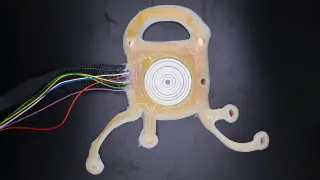
Researchers at Penn State have created CaroFlex, a soft, 3D-printed bioelectronic implant designed to treat drug-resistant hypertension. The device attaches to the carotid sinus without stitches, using electrical stimulation to activate the body’s natural baroreflex. In rat trials, it reduced blood pressure by over 15% with no tissue damage, offering a potential alternative to multiple medications for difficult-to-control cases.

New X-ray technique maps spine mechanics from molecule to organ
science22 days ago

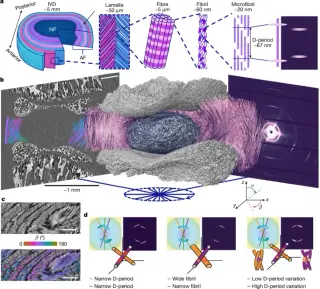
New X-ray technique maps spine mechanics from molecule to organ

Researchers developed TomoSAXS, a multimodal X-ray imaging method that links nanoscale collagen fibril mechanics to microscale fibre organization in intact intervertebral discs. Applied to rat and human discs, it reveals how molecular pre-strain and radial strain regulate load-sharing and elasticity, offering a platform for studying tissue disease and designing bio-inspired materials.

Cambridge Team Unveils $10 Optical Sensor for Non-Invasive Health Monitoring
science-and-technology1 month ago

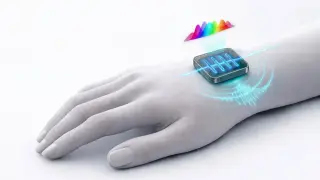
Cambridge Team Unveils $10 Optical Sensor for Non-Invasive Health Monitoring

University of Cambridge researchers have developed a low-cost optical spectrometer that achieves laboratory-grade precision in a miniature form factor. The device, which costs approximately $10 to produce, utilizes a novel convolutional approach to analyze light, enabling accurate identification of materials and non-invasive monitoring of biological markers. Tests demonstrated 100% accuracy in classifying various substances and the ability to track blood glucose without needles. The technology is designed to be integrated into wearable devices, potentially revolutionizing personal health monitoring, industrial quality control, and environmental analysis by making sophisticated spectral analysis accessible and affordable.

New Hydrogel and MRI Techniques Aim to Enhance Wearable Health Monitoring and Metabolic Imaging
biomedical-engineering1 month ago

New Hydrogel and MRI Techniques Aim to Enhance Wearable Health Monitoring and Metabolic Imaging

Two biomedical engineers are advancing healthcare through novel material and imaging techniques. Xinyu Dong at the National University of Singapore has developed tougher, conductive hydrogels using a modified freeze-casting method, enabling wearable sensors that monitor vital signs. James Eills at the Jülich Research Centre in Germany is improving MRI capabilities by developing new hyperpolarization methods to strengthen weak magnetic signals from metabolites, potentially allowing real-time monitoring of drug responses in human tissue.

Dissolving magnesium battery powers ingestible medical devices in pig trials
science-and-health2 months ago

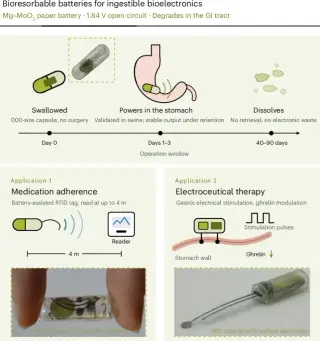
Dissolving magnesium battery powers ingestible medical devices in pig trials

Researchers have developed a bioresorbable magnesium-molybdenum trioxide battery that powers ingestible medical devices for up to three days before safely dissolving in the gastrointestinal tract. Tested in swine, the battery enabled wireless medication tracking and gastric electrical stimulation, offering a non-invasive alternative to surgical implants. The technology aims to eliminate electronic waste and toxic leakage risks associated with conventional batteries, with human clinical trials expected to begin within two years.

MIT team tests edible battery that powers stomach devices and dissolves safely
science-and-technology2 months ago

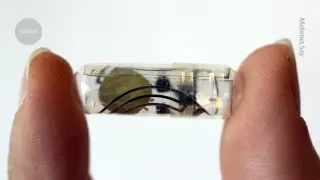
MIT team tests edible battery that powers stomach devices and dissolves safely

Researchers at MIT have developed a biodegradable battery capable of powering medical devices inside the human body. Tested in pigs, the battery uses magnesium and molybdenum trioxide to power wireless tags and stomach stimulators before dissolving into safe, absorbable components. The technology aims to replace invasive implants with swallowable devices for monitoring health and regulating appetite.

Duke Engineers Develop Injectable Scaffold to Rebuild Brain Tissue After Stroke
science-and-health2 months ago

Duke Engineers Develop Injectable Scaffold to Rebuild Brain Tissue After Stroke

Duke University researchers have developed an injectable biomaterial designed to facilitate brain repair after ischemic strokes. By using microporous annealed particle scaffolds loaded with specific immune signals, the treatment encourages the formation of new blood vessels and neural connections. In mouse trials, this approach restored motor function to levels comparable to healthy controls, suggesting a new strategy for rebuilding damaged brain tissue rather than merely preserving existing tissue.

Pocket-Sized Fluorometer Matches Lab Accuracy for Cancer and HIV Detection
science-and-technology2 months ago

Pocket-Sized Fluorometer Matches Lab Accuracy for Cancer and HIV Detection

Researchers at the University of Illinois Urbana-Champaign have developed a handheld device called the VPodDuo that performs fluorescence assays with accuracy comparable to expensive laboratory equipment. The device, roughly the size of an AirPod case, can detect pathogens like HIV and Zika, as well as cancer biomarkers including microRNA and circulating tumor DNA. Published in the IEEE Sensors Journal in July 2026, the technology aims to bring sophisticated diagnostics to home settings to enable earlier detection and preventable deaths. While the device has shown promising results in initial tests, it is not yet commercially available as researchers work on automating sample processing.

3D-Printed E-Skin Brings High-Resolution Touch to Prosthetics and Robots
technology3 months ago

3D-Printed E-Skin Brings High-Resolution Touch to Prosthetics and Robots

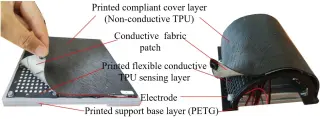
Researchers at Washington State University have developed a customizable electronic skin for prosthetics that offers ten times the spatial resolution of commercial glove sensors. By using a 'scan-model-print' manufacturing process, the system creates modular, snap-together sensor arrays that conform to complex limb geometries while maintaining high-density pressure and temperature sensing. This approach aims to democratize medical-grade tactile feedback, potentially improving the daily functioning of amputees by providing multimodal sensory data that mimics human skin.

New 3D Printing Method Converts Hydrogel Particles into Aligned Fibers for Muscle Regeneration
science3 months ago

New 3D Printing Method Converts Hydrogel Particles into Aligned Fibers for Muscle Regeneration

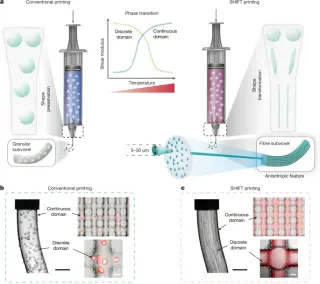
Researchers at Tsinghua University have developed a novel 3D printing technique called SHIFT (shear-extensional in situ particle-to-fibre transformation). This method extrudes particle-embedded hydrogels to create highly aligned microfibers with diameters between 5 and 30 micrometers. The process leverages opposite phase transitions in the particles and surrounding matrix during flow, enabling the creation of structurally anisotropic materials. This innovation facilitates the formation of long myotubes in vitro and accelerates the regeneration of volumetric muscle loss, offering a versatile approach for biomedical applications.

HealTEC: Off-the-shelf non-living cells enable scalable, low-immunogenic therapies
biomedical-engineering5 months ago

HealTEC: Off-the-shelf non-living cells enable scalable, low-immunogenic therapies

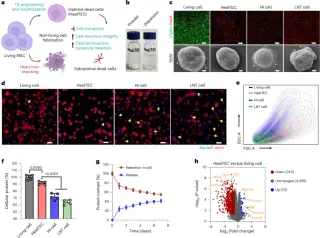
Nature Biomedical Engineering reports HealTEC, an off-the-shelf, lyophilized non-living cell platform created by tannic‑acid–mediated inactivation and low‑temperature condensation of mesenchymal stem cells. HealTEC preserves immunomodulatory or angiogenic factors (or carries drug nanoparticles), enabling ready-to-use cell therapies for ulcerative colitis, hindlimb ischemia, and asthma, with long-term storage stability and markedly lower immunogenicity than living cells, supporting scalable manufacturing and commercialization.

No Pricks, Big Hopes: The Quest for Noninvasive Glucose in Wearables
technology6 months ago

No Pricks, Big Hopes: The Quest for Noninvasive Glucose in Wearables

Researchers continue to chase truly noninvasive glucose monitoring for wearables, a notoriously difficult problem because glucose signals are small and easily swamped by other biological signals. The effort has shifted from tear-based sensors (which proved unreliable) to methods that detect glucose through the skin, with Raman spectroscopy showing promise but requiring highly sensitive, bulky optics. MIT researchers have developed a working shoebox-sized prototype that reads skin glucose signals and aims to miniaturize it for wearables, with a startup partner planning market release around 2029–2030 after FDA clearance. The path to a consumer device like an Apple Watch remains long due to the need for medical-grade accuracy and substantial miniaturization, but progress continues on narrowing the signal-to-noise gap and shrinking the technology for everyday use.