
BMJ Group Retracts 2024 Study on Excess Deaths After Prolonged Investigation
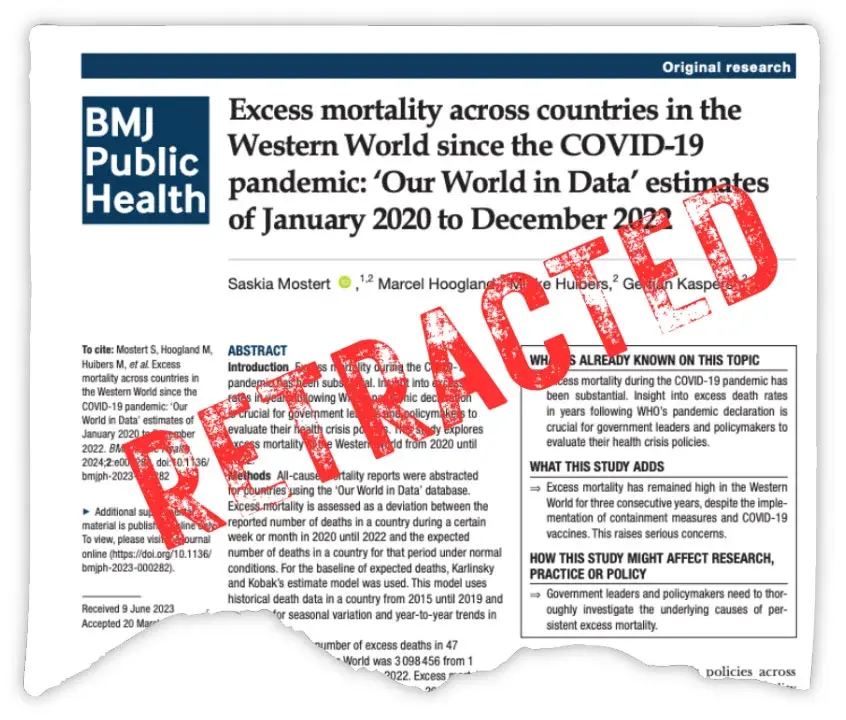
BMJ Public Health retracted a 2024 study on excess mortality during the pandemic, citing misinformation and insufficient original work. The paper, which fueled anti-vaccine claims, was investigated for over two years after data creators flagged potential plagiarism. While the journal retracted the work, the lead author and one co-author disputed the decision, and the institutional investigation found negligence but not misconduct.
Key points
- BMJ Public Health retracted a 2024 paper on excess mortality on August 11, 2026, citing misinformation regarding causes of death and limited original work.
- The study, published in May 2024, used 'Our World in Data' and the World Mortality Dataset to analyze deaths during the pandemic, leading to widespread misreporting by outlets like The Telegraph and The New York Post.
- An expression of concern was issued in June 2024, followed by an investigation by the Princess Máxima Center in the Netherlands, where three of the four authors were based.
- The institutional investigation concluded that authors Minke Huibers and Gertjan Kaspers exhibited 'carelessness, ignorance and negligence' but did not constitute formal misconduct.
- Lead author Saskia Mostert resigned from the Princess Máxima Center in 2024 and testified before a U.S. Senate subcommittee, arguing the retraction violated academic freedom.
- Economist Ariel Karlinsky, who created the World Mortality Dataset, criticized the journal's slow response and alleged the paper plagiarized his work, including distorted mathematical notations.
Background
This retraction follows a pattern of scientific integrity issues in recent years, such as the Cochrane retraction of an AI-methods paper over conflict-of-interest breaches in July 2026. It also aligns with broader political tensions regarding pandemic research, as seen in the August 2026 Senate hearing on COVID origins, where partisan disputes over scientific findings remained unresolved. The current case highlights the ongoing challenges in managing public health misinformation and the slow pace of institutional responses to research integrity concerns.
How outlets are covering it
Retraction Watch emphasizes the prolonged timeline of the retraction, noting that the journal waited for the formal outcome of the institutional investigation before acting, a delay criticized by data creator Ariel Karlinsky. The Straits Times focuses on the paper's role in amplifying vaccine skepticism, highlighting that while the study did not explicitly link vaccines to deaths, its ambiguous conclusions were widely misused in anti-vaccine narratives. Both sources agree on the retraction's basis but differ in emphasis: Retraction Watch details the internal disputes and the authors' disagreement with the journal's decision, while The Straits Times underscores the public health impact of the paper's misinterpretation. The Straits Times also notes the BMJ Group's prior investigation and the expression of concern issued in 2024, providing a clearer timeline of the journal's response.
Why it matters
The retraction underscores the risks of ambiguous scientific findings being misused in public discourse, particularly regarding vaccine safety. It highlights the challenges in balancing academic freedom with scientific integrity, as the lead author's claims of censorship contrast with the journal's focus on preventing public health misinformation. The case also illustrates the slow pace of institutional responses to research integrity issues, potentially delaying corrections to misleading studies that influence public policy and health decisions.
What to watch
The retracted paper will likely be cited in discussions about scientific integrity and the handling of controversial research. The authors' disagreement with the retraction may lead to further legal or academic disputes. Additionally, the case may prompt stricter guidelines for data usage and citation in public health research, particularly when studies are used in political or public health debates.
- BMJ Group retracts paper on COVID-19 vaccines and mortality featured in Senate hearing Retraction Watch
- A widely covered excess-death paper is retracted over misinformation concerns Medical Xpress
- Study Linking Excess Deaths To Covid Vaccines Retracted Amid Scientific Criticism ndtv.com
- COVID Excess Deaths Paper Retracted Over Misinformation medpagetoday.com
- Controversial study on excess deaths during Covid-19 retracted The Straits Times
Want the full story? Read the original reporting
Read on Retraction Watch