
AI analysis of child speech predicts mental health risks six years ahead
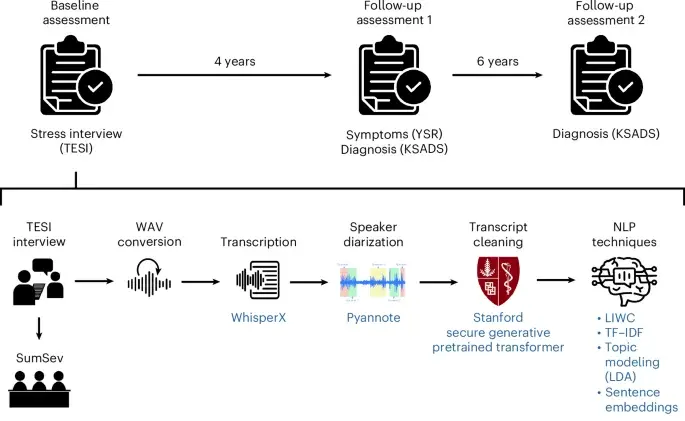
A study published in Nature Mental Health demonstrates that automated analysis of youth speech can predict future mental health outcomes with greater accuracy than traditional human-rated risk factors. Researchers applied natural language processing techniques to stress interviews with 204 children aged 9 to 13, finding that linguistic style and semantic themes, rather than explicit emotional content, were the strongest predictors of internalizing psychopathology up to six years later. The study highlights narratives of physical violence and social exclusion as key risk markers, while structured routines and healthcare access served as protective factors. This approach offers a scalable framework for identifying objective risk markers in early life, potentially improving early intervention strategies for developmental psychopathology.
Key points
- Researchers analyzed naturalistic speech from 204 youths (mean age 11.38) to predict internalizing psychopathology up to six years later.
- Linguistic features explained more than twice the variance of traditional human-rated risk factors in predicting future mental health outcomes.
- Linguistic style proved more predictive of mental health issues than explicit emotional content in the interviews.
- Narratives involving physical violence and social exclusion emerged as significant markers of risk.
- Themes related to structured, routine activities and access to healthcare were identified as protective factors.
- Data-driven semantic dimensions outperformed expert ratings of cumulative stress severity in predicting diagnostic outcomes.
Background
This research builds on prior findings that language processing in the brain and AI models share hierarchical structures, as noted in recent studies on brain language processing mirroring AI layering. It also aligns with trends in using compact language models for scalable medical tasks, as discussed in earlier coverage on AI in medicine. The focus on early life stress as a risk factor for psychopathology is consistent with established developmental psychology literature, which emphasizes the impact of early adversity on mental health trajectories.
Why it matters
The ability to predict mental health outcomes through scalable, automated speech analysis could transform early intervention strategies. By identifying objective risk markers in childhood, clinicians and policymakers may develop more targeted interventions, potentially preventing the onset of psychopathology in adolescence. This approach addresses the lack of scalable tools for identifying vulnerable youths, offering a new dimension to developmental clinical science and enhancing the precision of mental health care.
What to watch
Future research will likely focus on validating these findings in larger, more diverse populations and exploring the integration of such AI-driven tools into clinical practice. Ethical considerations regarding the use of AI in child health, as highlighted in recent literature, will also need to be addressed to ensure safe and equitable deployment. Additionally, further studies may investigate the long-term efficacy of interventions based on these predictive models.
Want the full story? Read the original reporting
Read on Nature