
Study Links Generational Memory Gains to Slowing Dementia Rates
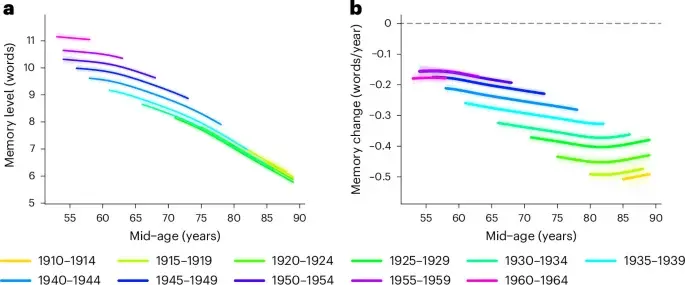
A new analysis of 219,000 people suggests that later-born generations enter old age with better memory and experience slower cognitive decline. This 'double dividend' may explain the 13% per-decade drop in dementia incidence in Western countries, highlighting the need for lifelong prevention strategies.
Key points
- Researchers analyzed 783,000 memory assessments from 219,000 individuals in five longitudinal studies across Europe and the U.S., followed for up to 30 years.
- Later-born cohorts showed a 10% higher memory score at age 60 per decade of birth, with 64% higher odds of stable memory and 38% lower odds of steep decline.
- The combined advantage of higher baseline memory and slower decline is large enough to plausibly account for the documented 13% per-decade decline in dementia incidence.
- Improvements were concentrated among the fastest decliners, with later-born generations showing longer periods of stable memory and slower hippocampal atrophy.
- Authors note that memory capacity is built in early life, while decline rates are shaped by adulthood conditions, suggesting prevention must begin in childhood.
Background
A 2020 meta-analysis by Wolters et al. in Neurology established a 13% per-decade fall in dementia incidence in Europe and the U.S. between 1998 and 2015. The current study by Anders Fjell et al. seeks to explain this trend by examining generational differences in cognitive capacity and decline rates. Previous research, including a 2026 study in PNAS, has noted the reversal of the Flynn effect in some populations, highlighting that cognitive gains are not automatic but depend on societal conditions.
How outlets are covering it
Nature Medicine and MedPage Today emphasize the 'double dividend' of higher baseline memory and slower decline, linking it directly to the fall in dementia incidence. The Walter Bradley Center highlights the observational nature of the study and the uncertainty regarding specific causes, noting that gains are tied to 20th-century improvements in education and health. Dr. Axe focuses on the practical implications, arguing that prevention must start in childhood and continue through adulthood, rather than focusing solely on older age. All sources agree that the findings are limited to high-income countries and may not apply globally.
Why it matters
The findings suggest that dementia prevention is a lifelong process, not just a late-life concern. If generational gains are driven by early-life conditions and adulthood health behaviors, public health strategies must shift to protect brain health from childhood through adulthood to sustain the decline in dementia rates.
What to watch
Fjell’s research group plans to investigate whether generational cognitive improvements are equally distributed across socioeconomic groups and whether better living conditions protect equally regardless of genetic vulnerability to dementia. The study also suggests that current trends in physical activity, overweight, and inequality may not support continued gains, requiring new prevention policies.
- Later-born generations have better memory and lose it more slowly Nature
- Large memory loss study: Is aging slowing down? Walter Bradley Center for Natural and Artificial Intelligence
- Sharper at Age 60: Later-Born Generations Have Slower Memory Decline MedPage Today
- Why Later-Born Generations May Be Protecting Their Memory Twice Over Dr. Axe
Want the full story? Read the original reporting
Read on Nature