
Meghalaya’s Living Root Bridges: A Century-Old Engineering Solution That Strengthens with Age
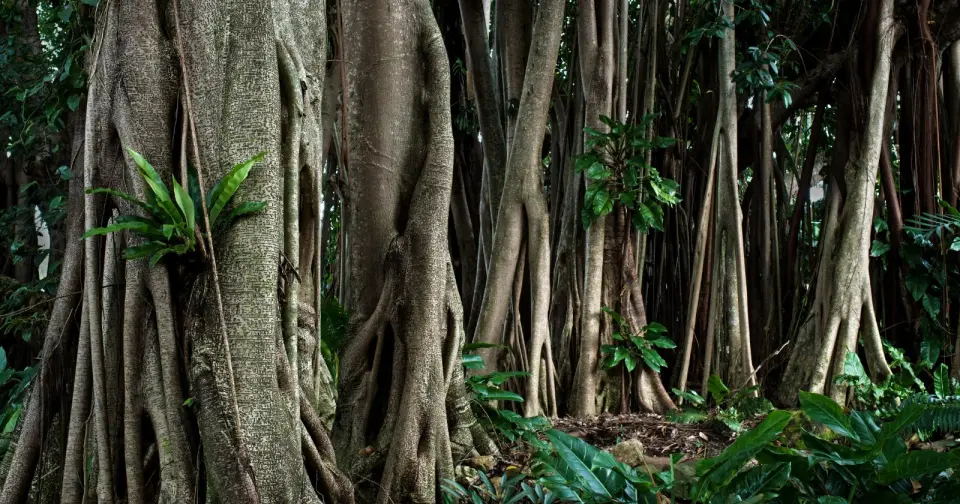
In the hills of Meghalaya, India, Khasi and Jaintia communities cultivate living bridges by guiding the roots of rubber fig trees across rivers. Unlike conventional structures that degrade over time, these bridges grow stronger as they age, with roots fusing together to support heavy loads. The process takes 15 to 30 years, and the knowledge required to build them is held by fewer than two dozen elders, raising concerns about the survival of this traditional skill.
Key points
- Construction involves threading young roots of Ficus elastica trees through hollowed betel nut trunks or bamboo scaffolds across gaps, a process that takes 15 to 25 years to become safe for human use.
- The bridges are known locally as 'jingkieng jri' and are built by the matrilineal Khasi communities, with women often responsible for the ongoing tending and maintenance.
- As roots bear weight, they thicken and flatten into a T-shape, and separate roots fuse together through a process called inosculation, creating a single, continuous load-bearing structure.
- A completed bridge can support up to 50 people at once and may last for several hundred years, with some spans reaching over 50 meters in length.
- The building knowledge is passed down orally, primarily during the rainy season, and is currently held by fewer than two dozen elders, creating a risk of the skill being lost despite UNESCO's 2022 tentative World Heritage listing.
Background
This story highlights a traditional ecological practice that contrasts with modern engineering principles. While conventional materials like steel and concrete degrade over time due to corrosion and weathering, living root bridges utilize biological growth to reinforce their structure. This aligns with broader interests in sustainable and bio-integrated infrastructure, where natural processes are leveraged for durability. The concern over the loss of traditional knowledge echoes other discussions on the preservation of indigenous skills and the impact of modernization on local practices.
Why it matters
The existence of living root bridges offers a practical example of sustainable engineering that defies the typical lifecycle of human-made structures. As interest in green technologies and climate-resilient infrastructure grows, these bridges serve as a model for how biological systems can be integrated into civil engineering. However, the fragility of the knowledge base, held by a small number of elders, underscores the urgent need for documentation and preservation of traditional ecological knowledge to ensure these structures can continue to be built and maintained.
What to watch
Researchers and architects are increasingly looking to living root bridges as a model for future sustainable infrastructure. The primary challenge remains the preservation of the traditional knowledge required to build them, as the number of skilled elders dwindles. Efforts to document and teach the skill, potentially through formal education or community programs, will be crucial to ensuring the continuity of this practice.
Want the full story? Read the original reporting
Read on Space Daily