
3D Epigenomic Mapping of Glial Cells Links Schizophrenia Risk to Human Cortical Evolution
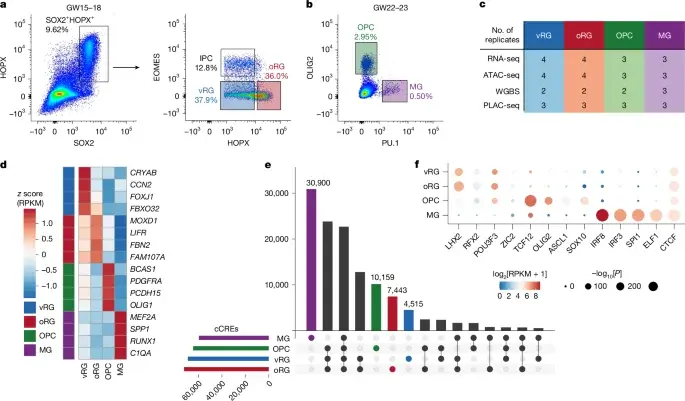
Researchers have mapped the 3D epigenome of four glial cell types in the developing human cortex, identifying cell-specific regulatory elements that link schizophrenia risk variants to gene expression. The study highlights how outer radial glia (oRG) are enriched for human-accelerated regions, suggesting a unique evolutionary mechanism for human cortical expansion. While a separate UCLA study focuses on metabolic and physical signals guiding radial glia fate, this new work provides a genomic framework for understanding how non-coding variants disrupt these processes in neuropsychiatric disorders.
Key points
- Analysis of ventricular and outer radial glia, oligodendrocyte precursors, and microglia identified 69,141 to 72,450 candidate cis-regulatory elements (cCREs) per cell type.
- Machine learning models prioritized 112 schizophrenia risk variants within glial cCREs, with in vivo validation confirming that the rs4449074 risk allele disrupts enhancer activity in radial glia.
- Outer radial glia (oRG) cCREs show significant enrichment for human accelerated regions (HARs), with some HARs showing activity differences from chimpanzee orthologues that affect neuronal development genes.
- High-resolution 3D chromatin interaction data revealed that cCREs participate in promoter-enhancer loops, with 21.5–26.4% of interactions containing cCREs showing higher contact frequencies than those without.
- The study integrates ATAC-seq, DNA methylation, and 3D chromatin data to define cell-type-specific regulatory landscapes, addressing gaps in previous neurogenesis-focused epigenomic studies.
Background
This research builds on prior studies of neurogenesis in the developing human cortex, which established that chromatin looping underlies transcriptional regulation for lineage-specific genes. Earlier work by the same group identified regulatory elements in radial glia and neurons but lacked comprehensive coverage of glial populations. Recent archival coverage has explored cell-type-specific gene programs in the adult cortex and plasticity in sensory processing, but this study focuses on the prenatal epigenomic architecture that establishes the foundation for cortical diversity. The findings complement broader efforts to understand how non-coding genetic variants contribute to neuropsychiatric disorders by disrupting cell-type-specific gene regulation.
How outlets are covering it
The primary source from Nature emphasizes the epigenomic and genomic mechanisms, focusing on how 3D chromatin structure and specific regulatory elements link schizophrenia risk variants to glial cell function. It highlights the evolutionary significance of oRG-specific regulatory elements enriched for human accelerated regions. In contrast, the secondary source from Mirage News focuses on the functional and environmental drivers of radial glia fate, specifically metabolic pathways and physical signals from the thalamus. While the Nature study provides a static genomic map of regulatory potential, the Mirage News report describes dynamic processes that influence cell fate decisions. Both sources agree that radial glia are central to human cortical expansion and neuropsychiatric disorders, but they differ in their focus: one on the genomic architecture of regulation, the other on the environmental and metabolic inputs that guide cell differentiation. The Nature study provides a framework for understanding how genetic variants disrupt these processes, while the Mirage News report offers insights into how external signals shape the same cells.
Why it matters
This research provides a detailed map of the epigenomic landscape in glial cells during human cortical development, offering a new framework for understanding how non-coding genetic variants contribute to neuropsychiatric disorders like schizophrenia. By identifying cell-type-specific regulatory elements and linking them to disease risk variants, the study enables more precise targeting of therapeutic interventions. The finding that oRG cCREs are enriched for human accelerated regions suggests that these elements may underlie the unique features of the human brain, providing insights into human evolution. This work bridges the gap between genomic association studies and functional validation, offering a path to understanding how genetic risk translates into biological dysfunction in specific cell types during development.
What to watch
Researchers will likely expand the analysis to include additional glial subtypes and later developmental stages to capture the full trajectory of cortical maturation. The identified schizophrenia risk variants may be tested in larger cohorts to confirm their functional impact on glial cell behavior and disease susceptibility. Further studies may explore the therapeutic potential of targeting these regulatory elements to mitigate neuropsychiatric disorders. The integration of epigenomic data with metabolic and physical signaling pathways, as highlighted in the secondary source, may reveal how environmental factors interact with genetic predispositions to influence brain development. Longitudinal studies tracking these regulatory elements from prenatal to postnatal stages could provide insights into the persistence of developmental epigenomic marks in adult brain disorders.
Want the full story? Read the original reporting
Read on Nature