
Brain Remodeling in Puberty and Pregnancy Shares Patterns, While Menopause Shows No Volumetric Loss
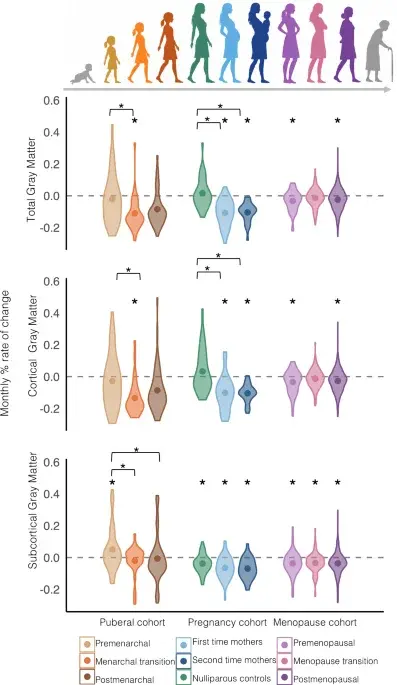
A large-scale study reveals that puberty and pregnancy trigger similar but distinct brain volume reductions, while menopause is marked by a lack of change rather than loss.
Key points
- Puberty and pregnancy both cause widespread cortical gray matter reductions, with overlapping changes in prefrontal, parietal, and temporal regions.
- Menopause shows a distinct pattern: women transitioning through menopause experienced no significant gray matter volume loss, unlike stable pre- and post-menopausal groups.
- The study used identical analytical methods across 1,095 participants to compare these three major hormonal life events directly.
- Subcortical changes were observed only in puberty, with specific structures like the thalamus and hippocampus showing growth attenuation around menarche.
Background
Previous research established that pregnancy and puberty involve brain changes linked to rising sex hormones, but menopause had only been studied in limited, single-structure contexts. This study fills a gap by comparing all three transitions within a single framework, building on earlier findings that reproductive health impacts long-term physiological outcomes.
Why it matters
Understanding how hormonal shifts reshape the brain across a woman's lifespan is crucial for interpreting neuroplasticity, aging, and potential vulnerabilities. The distinct lack of volumetric loss during menopause challenges assumptions that hormonal decline always accelerates brain aging, suggesting a complex, non-linear relationship between hormones and brain structure.
What to watch
Researchers will need to investigate whether the absence of volumetric loss during menopause reflects heightened plasticity or a slowing of age-related decline, and how these structural shifts correlate with cognitive or clinical outcomes later in life.
Want the full story? Read the original reporting
Read on Nature