
Fly brain circuit uses inhibition to switch between tracking and memory
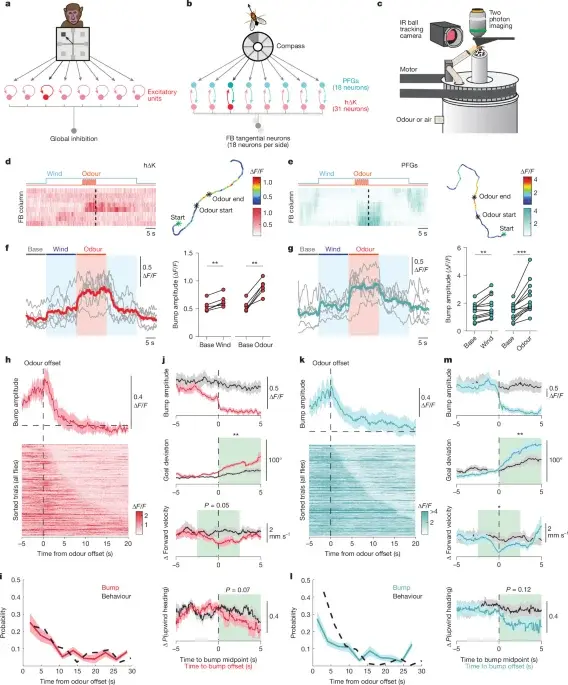
Researchers have identified a specific mechanism in the fruit fly brain that allows it to rapidly switch between tracking real-time sensory input and storing that information as a stable memory. By analyzing the central complex, scientists found that inhibitory signals act as a gate, decoupling two interconnected neuron populations to either follow a heading compass or lock in a navigational goal. This 'split attractor' design solves the trade-off between stability and flexibility in working memory, allowing the brain to update its internal map quickly without losing the current objective. While this study focuses on invertebrate navigation, it provides a biological blueprint for how recurrent networks manage dynamic information, offering insights applicable to broader cognitive functions and artificial intelligence models.
Key points
- The study focuses on the central complex of the Drosophila melanogaster, specifically the h∆K and PFG neuron populations.
- These neurons form a recurrent ring structure that exhibits persistent 'bump' activity during goal-directed runs.
- The circuit uses a 'split attractor' design where PFG neurons receive compass inputs, while h∆K neurons receive inhibitory control.
- Inhibitory inputs from FB5V neurons suppress h∆K activity during turns, decoupling it from PFG neurons.
- When inhibition is removed (disinhibition), the recurrent connection locks the current heading into a stable memory.
- This mechanism allows the fly to rapidly switch between following a moving compass signal and storing a fixed goal.
Background
Previous research established that recurrent attractor networks are fundamental to working memory but struggled to explain how these stable states could be rapidly switched on and off. Earlier studies in the prefrontal cortex highlighted a trade-off between stability and flexibility, often requiring external gates in computational models. This new work builds on prior findings in fly navigation, such as the role of h∆K neurons in driving goal-directed movement, by providing a detailed circuit-level explanation for how these memories are formed and updated in real-time.
How outlets are covering it
The primary source from Nature provides a detailed, mechanistic view of the fly's central complex, emphasizing the specific roles of h∆K and PFG neurons and the gating function of FB5V inhibitory inputs. It highlights the 'split attractor' design as a solution to the stability-flexibility trade-off in working memory. In contrast, the secondary source from Euronews discusses a separate study on the human hippocampus, focusing on how the dentate gyrus uses inhibition to balance new memory formation with the preservation of existing memories. While both studies explore the role of inhibition in memory dynamics, the Nature article focuses on rapid switching in a navigational circuit, whereas the Euronews report discusses the dynamic adjustment of inhibition based on memory load and task demands in a different brain region. The two sources do not directly contradict each other but offer complementary insights into how neural networks use inhibition to manage information flow, with the Nature study providing a concrete anatomical example and the Euronews study discussing broader computational principles in the hippocampus.
Why it matters
Understanding how biological brains rapidly switch between tracking and storing information offers a new model for designing artificial intelligence systems that can manage dynamic environments. The 'split attractor' mechanism described in the fly brain could inspire more efficient algorithms for working memory and decision-making in robotics and machine learning, allowing systems to update their internal states without losing critical data. This research also sheds light on the fundamental principles of neural computation, potentially informing treatments for cognitive disorders where memory updating or stability is impaired.
What to watch
Future research will likely focus on causal experiments to test the computational model, such as activating or silencing FB5V neurons to observe changes in PFG and h∆K activity. Researchers may also investigate the molecular signals that allow h∆K and PFG neurons to wire together in a ring structure and establish the necessary synaptic ratios. Additionally, the principles of disinhibitory gating may be explored in other types of attractor networks, such as those involved in motor control or emotional states, to see if similar mechanisms are used to rapidly alter neural functions in different contexts.
- A split attractor design for rapidly writing a navigational goal Nature
- Researchers discover how the brain updates memories with new information Euronews.com
- Fruit fly study reveals how neural gates switch on short-term memory Medical Xpress
- How the Brain Separates Memory Stages: Dentate Gyrus Study - News and Statistics IndexBox
Want the full story? Read the original reporting
Read on Nature