
Massive Finnish Immune Atlas Links Non-Coding Variants to Disease Mechanisms
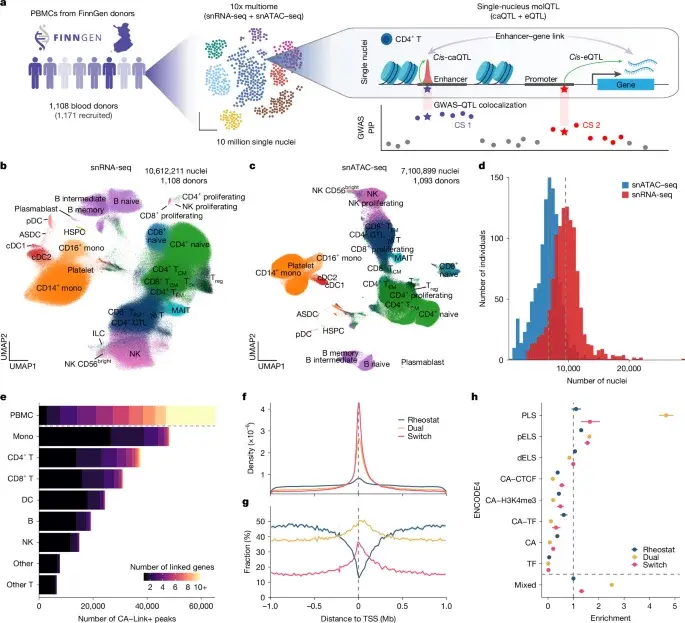
A massive new study published in Nature has created a population-scale atlas of the human immune system, linking genetic variants to disease mechanisms. By analyzing 10 million blood cells from 1,108 Finnish donors, researchers identified over 51,000 expression quantitative trait loci (eQTLs) and 338,000 chromatin accessibility QTLs. The study reveals how genetic variations in non-coding regions regulate gene expression, providing a clearer understanding of autoimmune diseases. This resource offers testable hypotheses for more than half of known immune disease associations, potentially accelerating drug discovery and personalized medicine.
Key points
- Researchers profiled 10 million peripheral blood mononuclear cells from 1,108 Finnish individuals using single-nucleus ATAC-seq and RNA-seq.
- The study identified 51,083 cis-expression QTLs and 338,100 cis-chromatin accessibility QTLs, linking genetic variants to gene regulation.
- Variants that complete chromatin-to-expression cascades show twice the disease colocalization compared to chromatin-only effects.
- The atlas reveals 'multilayered regulatory buffering' at evolutionarily constrained genes, explaining why disease variants target these regions despite apparent expression QTL depletion.
- The findings provide testable hypotheses for over half of immune disease associations, with specific examples at loci like TICAM1 and RHOH.
Background
This study builds on recent advances in single-cell genomics, such as the PsychAD Consortium's brain atlas, which mapped over 6.3 million brain cells to link genetic risk with cellular disease mechanisms. While previous studies focused on specific tissues or diseases, this new atlas provides a comprehensive, population-scale view of immune cell regulation, bridging the gap between genetic variation and molecular consequences in disease.
Why it matters
This atlas provides a crucial resource for understanding the molecular mechanisms behind immune-related diseases, which account for a significant portion of human disease burden. By linking genetic variants to specific regulatory mechanisms, researchers can identify new drug targets and develop more precise therapies. The findings also help explain why certain genetic variants are associated with disease, even when they do not directly affect gene expression, offering insights into the complex interplay between genetics and disease.
What to watch
Researchers will likely use this atlas to identify new therapeutic targets for autoimmune diseases and other immune-related conditions. The study also opens up possibilities for personalized medicine, where treatments can be tailored to an individual's genetic profile. Additionally, the data may be used to develop new diagnostic tools that can predict disease risk based on genetic variations.
Want the full story? Read the original reporting
Read on nature.com