
NTSB details Miami cargo jet crash: 5 dead in vehicle collisions, crew survives
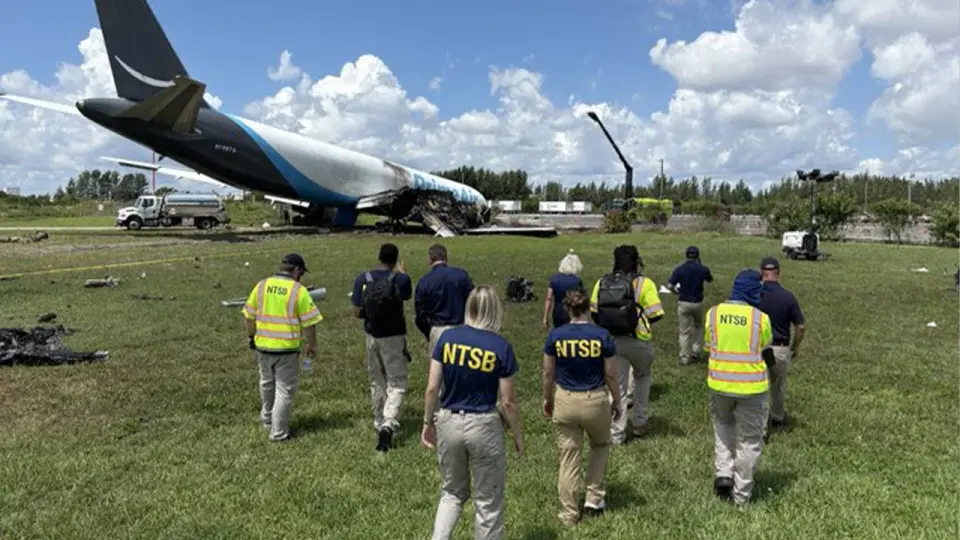
The NTSB confirmed that an Amazon-operated Boeing 767 cargo plane overran the runway at Miami International Airport on September 6, killing five people in two vehicles while the two crew members survived. The aircraft traveled 1,300 feet beyond the paved surface, striking a cleaning van and a civilian car before crashing into a fence near a robotaxi staging area. Investigators have recovered flight recorders and are examining why the plane failed to stop, with early scrutiny on landing distance and braking performance.
Key points
- The crash killed five people and injured five others; the two pilots survived the incident.
- The Boeing 767, operated by 21 Air for Amazon Prime Air, overran Runway 30 by approximately 1,300 feet.
- The aircraft struck a 2012 Ford Econoline van carrying seven people and a Toyota Corolla Cross on Northwest 67th Avenue.
- The van belonged to Ocean Service Corporation, a contract cleaning company for airlines.
- The NTSB has recovered the flight data and cockpit voice recorders for analysis.
- The aircraft had completed two prior flights that day, including a route from Miami to San Juan, Puerto Rico, before the crash.
Background
This incident follows earlier reports from September 6 and 7 regarding the initial crash and immediate emergency response. Previous coverage noted that the aircraft was a 32-year-old former passenger jet converted for cargo use. The NTSB has been investigating factors such as touchdown distance, speed, and maintenance history since the initial incident.
How outlets are covering it
Fox News and The Washington Post both reported that the crash involved two vehicles with a total of eight occupants, resulting in five fatalities. The Miami Herald highlighted a specific safety question regarding the absence of an Engineered Materials Arresting System (EMAS) at Miami International Airport. While the airport met FAA standards for a 1,000-foot safety area, the Miami Herald noted that EMAS is used at 72 other U.S. airports to stop overruns. NTSB Chair Jennifer Homendy stated that the role of EMAS in preventing the deaths would be a key part of the investigation, while Miami-Dade Mayor Daniella Levine Cava expressed interest in learning more about the safety feature despite it not being a federal requirement for airports with full safety areas.
Why it matters
The crash highlights critical questions about runway safety infrastructure and the operational safety of older aircraft converted for cargo use. The NTSB's investigation into why the plane overran the runway by such a significant distance, and whether additional safety systems like EMAS could have mitigated the disaster, may lead to changes in federal aviation safety standards or airport infrastructure requirements.
What to watch
The NTSB will analyze the recovered flight recorders to determine the cause of the overrun. Investigators are also examining the aircraft's maintenance history and the specific landing decisions made by the crew. The NTSB will assess whether the lack of EMAS at Miami International Airport contributed to the severity of the crash and may recommend safety improvements for airports with similar configurations.
- NTSB reveals if crew survived Amazon cargo jet disaster as it shares details about victims Fox News
- Officials Search for Answers After Fatal Miami Airport Cargo Plane Crash The New York Times
- Miami-Dade Sheriff to provide update on deadly Amazon cargo jet crash NBC 6 South Florida
- Van carrying seven people among two vehicles crushed by Amazon cargo plane in Miami The Washington Post
- MIA doesn’t have EMAS. What is it? Could it have prevented plane crash deaths? Miami Herald
Want the full story? Read the original reporting
Read on Fox News