
2026 Nobel in Economics Awards Hall and Woodford for Microeconomic Stabilization Models
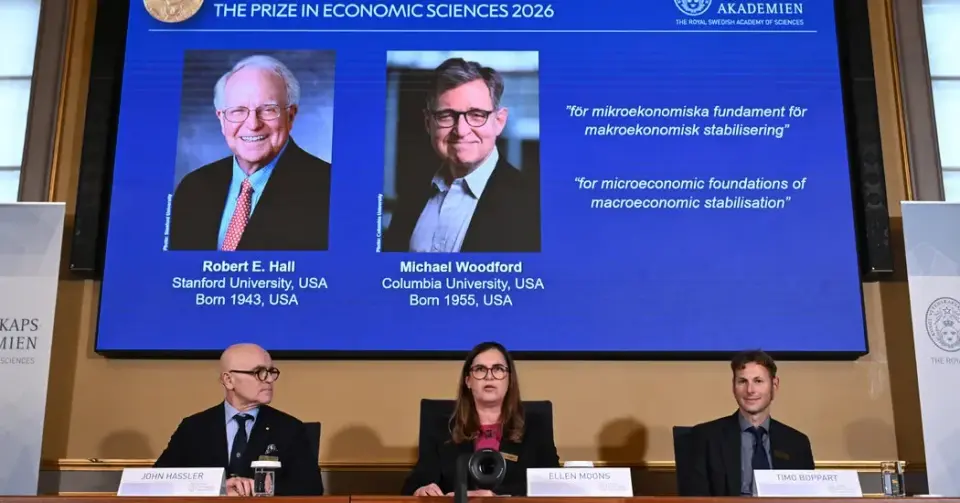
Robert E. Hall and Michael Woodford won the 2026 Nobel Prize in Economic Sciences for developing microeconomic foundations for macroeconomic stabilization. Their work provides central banks and governments with tools to manage economic shocks, such as the 2008 financial crisis, by analyzing how individual expectations influence broader economic outcomes. The award, worth 12 million Swedish kronor, recognizes their contribution to smoothing economic peaks and troughs through better policy communication and forward guidance.
Key points
- The Royal Swedish Academy of Sciences awarded the 2026 Nobel Prize in Economic Sciences to Robert E. Hall of Stanford University and Michael Woodford of Columbia University.
- The prize recognizes their development of 'microeconomic foundations of macroeconomic stabilization,' which helps policymakers manage economic volatility.
- Their models emphasize how forward-looking decisions by households and businesses affect the economy, allowing central banks to use tools like forward guidance to stabilize markets.
- The winners will split 12 million Swedish kronor (approximately $1.2 million), with each receiving 6 million kronor.
- The award follows the 2025 prize, which went to Joel Mokyr, Philippe Aghion, and Peter Howitt for research on innovation and economic growth.
Background
The 2026 Nobel Prize in Economic Sciences concludes the year's award cycle, following the Peace Prize awarded to Navi Pillay and the Literature Prize to Anne Carson. Previous economics laureates have focused on innovation (2025), institutional prosperity (2024), and labor market outcomes (2023). The current award highlights a shift toward microeconomic approaches that integrate individual behavior into macroeconomic policy, a framework that has become standard for central banks globally since the 2008 financial crisis.
How outlets are covering it
The New York Times emphasizes the 'bottom-up' nature of the winners' work, noting how their models connect individual decisions to broad economic variables like inflation. Axios highlights the historical context, explaining that their framework replaced older models that failed during the 1970s stagflation, and notes that the prize amount increased from 11 million to 12 million kronor. CNN focuses on the practical application of their work, stating that their models provide a 'stable theoretical foundation' used by central banks worldwide to smooth out economic peaks and troughs. All sources agree on the core achievement: using microeconomic insights to improve macroeconomic stabilization and policy communication.
Why it matters
The recognition of Hall and Woodford underscores the critical importance of understanding how individual expectations and behaviors shape macroeconomic outcomes. Their work has directly influenced modern central banking practices, particularly the use of forward guidance to manage crises. By validating these microeconomic foundations, the Nobel committee highlights the necessity of integrating real-world behavior into policy design to effectively mitigate the impact of external shocks, such as energy crises or sudden changes in consumption.
What to watch
The winners will receive their prize money and likely engage in public discussions regarding the application of their models in current economic conditions. The focus on microeconomic foundations may influence future academic research and policy debates, emphasizing the need for central banks to communicate effectively with the public to manage expectations. The 2026 Nobel cycle is now complete, with all major prizes awarded.
- Duo Share Nobel in Economics for Work on Steering Through Booms and Busts The New York Times
- Two U.S. professors win Nobel prize in economics Axios
- Americans Robert E. Hall and Michael Woodford awarded the Nobel Prize in economics CNN
- Nobel Prize Goes to Economists Who Recast Ideas of Keynes Bloomberg.com
- Two Americans win Nobel Prize in Economics for work on boom-bust cycles NPR
Want the full story? Read the original reporting
Read on The New York Times