
Hall and Woodford Win 2026 Nobel for Microeconomic Shock Models
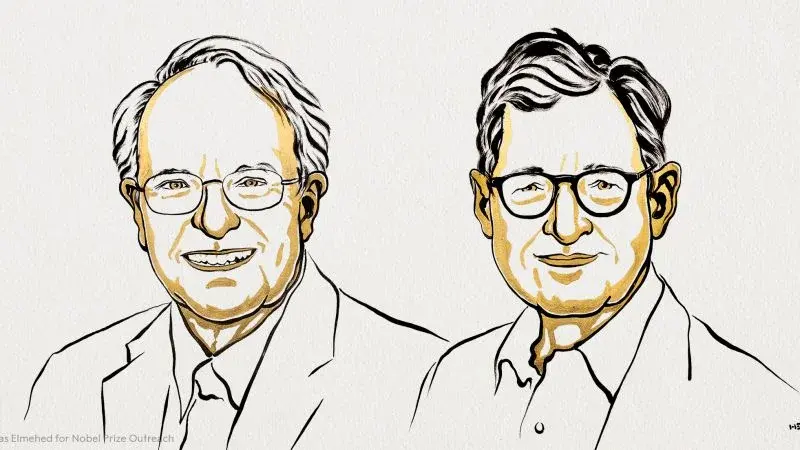
Robert E. Hall and Michael Woodford have been awarded the 2026 Nobel Prize in Economic Sciences for developing microeconomic models that help central banks stabilize economies during external shocks. The Royal Swedish Academy of Sciences recognized their work for providing a theoretical foundation used globally to manage downturns, such as energy crises or consumption shifts. Hall, a Stanford professor, and Woodford, a Columbia professor, will each receive 6 million Swedish kronor. Their approach focuses on how forward-looking decisions by households and businesses influence macroeconomic outcomes, offering tools like forward guidance to mitigate the impact of events like the 2008 financial crisis.
Key points
- The 2026 Nobel Prize in Economic Sciences was awarded to Robert E. Hall and Michael Woodford on October 12, 2026.
- The prize recognizes their development of new economic models that assist governments and central banks in stabilizing economies against external shocks.
- Hall, born in 1943 in Palo Alto, California, is a professor at Stanford University and chaired the committee that dates U.S. recessions for 46 years.
- Woodford, born in 1955 in Chicopee, Massachusetts, is a professor at Columbia University and described the award as a 'surprise' and 'tremendous honor.'
- Each laureate will receive 6 million Swedish kronor, totaling 12 million kronor (approximately $1.2 million) for the pair.
- Their work emphasizes microeconomic insights, specifically how forward-looking decisions by individuals and businesses affect inflation and monetary policy.
Background
The 2026 Nobel cycle has been marked by significant geopolitical and cultural events. Earlier this week, Canadian writer Anne Carson won the Literature prize for bridging classical antiquity with modern form. The Peace prize was awarded to South African jurist Navi Pillay, a former International Criminal Court judge, which triggered a sharp diplomatic conflict. U.S. President Donald Trump denounced the decision as an 'indelible stain' and claimed he deserved the award for settling wars, while the U.S. government imposed sweeping financial sanctions on the ICC hours after the announcement. Pillay, who led a UN commission finding Israel guilty of genocide in Gaza, responded with humor, contrasting with the intense anger from Washington. The economics prize, awarded to Hall and Woodford, concludes the year's honors, shifting focus from geopolitical tensions to theoretical frameworks for economic stability.
How outlets are covering it
CNN and Axios both confirm the award of the 2026 Nobel Prize in Economic Sciences to Robert E. Hall and Michael Woodford, highlighting their contributions to modeling economic shocks. CNN emphasizes the broad applicability of their models for governments and central banks worldwide, noting the prize money of 6 million Swedish kronor per winner. Axios provides additional context on the historical significance of their work, noting that traditional models linking inflation and unemployment failed during 1970s stagflation. Axios quotes Nobel committee member Timo Boppart, who described their solution as a new framework built from the ground up. Woodford’s reaction is highlighted by Axios, where he expressed being 'elated' and 'surprised' by the win. Both sources agree on the core contribution: using microeconomic insights, such as forward-looking behavior of households and businesses, to inform macroeconomic policy. CNN notes the total number of laureates (101) and the gender disparity in the prize's history, while Axios focuses on the practical application of their theories during the 2008 financial crisis and current energy market disruptions.
Why it matters
The award recognizes a shift in economic policy from traditional macroeconomic correlations to microeconomic foundations, providing central banks with more robust tools to manage external shocks. Hall and Woodford’s models, which emphasize the role of forward-looking expectations, have become standard in global monetary policy, helping to mitigate the impact of crises such as energy disruptions and financial downturns. This recognition underscores the importance of theoretical frameworks in practical economic governance, offering stability in an era of frequent external shocks. The prize also highlights the continued relevance of academic research in shaping real-world policy, with implications for how governments and central banks respond to future economic challenges.
What to watch
The 2026 Nobel Prize cycle is now complete, with all major categories awarded. Robert E. Hall and Michael Woodford will likely engage in public discussions and academic presentations to further disseminate their work. Central banks and governments may continue to reference their models in policy decisions, particularly in response to ongoing economic uncertainties. The geopolitical tensions surrounding the Peace prize award may continue to influence international relations, but the economics prize shifts the focus to technical and theoretical advancements in economic stability. Future research and policy discussions may build on the microeconomic foundations established by Hall and Woodford, potentially leading to new frameworks for managing economic shocks in a changing global landscape.
- Americans Robert E. Hall and Michael Woodford awarded the Nobel Prize in economics CNN
- Duo Share Nobel in Economics for Work on Steering Through Booms and Busts The New York Times
- Two U.S. professors win Nobel prize in economics Axios
- Nobel Prize Goes to Economists Who Recast Ideas of Keynes Bloomberg.com
- Two Americans win Nobel Prize in Economics for work on boom-bust cycles NPR
Want the full story? Read the original reporting
Read on CNN