
Federal Plan Shifts Colorado River Cuts to Lower Basin Amid Record Reservoir Lows
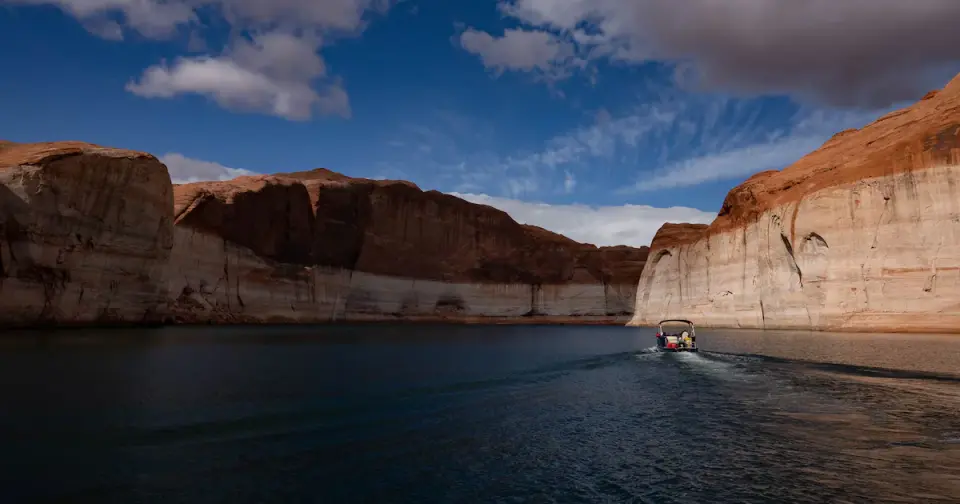
The Bureau of Reclamation released a two-year operating plan for the Colorado River, mandating significant water cuts for Lower Basin states while sparing Upper Basin states from mandatory reductions. Lake Powell and Lake Mead are at historic lows, prompting a 1.25 million acre-foot annual reduction for Arizona, California, and Nevada. The plan includes a 10-year framework to allow future consensus agreements and voluntary conservation measures.
Key points
- Lower Basin states must cut 1.25 million acre-feet annually: Arizona (760,000), California (440,000), and Nevada (50,000).
- Upper Basin states (Utah, Colorado, New Mexico, Wyoming) face no mandatory cuts but may voluntarily conserve up to 200,000 acre-feet per year.
- Lake Powell’s target elevation was raised to 3,510 feet to protect Glen Canyon Dam’s hydropower infrastructure.
- A new 10-year decision framework allows for future adjustments and consensus agreements among all seven basin states.
- Mexico agreed to a 250,000 acre-foot cut per year for 2027-2028, contributing to a total 1.5 million acre-foot shortage in the Lower Basin.
Background
Recent months saw Lake Powell and Lake Mead reach record-low levels, with Powell at 3,519 feet in August 2026. The combined contents of both reservoirs are at their lowest since Powell began filling in 1963. Prior to this plan, negotiations among the seven basin states stalled, leading the federal government to step in with a 10-year framework to manage the prolonged drought and protect critical infrastructure.
How outlets are covering it
The Salt Lake Tribune emphasizes the lack of mandatory cuts for Upper Basin states, noting Utah’s commissioner argues that natural conditions already force reductions. The Colorado Sun highlights the tension between Upper and Lower Basin states, with Colorado’s negotiator stating that upstream states already face pre-1922 water rights cuts. Maven’s Notebook, citing the Interior Department, frames the plan as a flexible tool to protect infrastructure while allowing for future consensus, noting over $3 billion in Lower Basin investments since 2025. All sources agree on the specific cut figures for Lower Basin states but differ in emphasis: the Tribune focuses on the equity of the cuts, the Sun on the legal authority differences, and Maven’s Notebook on the administrative flexibility and investment context.
Why it matters
The plan directly impacts water availability for 40 million people, 5.5 million acres of farmland, and hydropower generation for seven states. Failure to manage the reservoirs could lead to 'dead pool' conditions, cutting off water and power supplies. The 10-year framework aims to prevent litigation and encourage long-term cooperation, but the immediate cuts place a heavy burden on Lower Basin states, potentially straining agricultural and urban water supplies.
What to watch
The Bureau of Reclamation will adjust Lake Powell releases in April 2027 to maintain the 3,510-foot elevation. States and tribes will continue negotiating for a consensus agreement, which could be incorporated into future operational guidelines. The federal government will also finalize a binational agreement with Mexico regarding water deliveries. If reservoir levels drop below critical thresholds, additional emergency measures may be triggered.
- The Trump admin finalized a short-term Colorado River plan. Here’s what it means for Lake Powell. The Salt Lake Tribune
- 3 downstream Colorado River states will bear the brunt of water cuts under new 2-year plan The Colorado Sun
- Feds announce final water-reduction plan for Arizona as lakes reach drastic levels 12News
- COLORADO RIVER: Interior Department Finalizes Plans for 2027-2028 Colorado River Operations Maven's Notebook
- Interior spares California, Arizona, Nevada from most dramatic short-term Colorado River water cuts The Hill
Want the full story? Read the original reporting
Read on The Salt Lake Tribune