
Trump's Vaccine Order Faces Rejection from States and Global Health Leaders
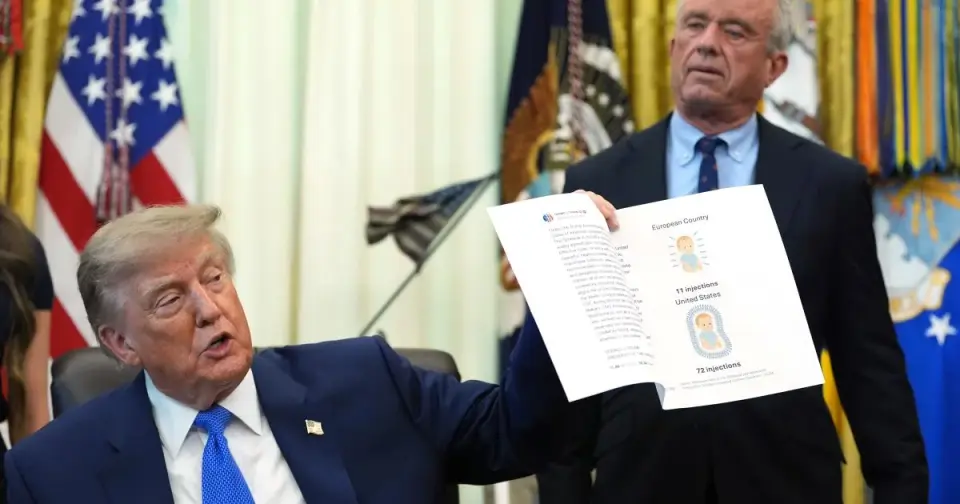
President Trump signed an executive order on August 10, 2026, to overhaul U.S. childhood vaccination policies, reducing recommended immunizations from 17 to 11 and splitting combined vaccines. The move, which includes reviving debunked autism claims, has been condemned by the WHO and pediatricians, while most states have refused to adopt the new federal guidelines.
Key points
- The executive order reduces the recommended childhood vaccine schedule from 17 to 11 diseases, moving six shots to a 'shared clinical decision-making' status that allows parents to refuse them.
- The order mandates the splitting of the combined measles, mumps, and rubella (MMR) vaccine into three separate doses, a change experts say is logistically impossible and medically harmful.
- Trump and HHS Secretary Robert F. Kennedy Jr. repeated false claims at the signing, including that vaccines cause autism and that the volume of vaccines is dangerously large.
- The World Health Organization and the American Academy of Pediatrics condemned the order, stating it contradicts decades of scientific evidence and puts children at risk.
- Most U.S. states, including 28 states and D.C., have announced they will not follow the federal order, maintaining existing mandates and decoupling from federal recommendations.
Background
This order follows a March 2026 federal court ruling that blocked Kennedy's previous attempt to cut the vaccine schedule. The administration has also slashed funding for vaccine research and rewritten CDC web pages to promote anti-vaccine myths, a trend that has intensified since early 2026.
How outlets are covering it
The Los Angeles Times and Al Jazeera highlight the scientific consensus that the order is based on misinformation, with the WHO calling it a rejection of 'decades of evidence.' AP News and the American Academy of Pediatrics emphasize the practical dangers, noting that splitting vaccines will delay protection and decrease uptake. Conversely, the White House and NIH Director Jay Bhattacharya argue that the changes will increase parental trust and vaccination rates, a view rejected by medical experts who cite data from Japan showing that splitting vaccines leads to higher disease incidence.
Why it matters
The order threatens to create widespread confusion among parents and could lead to a resurgence of preventable diseases like measles, which already saw 2,318 cases in the U.S. in 2026. It represents a significant shift in federal public health policy that prioritizes political ideology over established medical science.
What to watch
The CDC, under new director Erica Schwartz, must decide whether to comply with the order or maintain its scientific integrity. States will continue to enforce their own mandates, and the administration may face further legal challenges as it attempts to implement the 'peer country' model for vaccine recommendations.
- Commentary: Trump's new orders on child vaccines are even more dangerous than they seemed at first Los Angeles Times
- 5 questions parents may have after Trump's latest vaccine move NPR
- WHO chief says Trump vaccine push goes against ‘decades of evidence’ Al Jazeera
- Doctors say Trump’s vaccine order will raise fears, cause confusion and endanger kids AP News
- Trump’s goal to split MMR vaccine could take a decade, experts say Reuters
Want the full story? Read the original reporting
Read on Los Angeles Times